
Automatically apply for jobs with Zippia
Upload your resume to get started.
Biomedical equipment specialist skills for your resume and career
15 biomedical equipment specialist skills for your resume and career
1. Biomedical Equipment
- Accomplished in diagnosing and resolving biomedical equipment malfunctions.
- Managed inventory of all biomedical equipment.
2. Patient Care
Patient care entails the diagnosis, recovery, and control of sickness as well as the maintenance of physical and emotional well-being through the use of healthcare providers' services. Patient care is described as services provided to patients by health practitioners or non-professionals under guidance.
- Assemble and inspect new items of medical equipment prior to release for use in patient care.
3. Preventive Maintenance
- Perform preventive maintenance and electrical safety testing of clinical equipment, devices and systems Diagnose and correct systems and equipment malfunctions.
- Calibrate, complete preventive maintenance and repairs on inventory of over 500 ventilators and associated respiratory equipment.
4. Unscheduled Maintenance
- Performed scheduled and unscheduled maintenance and repair work orders on equipment.
- Managed the scheduled and unscheduled maintenance of all medical equipment in a 1.5 million square feet hospital with 55 clinics.
5. Medical Devices
Medical devices refer to apparatus for use in medical procedures.
- Developed and managed a virtual Windows Server Update Services (WSUS) environment for enterprise-wide patching of isolated medical devices.
- Perform Depot/Field repair or inspections on medical devices.
6. Laboratory Equipment
- Assured all laboratory equipment was within operating specifications.
- Performed bench work of such items as dental equipment, sterilizers, electrical beds, and laboratory equipment.
Choose from 10+ customizable biomedical equipment specialist resume templates
Build a professional biomedical equipment specialist resume in minutes. Our AI resume writing assistant will guide you through every step of the process, and you can choose from 10+ resume templates to create your biomedical equipment specialist resume.7. Test Equipment
Test equipment is a mechanical tool or a device which is used create signals and gather response from an electronic device under test. It helps in detecting any faults in the device and it also proves the proper operation of the electronic device.
- Designed tracking system for calibration of test equipment (TMDE) and Just In Time maintenance and chemical inventory delivery.
- Managed the calibration and location of 375+ pieces of test equipment within our inventory across Germany and Iraq.
8. Troubleshoot
Troubleshooting is the process of analyzing and fixing any kind of problem in a system or a machine. Troubleshooting is the detailed yet quick search in the system for the main source of an issue and solving it.
- Help them troubleshoot difficult problems and lend direction where needed.
- Dispatched equipment, troubleshoot,repair and delivered surgical equipment throughout hospital.
9. Equipment Maintenance
Equipment maintenance is any process that includes the use of maintenance methods and procedures to keep the organization's equipment in good and reliable working condition. This may include routine maintenance as well as corrective repairs. The practice takes place in a variety of settings, including catering establishments, industrial factories, manufacturing facilities, hotels, etc.
- Experience with documentation of all equipment maintenance and professional services within established policies and procedures.
- Camp Zama, Japan Provide equipment maintenance support to one medical, two dental and seven veterinary clinics located throughout Japan.
10. Logistics
Logistics is a complete organization and implementation of a problem. Logistics are often considered in a complex business operation, as some works need detailed plannings. Logistics are also used in military action.
- Performed medical logistic inventories, operated forklift, assisted with medical logistics shipping and receiving.
- Performed full logistics in regard to the equipment medical facility.
11. Medical Systems
- Perform corrective and preventative maintenance on medical systems and instrumentation.
- Conducted training of procedures, techniques, and methods of operations, testing and calibrating medical systems to new personnel.
12. Clinical Equipment
Clinical equipment refers to the operational apparatus that aid in the treatment of patients. Clinical equipment helps thwart, diagnose or cure ailment or disease, and identify, measure, repair, correct, or transform the body's arrangement for health improvement.
- Performed preventative maintenance checks services on various items of clinical equipment and documented in accordance with JCAHO and military CMMS requirements.
- Performed preventative maintenance and electrical safety testing of clinical equipment, and supported dialysis software CyberREN medical record system.
13. Electronic Equipment
Electronic equipment is equipment in which electrons are conducted in a controlled manner, especially in a gas or vacuum, or semiconductor amplifier. These equipment are components for controlling the flow of electrical current for information and signal processing, telecommunications, and system control.
- Maintained new equipment design trends and repairs of rapid changing electronic equipment that is being introduced into the health care field.
- Perform and assist with the maintenance and repair of biomedical electronic equipment and systems.
14. Sterilizers
- Field Service Work: Installed or repaired more than a hundred NX sterilizers in more than fifteen States.
- Provided support to four locations specializing in sterilizers, washers, infusions pumps, beds and stretchers.
15. Clinical Laboratory
- Maintained and supported Duke University Health System Clinical Laboratory instrumentation.
5 Biomedical Equipment Specialist resume examples
Build a professional biomedical equipment specialist resume in minutes. Browse through our resume examples to identify the best way to word your resume. Then choose from 5+ resume templates to create your biomedical equipment specialist resume.

What skills help Biomedical Equipment Specialists find jobs?
Tell us what job you are looking for, we’ll show you what skills employers want.
What type of skills will young biomedical equipment specialists need?
Elisha Blankson
Program Director NCCU, Assistant Professor, North Carolina Central University
List of biomedical equipment specialist skills to add to your resume
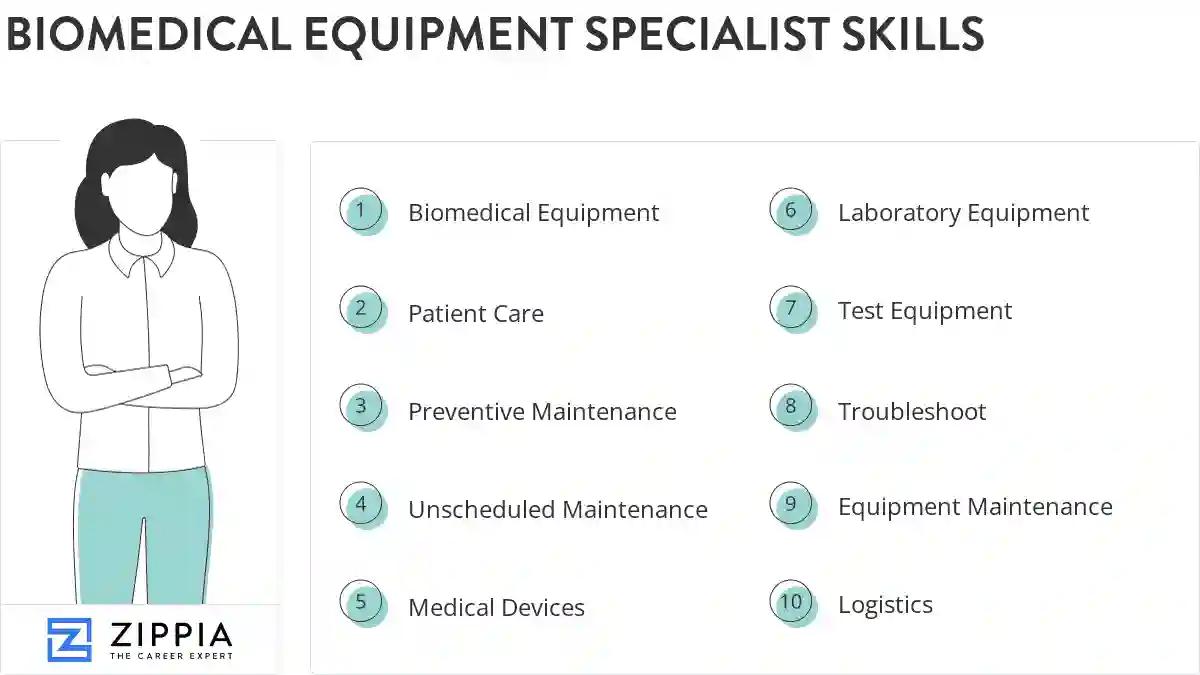
The most important skills for a biomedical equipment specialist resume and required skills for a biomedical equipment specialist to have include:
- Biomedical Equipment
- Patient Care
- Preventive Maintenance
- Unscheduled Maintenance
- Medical Devices
- Laboratory Equipment
- Test Equipment
- Troubleshoot
- Equipment Maintenance
- Logistics
- Medical Systems
- Clinical Equipment
- Electronic Equipment
- Sterilizers
- Clinical Laboratory
- Maintenance Procedures
- Circuit Boards
- TMDE
- Diagnostic Equipment
- Technical Assistance
- Technical Manuals
- Service Calls
- Patient Monitoring Systems
- Equipment Problems
- Vital Signs Monitors
- ECG
- Healthcare Organizations
- User Training
- Equipment Issues
- Fetal
- Equipment Repair
- Medical Equipment
- Surgery
- IV
- Technical Inspections
- OEM
Updated January 8, 2025
