
Automatically apply for jobs with Zippia
Upload your resume to get started.
Biostatistician skills for your resume and career
15 biostatistician skills for your resume and career
1. Data Analysis
- Provide statistically sound experimental design and data analysis input to meet project objectives and FDA statistical requirements.
- Assumed paid investigator roles on grant proposals and projects for statistical programming and data analysis.
2. Patients
- Assisted in the collection of data on admitted patients from the various wards.
- Clean 105,086 patients' data extracted from National Cancer Data Base using SAS2.
3. Data Management
The administrative process that involves collecting and keeping the data safely and cost-effectively is called data management. Data management is a growing field as companies rely on it to store their intangible assets securely to create value. Efficient data management helps a company use the data to make better business decisions.
- Provided statistical consulting, computer programming, and data management support to medical researchers and market analysts.
- Reviewed information provided by data management, such as data dictionaries and data management plans.
4. Statistical Analysis
- Prepare statistical analysis plans and programming specifications for a wide range of studies including clinical trials and an animal oncology study.
- Conduct basic and assist with complex statistical analysis in support of clinical research studies as specified in statistical analysis plans.
5. Study Design
Study design entails a detailed framework of data, methods, pathways, procedures, and operations to solve a research problem's variability. These designs come in different forms for different issues, sectors, and fields and aim to find answers and solutions to issues and questions in specific areas.
- Participate in study design and protocol development; Design statistical section of protocol including sample size calculation and power estimation.
- Provide statistical input into study design, randomization and analysis methodologies of clinical trial protocols.
6. Data Collection
Data collection means to analyze and collect all the necessary information. It helps in carrying out research and in storing important and necessary information. The most important goal of data collection is to gather the information that is rich and accurate for statistical analysis.
- Standardized data collection by foreign investigators.
- Provide consulting services to Principal Investigators on data collection or other areas related to the clinical studies.
Choose from 10+ customizable biostatistician resume templates
Build a professional biostatistician resume in minutes. Our AI resume writing assistant will guide you through every step of the process, and you can choose from 10+ resume templates to create your biostatistician resume.7. Research Projects
- Worked with multidisciplinary team to perform statistical analyses for research projects involving substance abuse treatment.
- Provide statistical consulting and technical support for clinical trials and clinical research projects.
8. FDA
The Food and Drug Administration (FDA) is a division of the US Department of Health and Human Services that regulates the production and sale of food, pharmaceutical products, medical equipment, and other consumer goods, as well as veterinary medicine. The FDA is now in charge of overseeing the manufacture of products like vaccines, allergy treatments, and beauty products.
- Designed validation studies and conducted equivalence testings for FDA approval of equipment and reagents for molecular diagnostics - AlloMap scoring.
- Played key role in Life Cycle Management assessments on multiple indications and participated in all FDA negotiations and IND submissions.
9. Survival Analysis
Survival analysis is the statistical branch concerning the modeling of time to events. That is, it measures the expected time taken before events such as mechanical failure or biological death occur. A synonymous engineering theory used is the reliability theory where mean time is used to evaluate operational failure rates.
- Evaluated the effectiveness of new heart therapy drugs using statistical analyses including t-tests, linear regression, survival analysis.
- Developed extensive SAS macros to obtain summary data on continuous and dichotomous variables and perform survival analysis.
10. Public Health
- Applied predictive modeling expertise contributing to the development of Public Health Laboratory capacity models for influenza.
- Produce scientific publication in different public health topics.
11. Statistical Software
Statistical software is a specialized computer program used for statistical analysis of data collection, organization, analysis, interpretation, and presentation to provide scientific information on patterns and trends.
- Performed complex analyses of data, developing a high level of programming proficiency with SAS and R statistical software.
- Perform statistical and descriptive analysis of national Medicare Claims Data utilizing SAS statistical software.
12. Macro
- Developed statistical programs and macros to perform analyses, and verified data accuracy and validity.
- Developed SAS macros and utilities for data cleaning and operational efficiency and accuracy improvement.
13. Statistical Support
- Project statistical support, interaction with clinicians to determine clinical trial design and select primary and secondary endpoints.
- Provided statistical support to investigators; performed data cleaning and analysis as designated.
14. Study Results
- Performed independent QA activities to verify study results, programs, and documentation.
- Interpret study results for non-statistical research staff members.
15. SQL
- Developed data integrity checking Cold Fusion application to verify the integrity of SQL Server research project databases with design requirements.
- Master Batch Record entry and verification within MIND database; database management and SQL query building for data extraction.
5 Biostatistician resume examples
Build a professional biostatistician resume in minutes. Browse through our resume examples to identify the best way to word your resume. Then choose from 5+ resume templates to create your biostatistician resume.

What skills help Biostatisticians find jobs?
Tell us what job you are looking for, we’ll show you what skills employers want.
What biostatistician skills would you recommend for someone trying to advance their career?
Rhonda Bacher PhD
Assistant Professor, University of Florida
Additional computational skills and data analysis experience should not be overlooked as ways to increase your value to potential employers. Highlight your interdisciplinary collaborative projects or work experience to demonstrate your communication and interpersonal skills, which are both highly valued professionally for biostatisticians.
What hard/technical skills are most important for biostatisticians?
Wei-Min Huang
Professor, Lehigh University
List of biostatistician skills to add to your resume
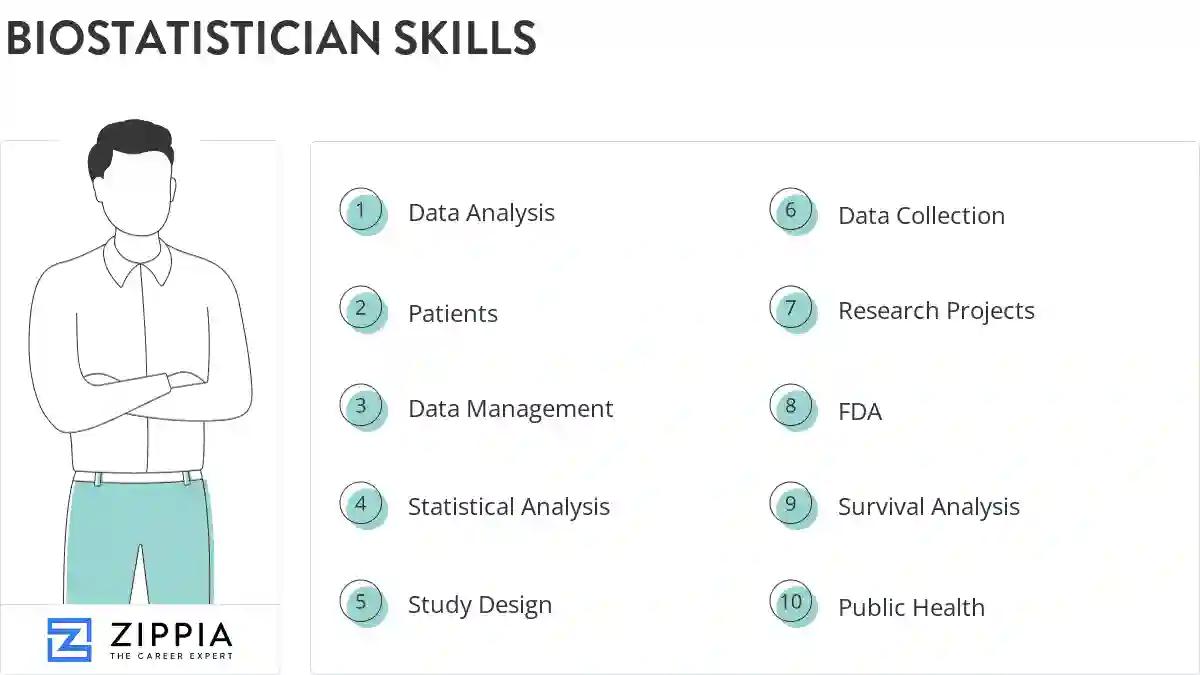
The most important skills for a biostatistician resume and required skills for a biostatistician to have include:
- Data Analysis
- Patients
- Data Management
- Statistical Analysis
- Study Design
- Data Collection
- Research Projects
- FDA
- Survival Analysis
- Public Health
- Statistical Software
- Macro
- Statistical Support
- Study Results
- SQL
- Analysis Results
- Biostatistical
- Statistical Expertise
- Statistical Input
- SPSS
- Analyze Data
- Study Protocols
- Clinical Study Reports
- Statistical Reports
- CRO
- Regression
- Experimental Design
- Regulatory Submissions
- Sample Size Calculations
- Statistical Aspects
- QC
- Clinical Trial Data
- Statistical Sections
- Observational Studies
- Calculation
- Adaptive
- Logistic Regression
- Adam
- CDISC
- Visualization
- Statistical Consultation
- NIH
- NDA
- Statistical Results
- R
- Clinical Research Studies
- IV
- IRB
- Time Series Analysis
Updated January 8, 2025
