Explore jobs
Find specific jobs
Explore careers
Explore professions
Best companies
Explore companies
Job outlook for business general managers in the United States
Business general manager job growth summary. After extensive research, interviews, and analysis, Zippia's data science team found that:
The projected business general manager job growth rate is 6% from 2018-2028.
About 189,200 new jobs for business general managers are projected over the next decade.
Business general manager salaries have increased 4% for business general managers in the last 5 years.
There are over 303,712 business general managers currently employed in the United States.
There are 411,126 active business general manager job openings in the US.
The average business general manager salary is $72,676.
Are business general manager jobs in demand?
Business general manager job and salary trends over time
Business general manager jobs over time
Business general manager job growth rate over time
| Year | # of jobs | % of population |
|---|---|---|
| 2021 | 303,712 | 0.09% |
| 2020 | 238,883 | 0.07% |
| 2019 | 244,253 | 0.07% |
| 2018 | 233,000 | 0.07% |
| 2017 | 225,097 | 0.07% |
Average business general manager salary over time
Business general manager salary by year
| Year | Avg. salary | Hourly rate | % Change |
|---|---|---|---|
| 2026 | $72,676 | $34.94 | +2.8% |
| 2025 | $70,664 | $33.97 | --0.1% |
| 2024 | $70,769 | $34.02 | +0.5% |
| 2023 | $70,404 | $33.85 | +1.1% |
| 2022 | $69,633 | $33.48 | +1.6% |
Business general manager jobs by state
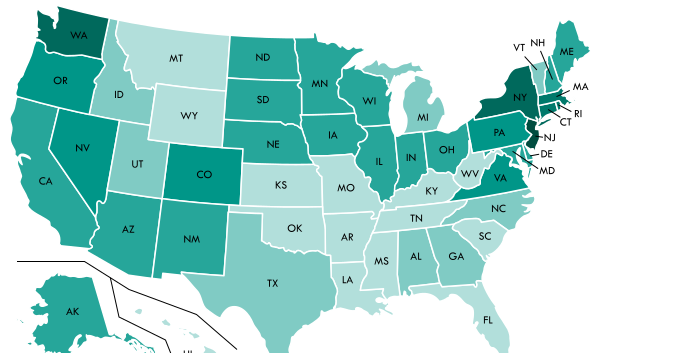
Most common states for business general managers
| Rank | State | Population | # of jobs | Employment/ 1000ppl |
|---|---|---|---|---|
| 1 | District of Columbia | 693,972 | 634 | 91% |
| 2 | Minnesota | 5,576,606 | 3,007 | 54% |
| 3 | Nebraska | 1,920,076 | 905 | 47% |
| 4 | Delaware | 961,939 | 429 | 45% |
| 5 | Indiana | 6,666,818 | 2,920 | 44% |
| 6 | Iowa | 3,145,711 | 1,377 | 44% |
| 7 | Pennsylvania | 12,805,537 | 5,515 | 43% |
| 8 | Massachusetts | 6,859,819 | 2,952 | 43% |
| 9 | South Dakota | 869,666 | 373 | 43% |
| 10 | Ohio | 11,658,609 | 4,870 | 42% |
| 11 | Kansas | 2,913,123 | 1,219 | 42% |
| 12 | Tennessee | 6,715,984 | 2,787 | 41% |
| 13 | Wisconsin | 5,795,483 | 2,350 | 41% |
| 14 | Montana | 1,050,493 | 427 | 41% |
| 15 | Alabama | 4,874,747 | 1,935 | 40% |
| 16 | Missouri | 6,113,532 | 2,408 | 39% |
| 17 | Arkansas | 3,004,279 | 1,159 | 39% |
| 18 | Virginia | 8,470,020 | 3,237 | 38% |
| 19 | Kentucky | 4,454,189 | 1,705 | 38% |
| 20 | Alaska | 739,795 | 273 | 37% |
Most common cities for business general managers
| Rank | City | # of jobs | Employment/ 1000ppl | Avg. salary |
|---|---|---|---|---|
| 1 | Draper | 1 | 2% | $59,776 |
| 2 | Baton Rouge | 1 | 0% | $53,595 |
| 3 | Boston | 1 | 0% | $79,442 |
| 4 | Irvine | 1 | 0% | $63,044 |
Business General Manager job outlook: Expert opinions
Our panel of business general manager experts
Murray State University
University Of Puget Sound
Texas Christian University

University of Maryland
Catawba College

Pennsylvania State University - Greater Allegheny

Landmark College
University of Saint Mary

Northwestern Michigan College

University of West Georgia
Tiffin University

The Pennsylvania State University

Brandeis University
Brandeis University
Montgomery College

Creighton University

Pepperdine University, Seaver College

Sam Houston State University

Houston Baptist University
Dr. Ben Littlepage
ProfessorMurray State University
Educational Administration And Supervision
What will help Business General Managers increase their earning potential?
Dr. Ben Littlepage: Salary is maximized when leaders are sought after. Leaders who pursue meaningful experiences and remain 'market ready' are viewed as an asset to any organization. Leaders must carefully consider where the field is moving and respond.
What general advice would you give to a Business General Manager?
Dr. Kim Roberts: Business-related occupations offer attractive salaries and offer a variety of disciplines, such as accounting, contract management, cybersecurity, finance, human resources, logistics, marketing, management, operations, sales, and more. However, business careers are often demanding, requiring long work weeks and travel.
Skills
leadership
communication
innovation
adaptation
critical thinking
problem solving
emotional intelligence
empathy
teamwork
cultural competence
conflict management
ethics and social responsibility
What Business General Manager skills would you recommend for someone trying to advance their career?
Dr. Kim Roberts: Business professionals lead organizations by focused efforts that revolve around products/services, processes, and people. Business professionals work to ensure the firm's products and/or services meet customer expectations, with an eye toward an ever-changing market. They manage processes that produce or support the firm's products. This requires the ability to analyze data to make informed decisions, to drive continuous improvement, and to solve problems through critical thinking. Successful business professionals must also create climates that promote teamwork and foster collaboration.
What will help Business General Managers increase their earning potential?
Dr. Kim Roberts: Now is a good time to enter business professions because of the projected growth of employment opportunities. According to the Bureau of Labor Statistics, "Overall employment in business and financial occupations is projected to grow faster than the average for all occupations from 2022 to 2032." Furthermore, the growth of online learning and online degrees means a full-time job and family commitments are not roadblocks to earning a business degree.
Andreas Udbye Ph.D.
Associate ProfessorUniversity Of Puget Sound
School of Business and Leadership
What soft skills should all Business General Managers possess?
Andreas Udbye Ph.D.: Collaboration and teamwork skills are crucial, as well as the ability to focus and meet deadlines. Although it is nice to mention that you are a good multi-tasker, most people are these days, and employers seem to like people who can stay the course and complete tasks on time and with high quality. Tenacity and accuracy are other attractive attributes.
Dr. Brandon Chicotsky
Assistant Professor of Professional Practice in Marketing at the TCU Neeley School of BusinessTexas Christian University
Specialized Sales, Merchandising And Marketing Operations
What hard/technical skills are most important for Business General Managers?
Dr. Brandon Chicotsky: Sales enablement software, customer relationship management systems; customer analytics and social listening tools; and video playbooks are becoming increasingly important.
Roland Rust Ph.D.
Distinguished University Professor, David Bruce Smith Chair in Marketing, Executive Director, Center for Excellence in Service, Ph.D., Business Administration, University of North Carolina at Chapel Hill MarketingUniversity of Maryland
Robert H. Smith School of Business
What skills stand out on Business General Manager resumes?
Roland Rust Ph.D.: One might think that a stellar sales record would be most important, but that would be most relevant only if the individual has prior sales manager experience. If promoting a salesperson to sales manager, the thing that may be missing is administrative and managerial skills. In addition, we are in a technological revolution, driven by AI, which means that prior knowledge and experience with AI-related analysis would also definitely stand out (although probably hard to find).
What soft skills should all Business General Managers possess?
Roland Rust Ph.D.: We consider empathy the most important soft skill (see our 2021 book, "The Feeling Economy: How Artificial Intelligence Is Creating the Era of Empathy," authored with Ming-Hui Huang). This is central for both sales managers and salespeople. The sales manager can best manage a salesperson by being able to understand their emotions. Different salespeople require different approaches. Likewise, salespeople need to relate to the customer's feelings. In addition, because so much of business is now digital, and we're in a pandemic of unknown duration, skills on media such as Zoom are more important than ever, as is the capability of texting and other modes of electronic communication.
Dr. Elizabeth Homan Ph.D.
Professors, Department ChairCatawba College
Theatre Arts
What soft skills should all Business General Managers possess?
Dr. Elizabeth Homan Ph.D.: Networking, networking, networking. And being a nice, friendly, honest human being. Flexibility and a level head in the face of persistent change. Resilience and an ability to work with the conditions in which you find yourself. Working with what you have, not what you wish you had.
What hard/technical skills are most important for Business General Managers?
Dr. Elizabeth Homan Ph.D.: Organization, written and oral communication, adeptness at social media. Ability to use and manipulate data.
What skills will help Business General Managers earn the most?
Dr. Elizabeth Homan Ph.D.: Being someone others want to work with again and again. The industry is small, and your reputation will either sink you or get you lots of work.
Bernie Cerasaro
Assistant Teaching ProfessorPennsylvania State University - Greater Allegheny
Business Department
What skills stand out on Business General Manager resumes?
Bernie Cerasaro: Skills employers would be looking for would be functional skills and interpersonal skills. Functional skills should stand out on a resume and be aligned to the business job in question. For example, if focused on marketing positions, marketing skills such as data analytics, market research, consumer behavior, global marketing, and professional selling skills would be areas for which employers would be looking. If the job market is looking for someone in accounting, then functional skills that would stand out would be intermediate financial accounting skills and courses on taxation and auditing. For those seeking positions in project management or supply chain management, skills that would stand out would encompass subject matter such as project management, portfolio management, operations planning and control, purchasing and materials management, and knowledge of ERP type systems and other business processes.
Skill sets can be enhanced via various types of certification. For example, those interested in accounting might pursue a CPA (Certified Public Accountant) license, which requires 150 credits. As most universities require 120 credits for a bachelor's degree in business, a CPA would require just an additional 30 credits, which students can start accumulating while still at college. Project management certification is also an opportunity to enhance the aforementioned skills and would certainly stand out on an applicant's resume. The Project Management Institute (PMI) promotes PMP certification, which validates that you are highly skilled in soft skills to lead project teams and have the required technical aspects of managing projects. Some universities are working with the PMI to have PMI-approved courses. Approved courses are used toward the PMP training hours required to sit for the exam. For example, Penn State University has received approval for two such courses, Portfolio Management and Organizations and Project Planning and Resource Management.
Due to the high rate of interaction with the global marketplace and the complexity of international business, managers are looking more closely at applicants who have some familiarity with global markets and international culture, such as applicants who may have study abroad experience, traveled internationally, speak a foreign language or have lived or worked in another country.
What soft skills should all Business General Managers possess?
Bernie Cerasaro: Soft skills or conceptual skills are critical in today's business world. Lack of such interpersonal skills is a major reason highly qualified professionals are not promoted (Lee, n.d.)
As a former recruiter for Xerox Corporation, I looked for problem-solving, decision-making, and time management skills. Problem-solving supports creativity allowing workers to evaluate and prioritize options to determine the best solution. Much time and money can be wasted in selecting the wrong option.
Proper decision-making allows companies to quickly react to internal problems, customer concerns, changing market trends, and the use of ever-advancing technology in the workplace. The increased use of empowerment in the workplace, which has been enhanced due to the pandemic, has allowed employees to make more decisions, which requires strong decision-making capability. In addition, the pandemic has caused many businesses to use alternate work structures such as working from home, leading to less direct supervision. Consequently, employers are looking for people who are self-motivated, self-directed, and who employ good time management skills.
Teamwork is one of the most commonly required skills in the work environment. The ability to work together is essential. Due to downsizing, there are fewer managers within companies. Since few individuals possess all the knowledge and skills needed, teamwork has become essential. Getting along and working together to achieve objectives and meet deliverables is critical to project completion. Managers are also looking to teams to provide a greater range of ideas and innovation. Teams can also motivate each other for the timely completion of tasks.
Conflict management enhances decision-making abilities and increases creativity which produces innovative solutions for ongoing problems. The ability to handle conflict productively helps solve problems resulting in demoralization, absenteeism, and turnover. Productive resolution of such problems leads to increased trust and increased employee involvement.
For those aspiring to management positions, leadership is key. Leaders need to promote the company's mission and vision among their subordinates. They need to influence employees to achieve goals by motivating them, resulting in a higher level of performance. This type of leadership is paramount in today's marketplace for company advancement, expansion, and survival.
Other important soft skills include verbal and written communication, persuasive skills, negotiation, and listening skills. Communication is vital to company performance. The ability of company personnel to communicate clearly, succinctly, and accurately will increase productivity. Good communication requires being observant of both verbal and nonverbal signals.
Persuasion and negotiation, two other soft skills, require good listening skills. In today's work environment, employees are no longer subject to a hierarchical structure, a structure of non-questioning of their manager's requests. This requires managers to be more persuasive. Negotiation is practiced by all of us on a day-to-day basis, and more so in business. Strong negotiation skills are essential internally (managers and employees) and externally (sales negotiations, contract negotiations, etc.).
We often forget the skill of listening, as most of us prefer to talk rather than listen. However, it is essential to understand what your company and customers want. This is not just "hearing" but actually practicing listening skills by asking questions, confirming content heard, and providing feedback. Listening requires effort; it requires concentration and attention to what is being said.
What hard/technical skills are most important for Business General Managers?
Bernie Cerasaro: Most technical skills required in today's marketplace are associated with task requirements in specific functional areas. However, some skillsets can be considered general, such as using Word, Excel, or Zoom. Technical skills relevant to social media are also critical. The ability to construct a web page and post on social media platforms such as Facebook, Instagram, and Twitter is essential. For [CBC1] functional areas, examples of needed technical expertise would be Microsoft Project for project management and SAP for supply chain management.
What skills will help Business General Managers earn the most?
Bernie Cerasaro: Some of the same skills as indicated above are important as the person works their way up the ranks and increases their salary. Prominent skills include strong leadership, superior performance, handling conflict, and creating a trusting and productive work environment.
The choice of a functional area can also impact one's earnings depending upon the market's needs. Areas such as corporate accounting and finance, project management, supply chain management, and entrepreneurship can command higher earnings due to a higher demand for such individuals in the marketplace. However, the higher salaries for some of these positions might require a master's degree.
As a concluding note, even though we are amid a pandemic, which has resulted in certain industries/companies being unable to find sufficient employees, this does not imply that this will be the situation for all industries or that the graduate can relax as to developing a strong skill-oriented resume. Graduates still need to focus on functional, technical, and soft skills in order to design impactful resumes that clearly indicate their strongest skills and experience.
What skills stand out on Business General Manager resumes?
Dr. Jeanette Landin: Skills that stand out on contemporary business manager resumes are soft skills. Business managers indeed need insight and knowledge about the business and hard skills, including financial and other technical skills. What stands out on contemporary, successful business manager resumes are their soft skills. Interpersonal skills are atop the list because business is all about people working with other people to achieve a common goal: The business's mission. The people skills of communication, collaboration, and delegation are a vital part of the manager's ability to influence colleagues, delegate work, and achieve the company's mission.
What soft skills should all Business General Managers possess?
Dr. Jeanette Landin: The most important soft skills have a common denominator: Communication. Communicating effectively across various media and with widely varying personalities is the key to being an effective business manager. Another critical soft skill is time and information management. The amount of information business managers process on an everyday basis has grown at an increasing rate during the last couple of decades. Business managers must manage multiple priorities, meetings, written and verbal communications, and social media efficiently. Therefore, handling multiple commitments and massive amounts of information is another essential soft skill.
What hard/technical skills are most important for Business General Managers?
Dr. Jeanette Landin: The most important hard skill is using current technology and the aptitude to learn innovative technology. Old-world technologies such as office technology skills are an absolute minimum for business managers. A business manager must be willing to learn and adapt to emerging electronic communication media to reach organizational goals. Managers can learn other hard or technical skills as needed to accomplish the company's objectives if the manager possesses the aptitude and disposition to be effective.
What skills will help Business General Managers earn the most?
Dr. Jeanette Landin: The skill that will help you earn the most is inspiring other people to increase company productivity and high employee morale. An engaged and productive employee is the most important product of an effective manager. Managers who possess the ability to inspire colleagues and drive company objectives are invaluable.
Dr. Mark Harvey Ph.D.
Associate Professor, Director of Graduate and Undergraduate Programs, Coordinator of All-University Honors ProgramUniversity of Saint Mary
Division of Business and Information Technologies (DBiT)
What skills will help Business General Managers earn the most?
Dr. Mark Harvey Ph.D.: One consideration is, does the position pay commission? If so, the soft skills listed above are extremely important because the more you apply those skills, the more likely you are to grow your business.
When a manager is not on commission, there's little correlation between skills and pay while doing the job. The employer will hire you at a given salary level, and it is your job to negotiate to the best position. Once they have chosen you-that's the moment when you have the most leverage. You will never get a raise that is as substantial as what you might be able to ask for upon hire. After that, most raises are not going to be tied mechanically to performance and skills. Your next chance at a raise will be when you move or are promoted to a new position. Thus, those soft skills can affect your ability to negotiate.
I will repeat a previous theme: education and experience are probably more important than skills in terms of making more money. An employer can't really tell what your skills are from your resume. Just because you say you have a skill doesn't mean that you really do. They can reasonably guess that somebody with a degree is responsible enough to have accomplished something big. Somebody who makes it through a graduate program is probably very good at what they know. And somebody who has been in the industry and/or in a similar job is more likely to be able to walk in with little orientation and know what they are doing. Employers take risks on employees and hope that they can deliver. Thus, with more education and more experience, you are able to apply for higher-level jobs, which usually come with higher salaries.
What skills stand out on Business General Manager resumes?
Dr. Mark Harvey Ph.D.: Resumes are hard. It is very difficult to predict what any employer is looking for on any resume. The "skills" section of a resume is probably not the first thing most employers are looking at. The first consideration is probably education. Those with a bachelor's degree will be sorted first in fields-such as those who have business degrees, or particularly sales and marketing majors. Those with MBAs will be placed on the top. Those who have MBAs and marketing concentrations will likely be valued the most. The second consideration would probably be experience. Someone with several years of experience in business development or sales and marketing will be moved to the top. Someone with a bachelor's degree who has a lot of experience might beat out a fresh MBA. However, MBA plus experience beats almost everything. Someone with an MBA going for an entry-level position with little experience needed will likely beat out all bachelor challengers. For new graduates, getting some kind of internship in sales and marketing can differentiate them from those who do not.
Most hiring managers will probably assume that somebody who has sales and marketing education and/or experience probably has the skills necessary to do the job. An interviewer may probe on specific skills. I'll comment more specifically on other kinds of skills below, but it's also fair to say that a candidate's soft skills should shine in the interview. Simply saying that you have certain skills on a resume doesn't mean that you actually have them.
I think that the best thing a candidate can do is to research the company they hope to work for and tailor their resume to that employer. What does the business do? What kinds of things do you think that development manager is going to do in that particular industry? How do your skills as a candidate match what you guess they're looking for? The more you customize your resume, the better chances you have of resonating with the company. Employers are impressed when you already know something about the job and the industry.
What soft skills should all Business General Managers possess?
Dr. Mark Harvey Ph.D.: First, critical and creative thinking. Employers value problem solvers. A Business Development Managers' problem usually is finding growth opportunities. Candidates need to learn to take the initiative to figure out how to solve problems like those.
Second, writing. The best employees know how to communicate in writing. More and more communication occurs through email and other forms of social media and apps, and as such, this skill is absolutely critical. You don't need to be a creative writing genius, but you do need to know how to write in a professional tone, present your ideas in an organized way, get to the point, and avoid errors. There is a direct line between a student's ability to write an academic essay with a clear thesis and an employee's ability to write a good email or proposal. If you can't do those things, then you risk embarrassment and possibly limited options for promotion.
Third, speaking. The American business world discriminates against introverts-sometimes at their own peril. Everyone needs to know how to give a quality speech, but more importantly, you need to sound confident and assertive in a board room during meetings. You need to be confident in front of clients. Fake it if you have to. The way you present yourself is absolutely critical.
Fourth, social skills. You need to be friendly. Get to know co-workers and clients. Find out what they like and show an interest. Find common ground. Your undergraduate degree hopefully exposed you to a wide diversity of topics you may have thought were irrelevant at some point. Now is the time to remember that stuff and use it to connect with people. Nearly everything you learned will have some application someday. It will help you connect with others. In addition, put away your cell phone when you are at work or on social occasions. To some people, a preoccupation with a cell phone communicates a lack of interest in the person you are with. It can alienate bosses, co-workers, and clients.
Kristy Berak McDonald
Experiential Learning Institute DirectorNorthwestern Michigan College
Business Academic Area Faculty
What skills stand out on Business General Manager resumes?
Kristy Berak McDonald: I asked a local HR expert for this question- Jennifer Ewing. She told me, "Ability to lead and motivate, financial acumen and a strategic thinker."
I would add that experiential learning (internships, work/study, relevant class projects) any real-world application of business skills stands out!
What soft skills should all Business General Managers possess?
Kristy Berak McDonald: This is what I teach, so I love this question. Soft skills are the hard skills to teach because they really should be taught from a young age, and many times the student has never heard of soft skills. I think all soft skills are the most important, but in terms of being a business student, Dependability, life-long learner, strong communicator, attention to detail, adaptability, and empathy are my top priority.
What hard/technical skills are most important for Business General Managers?
Kristy Berak McDonald: All students should have strong computer skills, accounting basics, and marketing knowledge.
What skills will help Business General Managers earn the most?
Kristy Berak McDonald: As the soft skills instructor, I believe you can teach skills, but you hire for effective human relations. Technical skills are not enough - interpersonal skills have to be strong. This means the student has been taught personal qualities like treating others with respect, making the right ethical decisions, emotional control, and the ability to work as a team. It also means that the student show thinking skills like creative problem solving, critical listening, and making effective decisions.
Thomas Gainey Ph.D.
Chair and ProfessorUniversity of West Georgia
Department of Management in the Richards College of Business
What skills stand out on Business General Manager resumes?
Thomas Gainey Ph.D.: Given the recent pandemic, many employers are looking for employees who can easily adjust to changing conditions and adapt to working online if necessary. Thus, resumes that demonstrate a candidate is flexible, creative, and self-disciplined are going to be attractive. Additionally, the extent to which a candidate can show excellent time-management skills will likely create more opportunities in the job market.
What soft skills should all Business General Managers possess?
Thomas Gainey Ph.D.: Soft skills are critical as many workers continue to work from home or at least work more of a hybrid schedule. The ability to work effectively with other individuals, sometimes from a distance, has never been more critical. Those individuals who exhibit excellent communication, teamwork, and interpersonal skills will likely be in high demand.
What hard/technical skills are most important for Business General Managers?
Thomas Gainey Ph.D.: With the recent pandemic and the growing reliance on technology to perform many jobs, individuals have been forced to quickly develop or strengthen their technical skills. And these technical skills are in high demand by employers. Individuals with knowledge and experience with enterprise systems, Microsoft Office applications, and popular programming languages will have a significant advantage.
What skills will help Business General Managers earn the most?
Thomas Gainey Ph.D.: With such a growing reliance on technology and data analytics, skills related to these areas will likely command higher salaries. Individuals with training in areas such as software engineering, digital marketing, web design, and quantitative analysis should find well-paid opportunities in the job market.
Dr. Bonnie Tiell
Professor of Sport ManagementTiffin University
School of Business
What skills stand out on Business General Manager resumes?
Dr. Bonnie Tiell: Experience and proven record of accomplishments, achievements, and added value to an organization (e.g., demonstration of increasing market shares, sales quotas, membership acquisition, etc.).
What soft skills should all Business General Managers possess?
Dr. Bonnie Tiell: Interpersonal skills (communication), character development, effective decision making.
What hard/technical skills are most important for Business General Managers?
Dr. Bonnie Tiell: Direct occupational knowledge: Negotiating and understanding contracts | agreements, staff management, informational technology, budget, and financial reporting.
What skills will help Business General Managers earn the most?
Dr. Bonnie Tiell: Skills helping managers earn the most are those that impact the bottom line - it depends on the organization's needs, but those that can produce or increase revenue will earn more --- sales!
James Wilkerson Ph.D.
Business Program Coordinator, Project and Supply Chain Management Program CoordinatorThe Pennsylvania State University
Business Department
What skills will help Business General Managers earn the most?
James Wilkerson Ph.D.: Skill at rapidly learning market trends, relating business development to product development, and persuading major prospective clients when brought in to help with closing sales. Bottom line: the business development manager must be on the cutting edge of new market conditions and new business opportunities to help the firm organically grow its sales, especially in new markets or product/service lines.
Hagit Weihs Ph.D.
Associate Professor of Accounting in the Brandeis International Business School and the Undergraduate Advising Head to the Business ProgramBrandeis University
International Business School
What skills stand out on Business General Manager resumes?
Hagit Weihs Ph.D.: Students who gained experience in summer or part-time internships doing business analysis, financial analysis, data analytics, and business development tend to stand out. Students who served as either teaching assistants or research assistants also have an advantage. In addition, working on a school team and field projects on real companies provides students with both experience and networking opportunities that the market values.
What soft skills should all Business General Managers possess?
Hagit Weihs Ph.D.: Good communication skills are crucial: being able to listen, learn and apply, as well as communicate questions, concerns, and suggestions in an effective, direct, and timely manner. Time management skills are highly valued. They translate into an efficient and reliable employee. Team spirit is a big advantage: the ability to take the initiative to lead an effort and contribute while working well in a team. And, of course, the willingness to learn independently is always appreciated. Finally, showing critical thinking is important.
What hard/technical skills are most important for Business General Managers?
Hagit Weihs Ph.D.: Employers appreciate accounting, finance, and marketing literacy. These include a deep understanding of the different business disciplines (good financial statement analysis skills, understanding how budgets are created and followed, understanding financial markets, marketing, etc.). Application of these skills using data analytics tools are very important - these include data manipulation and presentation for the purpose of decision making using various software tools.
What skills will help Business General Managers earn the most?
Hagit Weihs Ph.D.: Students who specialize in a certain discipline will earn a higher initial salary. Examples are accounting or finance, marketing, real estate - having a deeper understanding of the discipline and internship and/or field project experience in that discipline. Networking, drive, and creativity, as well as the willingness to continue to learn and grow, will all continue to increase salary down the road.
Aldo Musacchio Ph.D.
Professor, Program Director of the MBABrandeis University
Brandeis International Business School
What skills stand out on Business General Manager resumes?
Aldo Musacchio Ph.D.: I think experiences or experiential learning in which they worked in teams with real companies using the hard skills that the market values. Summer internships doing data analytics or business development at a startup stand out. But also working on field projects at your school with a company in which you can display that you used your data analytics or digital marketing skills goes far.
What soft skills should all Business General Managers possess?
Aldo Musacchio Ph.D.: When we talk to employers, they usually tell you they want students who know how to listen and drive. They want someone who is going to be happy to be in the company, who is going to participate actively in meetings and teams, and who is going to be good at listening and the following guidance.
What hard/technical skills are most important for Business General Managers?
Aldo Musacchio Ph.D.: Lately, employers appreciate software skills to manipulate data, like some knowledge of Python or R, and information visualization software like Tableau. Many companies have their databases in SQL format, and having the capacity to work with it is key. Interestingly, digital marketing and social media skills also get a lot of traction as many employers do not know how to keep and manage a presence in social media, especially in Instagram, and may not be as good as students using tools like Google Analytics.
What skills will help Business General Managers earn the most?
Aldo Musacchio Ph.D.: More specialized knowledge in finance, accounting, and/or real estate with good programming skills will pay the most. The undergrads who get offers closer to $90-$100k spend a couple of years learning, say finance, and who had good internships in the topic. Real estate is also an impressive field at Brandeis. The salaries are good as long as our students have the training to do financial modeling, use Argos software, etc.
R. Scott Hengen
Technical Theatre Faculty/Production CoordinatorMontgomery College
Department of Performing Arts
What general advice would you give to a Business General Manager?
R. Scott Hengen: Your studies and time in school are a good base and support for your production in the industry. As you begin, please consider that you will still be learning and, even though you have learned the essentials, you will be asked to apply your skills and experience in new ways and in a more competitive and practical atmosphere. Deadlines must be met, and the economy of time and effort will be crucial. Work hard, but try to keep a balance between time in the industry and your home life.
What certifications/licenses/courses can have the biggest impact for Business General Managers?
Ravi Nath Ph.D.: Clearly, having professional licenses/certificates distinguishes a graduate from others in searching and securing a position in the MIS and Analytics fields. Thus, I would highly recommend that students craft a professional portfolio of accomplishments, such as certificates, unique courses taken, class project details, and other extra curricula activities in order for them to stand out. Further, there is no substitute for internship experiences while in college as this proves to a prospective employer that the candidate demonstrates a proven record of real-world experience.
What soft skills should all Business General Managers possess?
Ravi Nath Ph.D.: Good communication skills, both written and oral, always serve well. Unless a graduate is able to effectively communicate and share their ideas and thoughts with others, their technical skills alone will not be sufficient in having a rewarding professional career.
The ability to successfully adapt to changing environments is also pivotal as the half-life of technology is quickly shrinking.
I will also add "resiliency' to this list of soft skills. Recovering from setbacks and quickly getting back on your feet has become a mantra particularly in the tech fields such as MIS and Data Science.
Will there be an enduring impact of the coronavirus pandemic on Business General Managers?
Steven Bauer: The coronavirus has accelerated the transformation to a digital world, and this effect will continue after the pandemic is behind us. Graduates will need to be able to navigate a hybrid business environment, with in-person and virtual meetings, interactions and platforms. There will also be increased opportunities to be entrepreneurial and innovative in the digital area. In addition, graduates will have to become more skilled at navigating a global environment since greater digitization will draw countries closer to each other.
What soft skills should all Business General Managers possess?
Steven Bauer: The new hybrid world will make leading teams more challenging. This reality will put a premium on interpersonal skills. When the NASA astronaut, Richard Arnold, spoke at Pepperdine in 2019, he mentioned that team building was the single most important ability undergraduates could develop to become a good astronaut. The same holds for graduates wanting to go into business, particularly in the post coronavirus era. As part of their skills in this area, graduates will also need to be able and committed to addressing issues in the areas of diversity, equity and inclusion.
Carliss Miller Ph.D.
Assistant Professor of ManagementSam Houston State University
Department of Management & Marketing
What are the biggest trends we'll see in the Business General Manager job market given the pandemic?
Carliss Miller Ph.D.: Flexible working arrangements were considered a perk or benefit, but given the pandemic more and more jobs will be designed with flexible work arrangements in mind. We will continue to see trends in the labor market with a push towards personal services (e.g. virtual assistants, professional organizers) and professional services. There will also continue to be a demand for knowledge work. More and more, employers are looking to hire applicants that can provide concrete evidence of being "Day 1" ready.
Employers will focus more on identifying prospects with certain "soft skills" which were a nice-to-have pre-pandemic, but are now critical for organizational survival. These skills include: critical thinking, agility, ability to adapt to change, resilience, virtual team effectiveness, crisis management, emotional intelligence, empathy, and inclusive leadership. Additionally, data analysis and interpretation is a highly sought after skill even for jobs that historically did not require analytical ability.
What's a good job out of college for Business General Managers?
Carliss Miller Ph.D.: Good jobs out of college are those that offer structured training, development, and job rotation. While some college students identified their career at age 5 and never veered away, some are still figuring out what they want to do after college. A job opportunity that recognizes the potential of new talent, willing to invest in training and development, and provides opportunities for new employees to experience different job functions enables new graduates to gain a realistic job preview that pays and allows them to identify an opportunity within the company that best aligns with skills and interests. Positions that are for a specific job function but have an apprenticeship model, like a "sales trainee" position, are also great for career stepping stones right out of college.
Michael Kraten Ph.D.
Professor of Accounting, Chair, Department of Accounting, Economics and Finance, Program Coordinator, Accounting, BBAHouston Baptist University
Accounting, Economics and Finance Department
What's a good job out of college for Business General Managers?
Michael Kraten Ph.D.: Good jobs out of college place graduates on career paths to better future jobs. Graduates must train themselves to always think one job ahead, and not to be tempted by minor short-term wage or benefit differences.
What technical skills for a Business General Manager stand out to employers?
Michael Kraten Ph.D.: Short-term skills like data analytics establish college graduates as credible staff professionals. Long-term skills like critical thinking and persuasive communication can place graduates on long-term career paths to senior management.