Explore jobs
Find specific jobs
Explore careers
Explore professions
Best companies
Explore companies
Job outlook for business instructors in the United States
Business instructor job growth summary. After extensive research, interviews, and analysis, Zippia's data science team found that:
The projected business instructor job growth rate is 12% from 2018-2028.
About 159,400 new jobs for business instructors are projected over the next decade.
Business instructor salaries have increased 14% for business instructors in the last 5 years.
There are over 20,355 business instructors currently employed in the United States.
There are 68,512 active business instructor job openings in the US.
The average business instructor salary is $48,740.
Are business instructor jobs in demand?
Business instructor job and salary trends over time
Business instructor jobs over time
Business instructor job growth rate over time
| Year | # of jobs | % of population |
|---|---|---|
| 2021 | 20,355 | 0.01% |
| 2020 | 20,399 | 0.01% |
| 2019 | 21,449 | 0.01% |
| 2018 | 21,529 | 0.01% |
| 2017 | 21,557 | 0.01% |
Average business instructor salary over time
Business instructor salary by year
| Year | Avg. salary | Hourly rate | % Change |
|---|---|---|---|
| 2026 | $48,740 | $23.43 | +0.9% |
| 2025 | $48,292 | $23.22 | +3.9% |
| 2024 | $46,497 | $22.35 | +4.6% |
| 2023 | $44,470 | $21.38 | +3.6% |
| 2022 | $42,914 | $20.63 | +2.8% |
Business instructor jobs by state
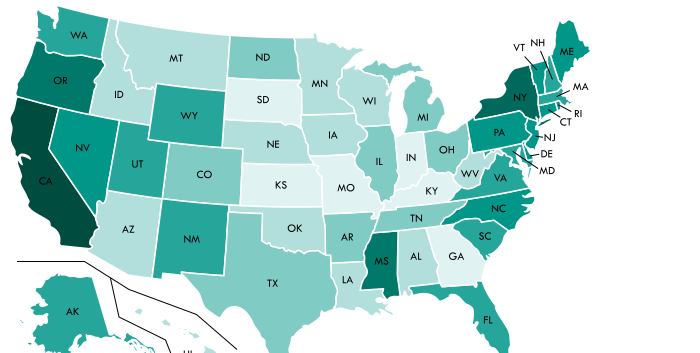
Most common states for business instructors
| Rank | State | Population | # of jobs | Employment/ 1000ppl |
|---|---|---|---|---|
| 1 | Montana | 1,050,493 | 319 | 30% |
| 2 | Alaska | 739,795 | 214 | 29% |
| 3 | Minnesota | 5,576,606 | 1,284 | 23% |
| 4 | Iowa | 3,145,711 | 685 | 22% |
| 5 | Nebraska | 1,920,076 | 420 | 22% |
| 6 | South Dakota | 869,666 | 192 | 22% |
| 7 | District of Columbia | 693,972 | 138 | 20% |
| 8 | South Carolina | 5,024,369 | 893 | 18% |
| 9 | Indiana | 6,666,818 | 1,147 | 17% |
| 10 | Kentucky | 4,454,189 | 778 | 17% |
| 11 | Kansas | 2,913,123 | 501 | 17% |
| 12 | Ohio | 11,658,609 | 1,830 | 16% |
| 13 | Missouri | 6,113,532 | 977 | 16% |
| 14 | Wisconsin | 5,795,483 | 902 | 16% |
| 15 | New Mexico | 2,088,070 | 325 | 16% |
| 16 | Nevada | 2,998,039 | 457 | 15% |
| 17 | Michigan | 9,962,311 | 1,380 | 14% |
| 18 | Tennessee | 6,715,984 | 973 | 14% |
| 19 | Arkansas | 3,004,279 | 407 | 14% |
| 20 | Virginia | 8,470,020 | 1,096 | 13% |
Most common cities for business instructors
| Rank | City | # of jobs | Employment/ 1000ppl | Avg. salary |
|---|---|---|---|---|
| 1 | Norfolk | 1 | 4% | $51,144 |
| 2 | Baltimore | 1 | 0% | $62,890 |
| 3 | Chicago | 1 | 0% | $58,606 |
| 4 | San Diego | 1 | 0% | $85,738 |
Business Instructor job outlook: Expert opinions
Our panel of business instructor experts
Morningside University
AGWA - American Grant Writers' Association, Inc.

Texas State University

Northwestern University

Union College

Linfield University
Caprice Moore
Assistant ProfessorMorningside University
School of Business
What soft skills should all Business Instructors possess?
Caprice Moore: Some soft skills that appeal to many employers include:
Listening Skills
Listening has always been a high priority for business communication graduates, but that is truer now than ever. With a shifting work dynamic, an increasingly remote workforce, and constant adaptation to changing conditions, employers are looking for people who can carefully listen to supervisors, co-workers, and clients.
Simplicity
In an age of information overload and shortened attention spans, simplicity shines like a star in the communication landscape. Unless a situation calls specifically for detailed, complex reports or presentations, it is generally best to arrange information in a way that is as straightforward and uncluttered as possible. Simplicity goes hand in hand with clarity and concision. When answering questions, it is best to be brief and specific if the situation allows for it.
Transparency
Transparency is the open sharing of information. It may be particularly important when you are conveying expectations. Clearly expressing what is expected in a role can help both job candidates and prospective employers make wise decisions about whether or not a position is a good fit.
What skills stand out on Business Instructor resumes?
Caprice Moore: While graduating with a business communications degree is exciting, entering an uncertain job market might not be. The "new normal" created by the COVID-19 pandemic has affected what employers are looking for. Let's talk about what skills might give you a leg up in your quest to kick start your career.
As a recent graduate, you have a multitude of potential opportunities in front of you, even in the current climate of economic uncertainty. The ability to take advantage of such opportunities depends on how well your skills and abilities shine through on your resume. You should always adjust your resume to the description of the job you are applying for. For example, if you wish to work as a dedicated Communications Specialist, it would be wise to include things like project management, strategic planning, and content creation on your resume.
Are you looking for guidance as you navigate the ups and downs of searching for a new job? A qualified coach can help you hone your resume, define your career goals, and possibly land your dream position!
What hard/technical skills are most important for Business Instructors?
Caprice Moore: The hard skills that you need to stand out as a job candidate can vary depending on the exact position you are aiming for. Some skills that might shine on your resume include:
The Right Vocabulary
Business communication graduates are invaluable across many different business sectors. Each sector, however, comes with a unique vocabulary. Reading relevant industry publications and news articles can help you to learn the lingo of industry and prepare you to impress at your next job interview.
You might even consider taking a brief course to get yourself up to speed on a particular industry. You might search for local college courses that are relevant or even try to earn a certificate on a platform like Coursera.
Research Capabilities
These days, many people equate "research" with typing something into Google's search box. Real research, however, is much more involved. Being familiar with a range of research tools, and knowing how to differentiate reliable information from unreliable information, can be a huge asset in your job search.
Media and Marketing
Especially if your desired job involves sending messages to the public, you should be familiar with a variety of advertising media and marketing techniques.
What skills will help Business Instructors earn the most?
Caprice Moore: The national average pay for a communications major is around $62,000. However, you might be able to make more by developing and showcasing specific skills, such as:
-Marketing. The base pay for a marketing manager is more than $100,000, while the mid-career median salary of a Vice President of Marketing is more than $162,000.
-Strategic planning. The mid-career median salary of a Director of Strategic Alliances is roughly $160,000
-Account management. The mid-career median pay of a Global Account Manager is more than $138,000.
What technology do you think will become more important and prevalent for Business Instructors in the next 3-5 years?
John Porter Ph.D.: There is not a lot of technology required in grant writing. The most critical and prevalent skill in grant writing, which is lacking, is appropriately writing. Over the past decade, there has been an increase in abbreviation and slang. When put into a standard text, these expressions can become confusing.
The technology is that younger, individual writers may like to stay up on the most recent software and communication methods. Whereas funders, private, corporate, and government, tend not to keep up as fast and have older software versions. This means that the newest and glitziest software may not be compatible with the funder's software when submitting grant proposals and applications.
Are there any particularly good places in the United States for Business Instructors to find work opportunities?
Dr. Rodney Rohde Ph.D.: There are large vacancy rates all over the country. This is a good news/bad news issue. However, with a degree in medical laboratory science (also known as a clinical laboratory science) AND certification, one can find employment anywhere in the U.S. One of the great things about this career is that graduates honestly can decide where they "fit best" with regard to geography and employer (urban, rural, large, or small).
What experience really stands out on Business Instructor resumes?
Helen Callus: It depends on what kinds of position you are applying for, and for performance students, it's going to be playing or teaching mostly. I recommend that students tailor their resumes to suit the positions, so teaching should be prioritized, and the outline should lead to that. I encourage them to put together their overview and then look at gaps - teaching experience, perhaps some administrative experiences that are always helpful.
If they don't have those things, actively search for them to add that line to their resumes. It can be a terrific way to develop the document in ways that can lead to better job success. A range of skills is most likely to appeal to a broader set of jobs. Doing multiple things (things we don't even realize we do, as musicians, daily) can be helpful. The student is then willing to be creative and open to start out doing things that are related but perhaps not their first choice.
What type of skills will young Business Instructors need?
Jennifer Matsue Ph.D.: Music majors, minors, and students who participate in ensembles, whether taking courses or not, go on to do many, many things--from graduate school in the sciences, social sciences and humanities, to entering the workforce immediately following graduation. Some students go on to careers in music composition, business or technology, or become educators themselves.
But the vast majority of students who study music in a liberal arts environment, such as the one found at Union College, learn to embrace creative, fearless, innovative idea-making, whether they pursue a future career in music or not. Studying music enriches all our lives, demanding deep focus and keen attention to detail, the ability to think on one's feet, and the ability to communicate with people, all grounded in the shared joy of the arts.
Are there any particularly good places in the United States for Business Instructors to find work opportunities?
Dr. Carrie Kondor: Still, I can say that I believe graduates will find more job possibilities than before, given the broader continuum of teaching environments that this pandemic has opened up!