Explore jobs
Find specific jobs
Explore careers
Explore professions
Best companies
Explore companies
Job outlook for business service coordinators in the United States
Business service coordinator job growth summary. After extensive research, interviews, and analysis, Zippia's data science team found that:
The projected business service coordinator job growth rate is -8% from 2018-2028.
About -286,900 new jobs for business service coordinators are projected over the next decade.
Business service coordinator salaries have increased 8% for business service coordinators in the last 5 years.
There are over 10,627 business service coordinators currently employed in the United States.
There are 81,610 active business service coordinator job openings in the US.
The average business service coordinator salary is $39,665.
Are business service coordinator jobs in demand?
Business service coordinator job and salary trends over time
Business service coordinator jobs over time
Business service coordinator job growth rate over time
| Year | # of jobs | % of population |
|---|---|---|
| 2021 | 10,627 | 0.00% |
| 2020 | 1,626 | 0.00% |
| 2019 | 4,678 | 0.00% |
| 2018 | 10,934 | 0.00% |
| 2017 | 10,360 | 0.00% |
Average business service coordinator salary over time
Business service coordinator salary by year
| Year | Avg. salary | Hourly rate | % Change |
|---|---|---|---|
| 2026 | $39,665 | $19.07 | +3.2% |
| 2025 | $38,423 | $18.47 | +1.5% |
| 2024 | $37,873 | $18.21 | +1.4% |
| 2023 | $37,364 | $17.96 | +1.3% |
| 2022 | $36,876 | $17.73 | +3.2% |
Business service coordinator jobs by state
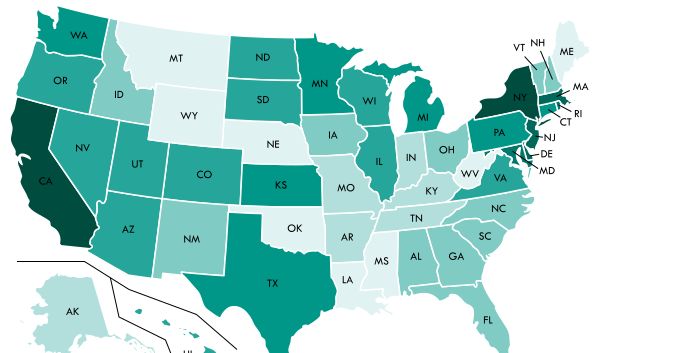
Most common states for business service coordinators
| Rank | State | Population | # of jobs | Employment/ 1000ppl |
|---|---|---|---|---|
| 1 | Vermont | 623,657 | 306 | 49% |
| 2 | Rhode Island | 1,059,639 | 411 | 39% |
| 3 | Wyoming | 579,315 | 195 | 34% |
| 4 | Maine | 1,335,907 | 417 | 31% |
| 5 | South Dakota | 869,666 | 240 | 28% |
| 6 | New Hampshire | 1,342,795 | 350 | 26% |
| 7 | Alaska | 739,795 | 174 | 24% |
| 8 | New Mexico | 2,088,070 | 451 | 22% |
| 9 | Minnesota | 5,576,606 | 1,106 | 20% |
| 10 | Utah | 3,101,833 | 632 | 20% |
| 11 | Iowa | 3,145,711 | 622 | 20% |
| 12 | West Virginia | 1,815,857 | 369 | 20% |
| 13 | Delaware | 961,939 | 189 | 20% |
| 14 | Maryland | 6,052,177 | 1,160 | 19% |
| 15 | Wisconsin | 5,795,483 | 1,109 | 19% |
| 16 | Alabama | 4,874,747 | 950 | 19% |
| 17 | Montana | 1,050,493 | 202 | 19% |
| 18 | Nebraska | 1,920,076 | 354 | 18% |
| 19 | Oklahoma | 3,930,864 | 664 | 17% |
| 20 | District of Columbia | 693,972 | 109 | 16% |
Most common cities for business service coordinators
| Rank | City | # of jobs | Employment/ 1000ppl | Avg. salary |
|---|---|---|---|---|
| 1 | Germantown | 1 | 3% | $35,718 |
| 2 | Beaverton | 2 | 2% | $41,816 |
| 3 | East Lansing | 1 | 2% | $44,811 |
| 4 | Gilroy | 1 | 2% | $53,133 |
| 5 | Janesville | 1 | 2% | $42,206 |
| 6 | Morgan Hill | 1 | 2% | $53,140 |
| 7 | Newport Beach | 1 | 1% | $50,704 |
| 8 | Salinas | 1 | 1% | $53,218 |
| 9 | Santa Rosa | 1 | 1% | $53,208 |
| 10 | Chicago | 1 | 0% | $40,623 |
| 11 | Fremont | 1 | 0% | $53,167 |
| 12 | Phoenix | 1 | 0% | $40,102 |
| 13 | Saint Louis | 1 | 0% | $35,848 |
| 14 | Saint Paul | 1 | 0% | $45,458 |
Business Service Coordinator job outlook: Expert opinions
Our panel of business service coordinator experts
Drexel University
Saint Mary-of-the-Woods College
University of Pittsburgh
Will there be an enduring impact of the coronavirus pandemic on Business Service Coordinators?
Susan Epstein: Clearly the pandemic has had both an emotional and financial impact on recent graduates, as it has had on everyone, really. For some college students, the financial implications mean postponing completion of their degree. For those who are completing their degree this year, the job market will be tight. There are many unemployed professionals with far more experience than a recent grad. It is a time of extreme uncertainty.
But I don't think the picture is all bleak. I think current students and graduates will be some of the most flexible and technically savvy candidates out there. They have proven their ability to pivot. They have had to change their style of learning, practically overnight. They have had to perfect their communication with classmates, teachers, and potential employers over Zoom, as opposed to having the benefit of face to face interaction - and they have done a great job! I think the perspective of these graduates will be quite different than those who graduated even 5 years ago. They have experienced first-hand how to adapt to the unexpected. They left campus in March, 2020 and likely have not been back.
This year's graduates are to be admired for their ability to stay focused amid such chaos. They have endured disruption and loss, yet are still working hard in school and in their communities, and as such are setting a wonderful example for the rest of us. As future leaders, I think this experience will influence their empathy, their relationships, and their willingness to think critically and consider alternate perspectives. And if that is the case, the future looks very bright.
What's a good job out of college for Business Service Coordinators?
Susan Epstein: The best job for a recent graduate is one for which her or she is passionate and prepared. The pandemic has not changed that. Taking a job that does not meet those criteria, regardless of what is going on in the world, will not be satisfying for the long term. In addition, working for an organization whose culture aligns with your own personal values is extremely important. Your first professional position sets the tone for the rest of your career. You want to ensure that there are challenging responsibilities and room for advancement. You should also take advantage of the networking opportunities within any organization you join. Feeling good about what you are doing and who you are doing it with affects not only your performance, but also the relationships you have with those around you. This is important as you pave the way for a career, as the reputation you create now will influence the way others respond to you going forward.
What technical skills for a Business Service Coordinator stand out to employers?
Susan Epstein: Technology-based skills such as software proficiency and data analysis are important in today's business environment, but obviously this will vary by industry and even job specifications. On the other hand, soft skills transcend job and industry. Strong interpersonal skills (including listening, often a weakness in our communication skill set), critical thinking, and time management make strong leaders and equally strong followers.
Michelle Ruiz Ph.D.
Assistant professor, Healthcare administration Program DirectorSaint Mary-of-the-Woods College
Master of Healthcare Administration, Business and Leadership Department
What are the biggest trends we'll see in the Business Service Coordinator job market given the pandemic?
Michelle Ruiz Ph.D.: When looking at specific fields, like healthcare, there are unusually high stressors right now that are bringing about higher than average turnover. This changes the job market for qualified candidates who are looking for work, making it easier for applicants to find a position than during previous economic downturns. Other industries will see a more permanent shift in their hiring, people who were employed in entertainment, travel, and dining for example are seeing a shrinking job market. Employees from those areas are pivoting to more stable industries to find work again, through entry level positions or going back to school for a new bachelors or master's degree.
What type of skills will young Business Service Coordinators need?
Dr. Jeanette Lehn: No matter where young graduates will be working, some habits of mind that will benefit graduates going forward are curiosity, openness, creativity, persistence, flexibility, and reflection. The ways that those skills are strengthened is through engaging in writing and composing, where those habits are practiced, and where critical thinking about context, audience, and process happens.
Also, I see the ability to dive into a composition or a project without the plan for the document being perfect as very valuable. Trusting in the process allows for some really exciting insights to emerge. We have to be able to get started before things are perfect and be open to modification.