Explore jobs
Find specific jobs
Explore careers
Explore professions
Best companies
Explore companies
Job outlook for business systems managers in the United States
Business systems manager job growth summary. After extensive research, interviews, and analysis, Zippia's data science team found that:
The projected business systems manager job growth rate is 16% from 2018-2028.
About 82,400 new jobs for business systems managers are projected over the next decade.
Business systems manager salaries have increased 11% for business systems managers in the last 5 years.
There are over 7,884 business systems managers currently employed in the United States.
There are 239,739 active business systems manager job openings in the US.
The average business systems manager salary is $126,569.
Are business systems manager jobs in demand?
Business systems manager job and salary trends over time
Business systems manager jobs over time
Business systems manager job growth rate over time
| Year | # of jobs | % of population |
|---|---|---|
| 2021 | 7,884 | 0.00% |
| 2020 | 7,431 | 0.00% |
| 2019 | 7,051 | 0.00% |
| 2018 | 6,360 | 0.00% |
| 2017 | 5,942 | 0.00% |
Average business systems manager salary over time
Business systems manager salary by year
| Year | Avg. salary | Hourly rate | % Change |
|---|---|---|---|
| 2025 | $126,569 | $60.85 | +3.3% |
| 2024 | $122,558 | $58.92 | +2.7% |
| 2023 | $119,350 | $57.38 | +2.4% |
| 2022 | $116,579 | $56.05 | +2.5% |
| 2021 | $113,715 | $54.67 | +3.2% |
Business systems manager jobs by state
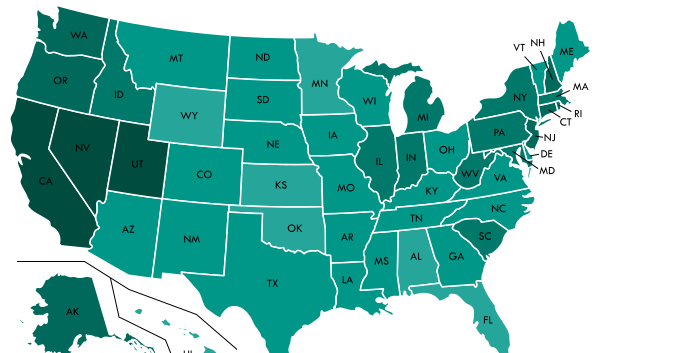
Most common states for business systems managers
| Rank | State | Population | # of jobs | Employment/ 1000ppl |
|---|---|---|---|---|
| 1 | District of Columbia | 693,972 | 807 | 116% |
| 2 | Washington | 7,405,743 | 3,185 | 43% |
| 3 | Minnesota | 5,576,606 | 2,264 | 41% |
| 4 | Alaska | 739,795 | 293 | 40% |
| 5 | Oregon | 4,142,776 | 1,534 | 37% |
| 6 | Nebraska | 1,920,076 | 714 | 37% |
| 7 | Rhode Island | 1,059,639 | 392 | 37% |
| 8 | South Dakota | 869,666 | 325 | 37% |
| 9 | North Dakota | 755,393 | 277 | 37% |
| 10 | Massachusetts | 6,859,819 | 2,465 | 36% |
| 11 | Montana | 1,050,493 | 374 | 36% |
| 12 | Delaware | 961,939 | 349 | 36% |
| 13 | Vermont | 623,657 | 224 | 36% |
| 14 | New Hampshire | 1,342,795 | 473 | 35% |
| 15 | Virginia | 8,470,020 | 2,546 | 30% |
| 16 | Kansas | 2,913,123 | 880 | 30% |
| 17 | Iowa | 3,145,711 | 916 | 29% |
| 18 | Illinois | 12,802,023 | 3,555 | 28% |
| 19 | Connecticut | 3,588,184 | 1,001 | 28% |
| 20 | New Mexico | 2,088,070 | 595 | 28% |
Most common cities for business systems managers
| Rank | City | # of jobs | Employment/ 1000ppl | Avg. salary |
|---|---|---|---|---|
| 1 | Waltham | 2 | 3% | $125,766 |
| 2 | Baltimore | 1 | 0% | $119,648 |
| 3 | Houston | 1 | 0% | $110,631 |
| 4 | San Diego | 1 | 0% | $136,847 |
| 5 | Washington | 1 | 0% | $121,552 |
Business Systems Manager job outlook: Expert opinions
Our panel of business systems manager experts
Worcester Polytechnic Institute
University of North Dakota
Saint John Fisher College
Western Kentucky University
University of La Verne
Kent State University
Widener University
Xavier University
Florida Gulf Coast University
Sullivan University
Prairie View A & M University
What Business Systems Manager skills would you recommend for someone trying to advance their career?
Dr. Swagata Banerjee PhD: Digital literacy: As technology continues to evolve, proficiency in digital tools and platforms will become increasingly essential. Adaptability: The ability to quickly learn new skills and adapt to changing circumstances will be crucial in a rapidly evolving industry landscape. Data literacy: Understanding and analyzing data will become more important for making informed decisions and optimizing strategies. Interdisciplinary skills: The ability to work across different disciplines and collaborate effectively with diverse teams will be highly valued. Emotional intelligence: Soft skills such as empathy, communication, and teamwork will continue to be in demand as workplaces become more interconnected and dynamic.
Prof. Mohammad Elahee Ph.D.
Perlroth Professor of Int’l. BusinessWhat general advice would you give to a Business Systems Manager?
Prof. Mohammad Elahee Ph.D.: The main advice I would give to a new graduate is to be prepared for continuous learning for the rest of his working life. AI and other technological breakthroughs are changing the job market landscape. The skillset that would help one get a job would not keep him/her there for long. To remain marketable, one has to regularly acquire new skills, develop and maintain a strong professional network and scan the market regularly to gauge impending changes.
What general advice would you give to a Business Systems Manager?
Dr. Laura Gonzalez Ph.D.: Technology, and in particular Artificial Intelligence, are becoming ubiquitous in all professions. New positions are being created and those who know how to use Artificial Intelligence will not be replaced by AI. This requires minimum programming knowledge, and it is useful to have some data analytics knowledge as well.
What Business Systems Manager skills would you recommend for someone trying to advance their career?
Dr. Laura Gonzalez Ph.D.: My first advice would be to celebrate and then rest a little, because graduation is just the beginning. It is imperative to continue professional and skill development even after finding a job. Interviewing takes both practice and skills. It is also important to stay in touch with the alma mater and attend alumni events to network. Networking within the alma mater circles is a key source of information, recommendations and referrals.
What will help Business Systems Managers increase their earning potential?
Dr. Laura Gonzalez Ph.D.: The most effective way to negotiate contracts and promotions is to have multiple options and offers. Moreover, compensation is a package with multiple components that can be negotiated, including reallocation bonus and different benefit providers. In addition to common minimum components in compensation packages, some employers can negotiate stock options besides bonuses, and assist with accommodation and/or mortgage conditions.
What general advice would you give to a Business Systems Manager?
Jennifer Barr PhD: All of the skills noted in my response to Q1. However, as business professionals advance in their respective careers, they must have a keen understanding about the impact of technology on every aspect of an organization. It is also essential to stay abreast of emerging technologies and understand their implications for business practice.
Professional development should be an ongoing priority. Attend conferences and seminars, complete certificate programs, etc. Build your personal brand and value at every level.
Hone leadership skills for middle management positions including collaboration, thinking and acting systemically, resiliency and learning agility. Never forget the importance of humanity when interacting with subordinates. Lead by example always.
Recognizing the role of data capture, analytics and technology in advancing organizations, creating competitive advantage and delivering exceptional user experiences is paramount.
Hire well. Employees are considered the most valuable asset of every organization. Abilities, knowledge and experience matter but the soft skills in terms of how someone works and interacts with others should be top priorities.
What Business Systems Manager skills would you recommend for someone trying to advance their career?
Jennifer Barr PhD: Do research on what market compensation is for a given role. Review websites like Glassdoor and Indeed.
Understand standard compensation negotiation tactics during the offer stage.
What will help Business Systems Managers increase their earning potential?
Jennifer Barr PhD: Embrace a lifelong learning mindset at the outset. Read case books about successful organizations, notable leaders and new business practices.
Establish an unwavering reputation as a disciplined and responsible worker.
Strive to be an excellent listener. Your attention to detail will be noticed as evidenced through your work.
Be creative and take risks. Suggest an idea to your supervisor about how to improve a procedure or system. This will position you as an early career problem solver.
Seize every opportunity to grow and build key skills including communication, interpersonal, critical thinking and technology.
Recognize the strong correlation between emotional intelligence and success. This is particularly important as you advance in your career.
Cultivate mentorship opportunities and network as much as possible. Eventually step into a mentorship role.
Honesty, integrity and character matter. Be true to yourself and never deviate from your moral compass. Listen to your instincts always.
Create a strong LinkedIn profile and update regularly. It is one of the top recruiting sites.
What Business Systems Manager skills would you recommend for someone trying to advance their career?
David Hart: Most businesses may hire you on like a consultant. The employees rarely welcome consultants in their business so that early friction is something that most new Business Analysts find distasteful, however if taken in that context, it is also the most challenging part of the field. When you discover processes that will enhance the productivity of the company and help the employees see more profit sharing you can end up being the hero. Most employees spend most of their work career never feeling fulfilled. This profession will definitely give you that rewarding feeling.
What will help Business Systems Managers increase their earning potential?
David Hart: This field has become more valuable ever since the supply chain interruption due to Covid. The analyst is challenged every day with supply chain issues and deployment of the right resources to their prospective areas. Every day can be a new challenge so the work is rarely mundane.
Dany Doueiri
ProfessorWhat Business Systems Manager skills would you recommend for someone trying to advance their career?
Dany Doueiri: Have a team mentality, share, keep learning, and seek all professional development opportunities available to you, through your work or individually.
What general advice would you give to a Business Systems Manager?
Adam Roth: As a liberal arts graduate, it is critical to focus on networking, continuous learning, and gaining practical experience. I strongly advise leveraging campus recruitment fairs, leadership positions, alumni gatherings, and platforms like LinkedIn to build a robust professional network. Utilize career services to seek out internships or volunteer opportunities that will enhance your skills and expand your professional network. Through your coursework and extra- and co-curricular activities, work on developing skills that are highly sought after by employers of new college graduates and which are in short supply; oral and written communication, analytical reasoning, problem solving, and teamwork. Complement these with technical skills that will make you more versatile in the job market. When possible, find mentors among alumni, internship supervisors, and even parents of friends who will offer guidance and support. Embrace opportunities to showcase your abilities, identify areas for improvement, and pursue additional coursework or online credentials to further enhance your skills and marketability.
What Business Systems Manager skills would you recommend for someone trying to advance their career?
Adam Roth: I recommend that students start by identifying a specific skill in demand within your field, such as data analysis or social media marketing, and focus on developing expertise in that area. Research salary ranges and living costs in particular areas where you’re interested in working to ensure your compensation aligns with the local market. Always negotiate a salary and consider other aspects of the offer, such as funds for continuing education, technology and more. Continuing to network and establish demand for your services is essential; attend industry events, join professional associations, and engage with professionals in your field. Never miss an opportunity to reach out to and check in with your professional contacts. Pursue additional learning opportunities and education, such as certifications or advanced degrees, to provide a competitive advantage and increase your earning potential over time.
What Business Systems Manager skills would you recommend for someone trying to advance their career?
Bradley Andrew Ph.D.: I’m going to change the question based on the evidence gathered by labor economists. Overall, income rises most in a person’s 20s and 30s, stagnates in one’s 40s and actually falls from age 50 on. Moreover, people who are willing to change jobs more frequently have greater salary growth. If this is your goal, then spending your twenties and thirties working hard on your skills and credentials, being willing to move from one position to another and being geographically flexible will increase your lifetime income.
What will help Business Systems Managers increase their earning potential?
Bradley Andrew Ph.D.: Once you have your first job, ask about or determine the 20% of your supervisor’s job that they hate and start doing that for them. They will love you for it and it will quickly get you recognition. You’ll also be well on your way to learning your boss’s job. Continue doing this as you progress in your career (Kudos to Theo Epstein, former GM for the Red Sox, for this recommendation)
No matter the task you’re given, do it to the absolute best of your abilities. In the professional world, you may often be given menial tasks or tasks that you don’t believe are part of your job description. Doing those tasks to the absolute best of your ability leads to increased trust, recognition and responsibility and will put you “above class.” If asked, the coffee you bring should be the best your boss has ever had. You never know who’s watching.
Don’t expect credit and don’t ask for credit when things go right; give the credit to others.
What Business Systems Manager skills would you recommend for someone trying to advance their career?
Zhu Mao: Specifically in the next 3-5 years, I would say it is the critical thinking and problem solving capability in interdisciplinary areas. Employers will increasingly value individuals who can think critically, analyze complex situations, and propose effective solutions in the cutting edge of multiple disciplines, especially those demonstrating adaptability and resilience in the era of data science.
Yvette Koepke
Associate Dean for Academic SuccessUniversity of North Dakota
Ethnic, Cultural Minority, Gender, And Group Studies
What Business Systems Manager skills would you recommend for someone trying to advance their career?
Yvette Koepke: Salary: Preparation is key. Prepare by taking advantage of opportunities and experiences through projects, jobs, internships, organizations, or volunteering. Prepare by doing homework about the field and the position, and research showing the value of diversity. And prepare by practicing how best to make the case for what you can contribute.
What general advice would you give to a Business Systems Manager?
Yi Liu Ph.D., CFP®: Interpersonal skills are increasingly important. It is no longer just about crunching numbers. The capacity to communicate effectively, collaborate successfully in a team, and adjust to change is equally important. Furthermore, the ability to properly use Artificial Intelligence (AI) tools to supplement your work will be a huge advantage. Furthermore, emotional intelligence—the ability to manage complicated interpersonal dynamics with empathy and understanding—is extremely significant.
Xiaowen Chen Ph.D.
Assistant ProfessorWestern Kentucky University
Psychology
What Business Systems Manager skills would you recommend for someone trying to advance their career?
Xiaowen Chen Ph.D.: Present your knowledge, skills, competencies, and experience by showing your research and applied projects so that employers will know what you have accomplished and the potential value you can bring to their organization.
What Business Systems Manager skills would you recommend for someone trying to advance their career?
William Luse PhD.: While mastering artificial intelligence (AI) is becoming increasingly important, I believe the timeless skills of effective communication will remain critical. Whether it's crafting clear emails, delivering impactful presentations, or engaging in meaningful conversations, these skills are indispensable across all career paths. Another skill that will become crucial is learning to interact with AI through conversational prompts. This ability to communicate effectively with AI not only enhances your productivity but also opens up new avenues for leveraging technology in innovative ways.
What general advice would you give to a Business Systems Manager?
Dr. Vaneet Kaur: You can maximize your salary potential by keeping yourself differentiated from your peers. You must identify, develop, and hone your unique selling proposition (USP). You want to show your prospective employer that you bring a unique value to their organization which is far superior to what other candidates can bring. You can achieve this by demonstrating to your prospective employer that you go above and beyond what is usually required and expected. More specifically, in addition to earning your degree, you should attain certifications, micro-credentialing, or badges in any niche area that you are passionate about. This will significantly add to your area specialization. Additionally, you should undertake internships or projects with faculty/business community as these will help demonstrate your working knowledge to the prospective employers. I exhort my students to continue to excel in these areas as these will not only communicate to the prospective employers that these select individuals have the drive and willingness to succeed, making them a perfect candidate to be inducted to their company, but this will also keep graduates highly relevant, marketable, and above par at all times in their career.
Tongyang Yang Ph.D.
Assistant Professor of Economics and Business AnalyticsWidener University
Business/Commerce
What general advice would you give to a Business Systems Manager?
Tongyang Yang Ph.D.: There are many reasons that people like about being a business analyst, including reasons listed as follows: 1. Analytical Skills and Data Exploration: BAs often analyze data to understand trends and identify areas for improvement. Seeing a successful implementation and its positive impact can be very rewarding. 2. Problem-solving. BAs get to identify inefficiencies and propose solutions that can improve how a business operates. 3. Continuous learning. Business analysts may work on a range of projects and the field of business analysis may be constantly evolving, which required BAs to actively cultivate skills in new businesses. For example, the coming of the AI era requires BAs to master AI fundamentals and data fluency. 4. While some thrive on the problem-solving and communication aspects of a BA role, others may find them less appealing. Carefully consider your personality and preferences to see if this aligns with your career goals.
What Business Systems Manager skills would you recommend for someone trying to advance their career?
Tongyang Yang Ph.D.: The rise of AI has brought many opportunities for the professions like business analysts in terms of AI integration. Businesses will need analysts who can bridge the gap between AI and human needs and focus on more strategic areas like identifying ethical considerations of AI implementation, developing plans to mitigate AI bias, and designing human-AI collaboration workflows. For people who are interested in entering this profession, I would suggest adapting your skillset to include AI understanding, data storytelling, and strategic thinking to be well-positioned in the future.
What will help Business Systems Managers increase their earning potential?
Dr. DAWN TOLONEN MBA: For the near future concentrate on three areas, soft skills, critical thinking, and artificial intelligence (AI). Your technical skills helped you land the job, but it’s your soft skills that lead to promotion.
Thomas Mathews CFA
InstructorFlorida Gulf Coast University
Finance And Financial Management Services
What will help Business Systems Managers increase their earning potential?
Thomas Mathews CFA: WHEN YOU START OUT, YOUR FOCUS SHOULD BE ON LEARNING AS MUCH AS POSSIBLE ABOUT THE COMPANY, ITS CLIENTS, ITS PRODUCT LINES, PROFIT-GENERATING ACTIVITIES, ETC. GO OUT OF YOUR WAY TO BE A TEAM PLAYER. YOU NEED TO ESTABLISH CREDIBILITY THROUGH OVER-DELIVERING ON PROJECTS THAT ARE ASSIGNED TO YOU. THEN, YOU CAN 'NEGOTIATE FROM A POSITION OF STRENGTH' IN SEEKING HIGHER COMPENSATION OR BONUSES.
What will help Business Systems Managers increase their earning potential?
Thomas Smith PhD: Soft skills (people skills) and critical thinking are both skills that will serve you well throughout your career, and unfortunately, they are areas that receive little focus in most education today. Remember the 'Golden Rule' and learn from your mistakes.
What general advice would you give to a Business Systems Manager?
Terésa Dowell-Vest Ph.D., M.F.A.: The greatest thing I learned starting my adult life was the power of determining a goal and creating a budget for it: Rent for a year, seeing a favorite artist in concert, producing a short film, traveling the world…create a budget and a plan of action, you can do anything you desire.