
Automatically apply for jobs with Zippia
Upload your resume to get started.
Cable system installer/maintainer skills for your resume and career
15 cable system installer/maintainer skills for your resume and career
1. Utility Poles
A column or pillar, that is used to uphold overhead electrical power lines and communication cables, is termed a utility pole. They are used to support a number of public utilities, such as electrical cables, fiber optic cables, telephone wires, and street lights.
- Climbed utility pole and connected test television.
- Measure signal strength at utility poles by using electronic testing equipment such as a signal meter, and reverse meter.
2. Construction Equipment
- Perform preventive maintenance on cable installations and construction equipment.
- Operated manual and motorized cable construction equipment.
3. Power Generators
- Install, operate and perform maintenance on power generators, ensuring mission readiness for field exercises and deployments.
- Ensured proper maintenance of cable/ wire communication systems, security devices, and power generators.
4. Repair Circuits
- Install and repair circuits and wiring.Majority of work includes using CAT 5 copper cabling across a variety of networks.
- Perform test on cable communications systems and circuit groups Install and repair circuits and wiring
5. MOS
MOS, Military Occupational Specialty, is a system that categorizes occupational fields. It is the duty or group of related duties for which a soldier is best qualified by training, skill, and experience and which forms a basis for the classification, assignment, and advancement of personnel. There are more than tens of thousands of different MOS in the military, spanning a variety of skills and levels of responsibility.
- Worked outside of MOS while in deployment and cross-trained as a cable systems installer- maintainer.
6. Electric Cables
- Tested electric cables and equipment wiring to detect broken circuits and incorrect connections using a voltmeter.
Choose from 10+ customizable cable system installer/maintainer resume templates
Build a professional cable system installer/maintainer resume in minutes. Our AI resume writing assistant will guide you through every step of the process, and you can choose from 10+ resume templates to create your cable system installer/maintainer resume.7. PMCS
- Operate and perform PMCS on telephone line and other vehicles.
- Install, operate and perform PMCS on power generators.
8. Combiners
- Experienced in working with Digital Group Multiplexers, Remote Multiplexing Combiners, repeaters, restorers, and voltage regulators.
- Configure digital group multiplexers and remote multiplexing combiners for operations.
9. Test Stations
- Installed and operated repeaters, restorers, voltage protection devices, telephones, test stations, and other tactical equipment.
- Installed and maintained cable lines containing repeaters, restorers, telephones and test stations.
10. System Quality
- Test cable communications systems, pinpoint issues and document circuit and system quality; detect line faults and circuit malfunctions.
- Performed tests on cable communications systems to ensure circuit and system quality.
11. Auxiliary Equipment
Auxiliary Equipment will differ depending on the work environment, but it is often recognized as machinery that promotes efficiency within a company. Auxiliary equipment can complete work without employee input or direct communication. This equipment can range from something as simple as conveyor belts and bulk storage to more complex machines that assist with oil extraction.
- Supervised team activities in construction, installation, and rehabilitation of tactical cable communications systems and auxiliary equipment.
- Repaired or replaced defective lines and auxiliary equipment.
12. Preventive Maintenance Checks
- Operated And performed preventive maintenance checks and services on assigned vehicles and power generators.
- Performed preventive maintenance checks and services as well as unit level maintenance on communication security devices.
13. CAT5
- Installed, maintained, and troubleshoot Cat5 and Cat6 data networks.
- Installed over three thousand feet of Cat5 and Cat3 cable.
14. Trouble Tickets
A trouble ticket is another term for a support/help ticket. At the point when a client or worker has an issue, they present a record, or ticket, to the IT group depicting their issue. The group records significant data on the ticket and uses it for correspondence between the client and the group.
- Received Army Accommodation Medal for 1,251 trouble tickets completed overseas.
- Managed the automated trouble ticket data base analyzed anomalies and prepared weekly trend analysis statistics improving overall communication readiness.
15. Cat-5
- Repaired, removed and replaced fiber, DGM, 25 pair, and Cat-5 parts and equipment.
- Stringed of network CAT-5 cabling infrastructure, 66/100 block punch down from Phone Company's demarcation to network patch panel.
5 Cable System Installer/Maintainer resume examples
Build a professional cable system installer/maintainer resume in minutes. Browse through our resume examples to identify the best way to word your resume. Then choose from 5+ resume templates to create your cable system installer/maintainer resume.

What skills help Cable System Installer/Maintainers find jobs?
Tell us what job you are looking for, we’ll show you what skills employers want.
List of cable system installer/maintainer skills to add to your resume
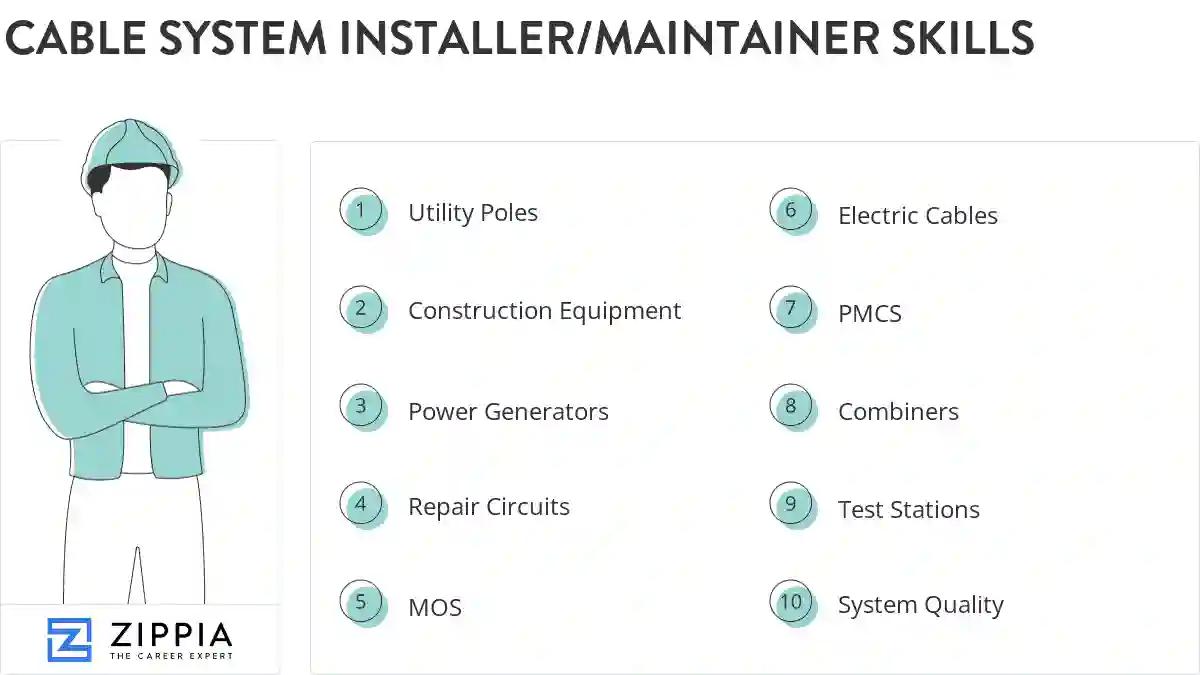
The most important skills for a cable system installer/maintainer resume and required skills for a cable system installer/maintainer to have include:
- Utility Poles
- Construction Equipment
- Power Generators
- Repair Circuits
- MOS
- Electric Cables
- PMCS
- Combiners
- Test Stations
- System Quality
- Auxiliary Equipment
- Preventive Maintenance Checks
- CAT5
- Trouble Tickets
- Cat-5
- Fiber Optic Cables
- Unit Level Maintenance
- RMC
- VoIP
- Test Equipment
- COMSEC
- LAN
- Combat
- Computer System
- Patch Panels
- Ethernet
- ST
- OTDR
- OSP
- Test Results
- US Army
- Secret Security
- IP
- Telephone Lines
- Cable Lines
- Nipr
- Rj-45
- Phone Lines
- PBX
- Telephone Systems
- Line Faults
- Rj45
- Customer Support
Updated January 8, 2025
