Explore jobs
Find specific jobs
Explore careers
Explore professions
Best companies
Explore companies
Job outlook for case planners in the United States
Are case planner jobs in demand?
Case planner job and salary trends over time
Case planner jobs over time
Case planner job growth rate over time
| Year | # of jobs | % of population |
|---|---|---|
| 2021 | 1,935 | 0.00% |
| 2020 | 1,943 | 0.00% |
| 2019 | 1,965 | 0.00% |
| 2018 | 1,906 | 0.00% |
| 2017 | 1,866 | 0.00% |
Average case planner salary over time
Case planner salary by year
| Year | Avg. salary | Hourly rate | % Change |
|---|---|---|---|
| 2026 | $43,496 | $20.91 | +2.6% |
| 2025 | $42,407 | $20.39 | +3.9% |
| 2024 | $40,823 | $19.63 | +1.9% |
| 2023 | $40,061 | $19.26 | +4.1% |
| 2022 | $38,476 | $18.50 | +3.2% |
Case planner jobs by state
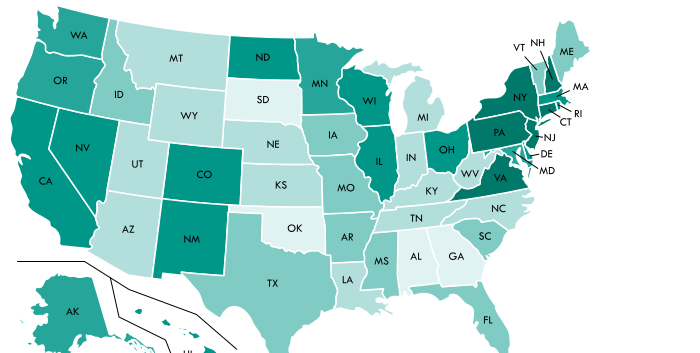
Most common states for case planners
| Rank | State | Population | # of jobs | Employment/ 1000ppl |
|---|---|---|---|---|
| 1 | Massachusetts | 6,859,819 | 2,451 | 36% |
| 2 | District of Columbia | 693,972 | 201 | 29% |
| 3 | Alaska | 739,795 | 178 | 24% |
| 4 | Maine | 1,335,907 | 288 | 22% |
| 5 | Maryland | 6,052,177 | 1,133 | 19% |
| 6 | Washington | 7,405,743 | 1,273 | 17% |
| 7 | Minnesota | 5,576,606 | 922 | 17% |
| 8 | New Hampshire | 1,342,795 | 228 | 17% |
| 9 | Rhode Island | 1,059,639 | 165 | 16% |
| 10 | Montana | 1,050,493 | 165 | 16% |
| 11 | Pennsylvania | 12,805,537 | 1,939 | 15% |
| 12 | Colorado | 5,607,154 | 816 | 15% |
| 13 | Iowa | 3,145,711 | 461 | 15% |
| 14 | Oregon | 4,142,776 | 561 | 14% |
| 15 | Connecticut | 3,588,184 | 508 | 14% |
| 16 | New Mexico | 2,088,070 | 291 | 14% |
| 17 | Nebraska | 1,920,076 | 274 | 14% |
| 18 | South Dakota | 869,666 | 121 | 14% |
| 19 | Illinois | 12,802,023 | 1,696 | 13% |
| 20 | New Jersey | 9,005,644 | 1,148 | 13% |
Case Planner job outlook: Expert opinions
Our panel of case planner experts
University of Indianapolis
Campbellsville University
Pennsylvania State University
Siena College
University of Houston - Clear Lake

The University of Texas Permian Basin
University of Nevada - Reno
University of Illinois-Springfield

Campbellsville University

California State University Northridge
Adelphi University
Adelphi University

University of Nebraska at Omaha
What will help Case Planners increase their earning potential?
Emily McCave PhD, MSW, LCSW: For clinical positions, which is what most social workers do, daily tasks typically include conducting assessments and providing individual, family, and/or group therapy to children and/or adults, while collaborating with other providers working with the client. There is also daily clinical documentation that needs to be completed.
What Case Planner skills would you recommend for someone trying to advance their career?
Lynell Cooper MSW, LCSW: Being empathetic will enhance your ability to connect with clients, while resilience will help you manage emotional stress effectively. Fostering a lens of cultural humility will serve as a conduit to success and effectiveness.
Dr. Kimberly Mudd-Fegett DSW, MSSW
Associate Professor of Social WorkCampbellsville University
Social Work
What Case Planner skills would you recommend for someone trying to advance their career?
Dr. Kimberly Mudd-Fegett DSW, MSSW: The best thing about being a Social Worker is the ability to serve, assist and empower other individuals who are facing challenges within their life. Although this can be very overwhelming, at times the rewards this can provide, and self-fulfillment is hard to put into words. One of the greatest challenges of Social Work is maintaining adequate self-care and knowing that you can impact or help all individuals. This can be extremely challenging and overwhelming, particularly for new workers. One must ensure that they have adequate supervision, education, and resources to protect their wellbeing or burnout is highly likely.
What Case Planner skills would you recommend for someone trying to advance their career?
Dr. J. Lendrum PhD: It will become increasingly important to use non-violent communication skills and empathy that you practiced and developed in your academic programs. As the world becomes more diverse, tapping into the cultural competency skills will also become increasingly useful.
What will help Case Planners increase their earning potential?
Dr. J. Lendrum PhD: Trust yourself and follow your passions. It is possible to find a meaningful career that aligns with your core interests and values.
What will help Case Planners increase their earning potential?
James Andrews LCSW, LICSW, BCD: Completing the MSW and graduating as a professional social worker is exciting and can be overwhelming. There are some general areas of professional development that I would strongly recommend new social workers entering the workforce focus on addressing. The first (and in many ways perhaps the most important) is to actively network. Connect with peers and mentors by building and maintaining professional relationships through joining professional organizations and attending industry events such as conferences and other professional events. Join your state chapter of the National Association of Social Workers (NASW) and become active; don’t just pay your dues every year. Contact the chapter office and volunteer for a committee and run for a volunteer leadership position. Get involved! Next, be adaptable! If the social service field is characterized by any one quality, it is change. Cultivating the ability to grow, adapt to new technologies, methodologies, and work environments will be crucial to one’s career success. Not only does the quality of flexibility makes one a valuable employee and prepares you for unexpected challenges and opportunities, but it is also a central trait needed for those who desire to open their own clinical practices one day. Related to adaptability is the practice of continuous learning. Social work and the larger industry of social services ever evolving, so it is imperative that new graduates embrace the idea that even though they have graduated, they must always be students, ever learning and developing new skills. This involves a commitment to lifelong learning which involves pursuing certifications, workshops attendance, and staying updated with the latest industry trends and technologies through independent reading and research. This not only keeps your skills relevant but also demonstrates your commitment to professional growth. And finally, and too often ignored, is the importance of developing and cultivating what are called “soft skills”. Skills such as communication, teamwork, problem-solving, and time management a(and others) are essential. For the successful social worker. Such soft skills complement one’s technical abilities and are highly valued by employers. And in many ways are what will enable a person to advance in their career.
Elisa Martin Ph.D., MSW
Associate Professor of Social Work, Department Chair & Program DirectorSiena College
Social Sciences
What general advice would you give to a Case Planner?
Elisa Martin Ph.D., MSW: The U.S. Bureau of Labor Statistics projects that the need for social workers will grow faster than many other professions, which means finding employment upon graduation will not be a problem.
What will help Case Planners increase their earning potential?
Elisa Martin Ph.D., MSW: The beauty of the social work profession is that the skills you learn from your degree can be applied in a range of settings and populations. Depending on your interest, you could be working with children, youth, adults, older adults, or in an area of interest like domestic violence, homelessness, child welfare, gerontology. The work you do could be one-on-one, with small groups, running programs within an organization, and/or working in communities.
What Case Planner skills would you recommend for someone trying to advance their career?
Dr. Dexter Voisin: There is a robust demand for social workers, and it is one of the fastest-growing professions in the country. Many states are not able to fill the growing demand for social workers to respond to the growing demand for mental health and substance abuse counselors.
What general advice would you give to a Case Planner?
Cynthia Peters MSW: When people hear the word social worker, they immediately think about the folks that take children from their families due to some report of abuse. They have a tendency to immediately not like what they think is social work. Social Work is so much more than working for DCS. What I like about Social Work is that there are so many jobs/careers you can walk into and utilize the skill you learned about the profession. Your job title does not need to be Social Worker. I know a social worker that is the Director of Public Works; Recreation Coordinator; Minister; Assistant to in the Governor's Office; Victim Advocate; Management Assistant; Council person; Governor; Senator. The sky is the limit to what career or job a social worker can do.
What Case Planner skills would you recommend for someone trying to advance their career?
Cindy Snell: Your first job out of school is not often your “dream job”. Consider it as an important step in your career journey. Evaluate job offers holistically, including salary & benefits, skill building, moving towards advanced licensure, good supervision and office culture. There are many ways to contribute to the field of social work. You will find your way on the way. Create a support network. This can include friends to have fun with, social work classmates to form a peer advising group, a mentor to help you chart your career path. Create your self-care strategy and stick with it. Bring joy, reduce stress, step away. Use continuing education requirements to advance your career.
What Case Planner skills would you recommend for someone trying to advance their career?
Andrew Schoolnik: Dialogue and compromise. There are many apparatuses in today's society which are designed to pull people apart. Cable news and online news sites are famous examples of this. Add to this the echo chambers of social media where people largely associate with like-minded people while looking negatively at those with a different world view. This silo-ing of society is the antithesis of dialogue and compromise. Instead, it creates a class system of those who agree (the favored class) and those who disagree (the unfavored class).
On a macro level, the more the social worker dialogues with all stakeholders (those in favor and those opposed) the more that person gains knowledge and goodwill. This is at the heart of compromise - winning being defined as doing the most good for the most people.
On a clinical level, social workers work mutually with their clients. Learning about a client's values begins with dialogue (even when our values are different) and creating treatment plans is often-based on compromise (agency policy/goals, and client goals).
What will help Case Planners increase their earning potential?
Andrew Schoolnik: Education does not end with graduation but instead continues in one's first several years of social work practice (and ideally for a lifetime); therefore, it is very important to find employment with an excellent supervisor. Whether doing formal weekly supervision, or just having an ear to share ideas and gain support, having a supervisor who is knowledgeable, available, and caring is critical to the success of a newly-graduated social worker.
What Case Planner skills would you recommend for someone trying to advance their career?
Candace Riddley: I anticipate technological, critical thinking, and communication skills will be most important in the field of social work over the next 3-5 years. AI and digital technologies have become popular in recent years, and new skills will need to be learned or refreshed to maintain in our changing job market. In today's job market, public speaking and problem-solving skills are critical factors when employers are seeking new hires.
Dr. Lisa Jones Ed.D.
Professor - Multicultural EducationUniversity of Houston - Clear Lake
Intercultural/Multicultural And Diversity Studies
What general advice would you give to a Case Planner?
Dr. Lisa Jones Ed.D.: I believe that you should not go into any career to "make money". However, you can maximize your salary potential by: * Loving what you do and expressing it through your constant professionalism. Employees do notice the small gestures and commitment to the field. * Being your authentic self. For example, if you do not know something, say so. It's okay to not know and to be vulnerable. That is how we learn. * Improving upon your skill(s) set. Seek ways to get more training, credentials, certificates, or professional development. * Being patient....you will have "character building" experiences that you should not let define you, but help you grow in the field. * Seeking out a mentor to help you navigate the field in the beginning. Later on, help others in the same manner. While trying to maximize your salary potential is a very practical goal, be mindful to guard your mental health. In most cases, salary increases involve much more work and time. If getting that salary increase requires you to sacrifice your mental health, is it really worth it? Alex, I know that my last statement may not be germane to the topic of maximizing salary potential, but I think it is extremely important. You may choose to delete it.
Sam Terrazas Ph.D.
Professor and Academic Chair Department of Social WorkThe University of Texas Permian Basin
Department of Social Work
What skills stand out on Case Planner resumes?
Sam Terrazas Ph.D.: Social work is a profession rooted in professional ethics and requires a wide range of skills that vary depending upon the role a social worker holds in an organization. In general, social work skills that stand out on a resume are skills gained through specialized training and certifications, skills in culturally responsive practice, proficiency in languages, and skills in assessment and evaluation.
What soft skills should all Case Planners possess?
Sam Terrazas Ph.D.: Social workers need to be skillful in documentation in writing case notes, assessments, and good managers of their time. Managing a client's case requires social workers to be diligent and ensure that all required documentation is completed on time and within professional standards. Social workers must also be effective communicators understanding their own power and the multiple professional roles they hold.
What hard/technical skills are most important for Case Planners?
Sam Terrazas Ph.D.: Social workers practice in various areas of practice and organizational auspices that may differ in the hard/technical skills that are most important. In general, the hard/technical skills most important can be categorized based on the level of education-BSW (Bachelors of Social Work) versus MSW (Masters of Social Work).
BSW's practice in a range of organizations providing various types of services; however, in general practice in the realm of case management that requires that ability to demonstrate cultural responsiveness, develop an alliance with clients, apply NASW and a state's ethics and professional standards of practice, conduct assessments, and to develop plans to meet a client's goals.
MSW's practice in many areas such as administration, clinical, public policy and advocacy, child welfare, public safety, and health care. Each of these practice areas requires specific technical skills; however, in general, MSW's are trained to assess individuals, families, groups, and communities. To that end, MSW's must understand the cultural context and how socio/economic local, state, federal policies impact social welfare problems such as poverty, intimate partner violence, and mental illness. MSW's must possess strong engagement skills/therapeutic alliance-building, diagnostic/evaluation skills, ethical application of interventions and therapeutic approaches, and advocacy skills.
Lillian Wichinsky Ph.D.
Associate DeanUniversity of Nevada - Reno
School of Social Work
What soft skills should all Case Planners possess?
Lillian Wichinsky Ph.D.: Social workers need to be prepared to work in integrated health and multidisciplinary settings and act as change agents across systems of care. They work with various communities and people, and therefore soft skills are very important to their success. Some of the most important soft skills include:
-Teamwork. ...
-Communication Skills
-Problem-Solving Skills
-Ethics
-Flexibility/Adaptability
-Leadership skills
What general advice would you give to a Case Planner?
Lillian Wichinsky Ph.D.: A master's degree in social work maximizes the potential of social workers salaries and their level of expertise to provide needed services. Programs offered by CSWE accredited programs like the University of Nevada Reno, School of Social Work can maximize the potential of a social worker's career.
What skills will help Case Planners earn the most?
Youngjin Kang Ph.D.: Self-care skills. It is imperative for human services professionals to practice self-care regularly. Human services jobs are emotionally and physically draining and challenging, although they are rewarding. If you do not know how to take care of yourself and your needs, how can you take care of others? If you do not practice self-care regularly, you are likely to experience burnout - no resilience to go back to your highest ability to help others. Many helping professionals put their client's needs first and neglect their needs, but in the long run, this is not a smart thing to do.
Dr. Dianna Cooper
Associate ProfessorCampbellsville University
Carver School of Social Work
What hard/technical skills are most important for Case Planners?
Dr. Dianna Cooper: Hard or technical skills are most likely to occur in the stages of assessing, planning, intervening, and evaluating change theory. Social workers are trained to gather lots of information and then analyze strengths and needs. Social workers present their assessments to clients and work together to create goals and the steps that reach goals when executed. The process involves using the client's vision of what "better" looks like. Social workers then use evidence-based techniques to move the client toward the goal and define measures to know when the goal is met. The technical skills used in this process include analyzing many types of information repeatedly, knowing what resources exist and how to refer, knowing how to design effective goals and steps to achieve goals, researching current evidence-based practices, defining and measuring progress, and setting limits and timeframes.
What skills will help Case Planners earn the most?
Dr. Dianna Cooper: Individuals who complete a master's degree in social work (MSW) are likely to earn higher pay than individuals with a bachelor's degree (BSW). MSWs are also desirable in many settings, including hospitals and medical settings, schools, mental health counseling centers, police departments, probation offices, in-home therapeutic service agencies, and private practice. Most states now require social workers to be licensed. MSWs who want to bill insurances for direct service to clients must be licensed at the clinic level where they practice to credential with insurance companies.
Alejandra Acuna Ph.D.
Associate ProfessorCalifornia State University Northridge
Department of Social Work
What experience really stands out on Case Planner resumes?
Alejandra Acuna Ph.D.: Experience is valued in social work. Taking advantage of opportunities like internships and volunteer work is smart. Training and certification in an evidence-based program/practice (EBP), curricula, or intervention is a plus, although if there is a particular EBP used by a hiring agency, the agency usually pays for the time and cost of the training once a social worker is hired. Any additional skills relevant to the specific job- software skills, electronic recordkeeping, language proficiency - are worthy of highlighting in a resume. Grant writing skills also add value to resumes.
The reason most industries advertise with the statement, "will train the right person" is that we know (based on research conducted by Harvard University, the Carnegie Foundation, and Stanford Research Center) that interpersonal and intrapersonal communication skills (so-called "soft skills") make up 85% of job success and only 15% of job success comes from technical skills and knowledge. Interpersonal skills can probably be highlighted best in the cover letter and in the interview. Show up and let them see who you are - your warm, authentic, and empathic essence.
Will there be an enduring impact of the coronavirus pandemic on Case Planners?
Alejandra Acuna Ph.D.: The coronavirus epidemic completely changed the work environment for social workers. While some were considered essential workers and continued in-person services, most had to shift to virtual services and become proficient in various online platforms as well as understand and work within the legal and ethical parameters surrounding telehealth (that is, the provision of health/mental health services remotely employing telecommunications technology). Further, building trusting relationships and creating caring communities is what social workers do and are the foundation of providing quality services, so finding creative ways to remotely connect to clients - individuals, families, groups, and communities - has been paramount.
Social workers are trained to create trauma- and resilience-informed systems (e.g., an organizational culture, structure, and treatment framework built on understanding, recognizing, and responding to all kinds of trauma) and practices (e.g., safety, choice, collaboration, trustworthiness, and empowerment). Now more than ever, these skills are valuable since everyone has been impacted by the double pandemic of racial discrimination amid coronavirus disease. The opportunity in this crisis is that we are moving away from pre-contemplation ("not thinking about it") and contemplation ("thinking about it") to preparation ("planning to make change") and action ("taking steps to make change"). These are exciting steps forward based on the Transtheoretical Model of Change (stages of change). While managing these stages, we can anticipate the stages that come later, which are maintenance ("maintaining the change") and relapse ("falling back into former patterns of behavior").
It is evident that front-line workers, like social workers, are intensely impacted by consistently responding to clients and patients who are affected by trauma. Building resilience is critical at the individual, family, community, institutional, and professional levels. We all need it now. Social work is sustainable in that our efforts to care for others are balanced with caring for ourselves, where no one is neglected or left behind.
Will there be an enduring impact of the coronavirus pandemic on Case Planners?
Dr. Manoj Pardasani Ph.D.: I believe that the pandemic has somewhat changed our ideas of what constitutes effective practice. As many agencies transitioned to remote services, professionals and recipients of services had to learn how to integrate technology and "distance" into their daily lives. Therefore, when we return to the "new normal," many social work agencies will integrate remote service opportunities into their regular practices. This does not mean that in-person services are going away anytime, but utilizing technology would allow social services to be accessible to a larger (and more diverse) group of consumers. From an educational perspective, we believe that schools of social work will have to integrate technology-assisted practices (intakes, diagnostic assessments, care planning, interventions, etc.) into their curricula. Preparing students to effectively practice in multiple modalities will be critical to the future of our profession. Those social workers already in the field might need to engage with additional training or continuing education opportunities in order to enhance their skills to meet these emerging practice needs.
What type of skills will young Case Planners need?
Dr. Manoj Pardasani Ph.D.: Some of the skills that social work graduates need in order to successfully enter the workforce haven't changed since the inception of social work education. Social work graduates need to be able to think critically, possess analytical and strategic problem solving skills, be able to engage and work with diverse populations, and be impactful advocates for their clients and programs. But as the world around us evolves, we need to examine what additional skills and knowledge should social workers possess. We believe that social workers need to learn how to be social justice advocates, fighting for equity and equality. They need to be able to work productively in interdisciplinary settings and integrate technology more intensively in their daily practice. As they advance in their careers, many social workers will be presented with opportunities for leadership in organizations and communities. They need skills in transformative leadership, effective management, governance, fiscal planning, board development, and community planning. These will be critical in ensuring social workers retain their leadership role on social service agencies and in governmental organizations.
What experience really stands out on Case Planner resumes?
Dr. Manoj Pardasani Ph.D.: I believe that employers are looking for different strengths, skills, and knowledge depending on the length of time in practice. For instance, in the case of recent graduates, employers look for internship experiences, fellowships, or specializations taken while obtaining their social work degree. Past volunteer experiences are helpful as well. Employers are interested in candidates who show initiative, are passionate about social work practice, are able to adapt to diverse work environments, and are eager to learn and grow. With experienced social workers, employers are looking at the trajectory of one's career: how have the various employment experiences contributed to the growth and development of this professional? What skills, knowledge and insights have they developed? They are hoping to see a commitment to continued learning and examples of having taken initiative in previous jobs. Overall, for both new and experienced social workers, possessing a social work license is critical. Most positions now require the social worker to be licensed by the state in which they practice, however, social workers have not always been quick to pursue licensure. I believe that is changing and the expectations for social work professionals to be licensed will only grow further.
What type of skills will young Case Planners need?
Livia Polise: The pandemic has heightened the realities of systemic disparities and the importance of "case-to-cause" social work practice. New graduates will be called to engage in practice that fully encompasses the social justice mission of the social work profession, addressing the needs of individuals, families and communities, while simultaneously reimagining and rebuilding systems and structures to promote greater equity.
What experience really stands out on Case Planner resumes?
Livia Polise: The profession's signature pedagogy, field education, provides opportunities for students to develop a foundational skill set that can be transferred to many different practice contexts. Resumes for new graduates may highlight tasks in different settings, the application of skills across diverse domains of practice, and a skill set that encompasses micro, mezzo, and macro levels of experience. Community engagement and social justice actions are activities that demonstrate a commitment to the core values of the profession.
Dr. Susan Reay
Assistant ProfessorUniversity of Nebraska at Omaha
Grace Abbott School of Social Work
What are the biggest trends we'll see in the Case Planner job market given the pandemic?
Dr. Susan Reay: There is always a need for social work. As an essential worker, individuals who hold social work degrees are positioned for job opportunities in multiple health care sectors to include medical, mental health, corrections, policy, and other vital areas of practice. One of the lessons learned from the pandemic is that social work is here to stay. As a recession proof job, social work is more vital than ever with job opportunities readily available.
What general advice would you give to a Case Planner?
Dr. Susan Reay: It is essential for graduating seniors to develop a lifespan career plan that includes identifying experiences they want, ones they might want to seek out, and the identification of ones they are not interested in exploring. Central to the plan is obtaining quality supervision. I tell all my graduating seniors that no matter what job you take, make sure that you have a quality supervisor. Start looking for mentors and people you can trust. Keep those folks close to you and hold on to them over the life of your career.