
Automatically apply for jobs with Zippia
Upload your resume to get started.
Centrifugal operator skills for your resume and career
12 centrifugal operator skills for your resume and career
1. Centrifuges
- Worked with centrifuges and horizontal verticals.
- Worked with centrifuges and horizontal verticals Separated tar & water, cleaned, and controlled oil tanks.
2. Repair Pumps
- Maintain and repair pumps and processing equipment.
3. Hand Tools
- Use of torch, forklift, backhoe, hand tools and power tools.
- Clean, maintain, and repair equipment, using hand tools, or request that repair and maintenance work be performed.
4. Safety Procedures
Safety procedures are a set of standardized procedures, that ensures minimal to no risk to people, resources, and the work environment. A company follows the step-by-step safety procedures as it they not only keep the customers and the employees safe, but also help in avoiding legal claims.
- Maintain clean work area through housekeeping practices and safety procedures, good manufacturing practice (GMP).
- Assisted patrons entering and exiting rides, monitored activities to ensure adherence to safety procedures, shut-down and emergency evacuation procedures.
5. Dryers
- Preform daily and monthly maintenance on centrifuge, Cuttings dryer, Augers and various pumps.
- Operate related dryers and calciners.
6. Rig
Rigging includes designing, preparing, or setting up equipment for drilling operations. This skill is one of the main and most important activities in the oil and gas industry, whether it's for onboard operations or port operations. Rigging systems should have parts like master links, shackles, slings, and lifting bags for underwater lifting. Professionals working with rigging systems are responsible for tasks like operating platform lifts, forklifts, and overhead cranes.
- Work was performed on a gas rig in all type's of Weather.
- Job Description: Our duties are to rig up and rig down equipment.
Choose from 10+ customizable centrifugal operator resume templates
Build a professional centrifugal operator resume in minutes. Our AI resume writing assistant will guide you through every step of the process, and you can choose from 10+ resume templates to create your centrifugal operator resume.7. Waste Water
- Route finished product and waste water to appropriate holding tanks.
8. RAN
RAN stands for "revenue anticipation note," which refers to a practice where an organization (often the government) borrows money to support a specific project. When these funds are then repaid, the money given to the lenders comes from the profits generated by the business originally funded.
- Mixed Chemicals (polymer) and also ran a backhoe for mixing of the product.
- Transported entire full crew to and from drilling locations, Ran casing until job was on bottom and completed.
9. Filter Press
- filter press operator shaker operator onsite vac truck operator no cdl
10. Blood Pressure
- Tested patients' blood type, iron and protein levels, blood pressure, temperature.
11. Storage Tanks
Storage Tanks are vessels containing substances in the form of liquid and gases which can be stored underground and above the ground. These containers can hold matter such as waste materials, chemicals, water, and petroleum. They come in shapes of horizontal and vertical cylinders with either open or closed tops.
- Operate and set up centrifuge to process waste oil from storage tanks.
12. Hazardous Materials
Any substance or good that is harmful to human health as well as the environment are called hazardous materials. Such materials must be handled carefully to avoid any mishaps. Harmful gases. chemicals, strong medicines or drugs, radioactive elements required for radiation purposes, a human blood sample that carries germs, all of these are considered hazardous materials.
- Conduct daily equipment inspections and successfully maintain daily equipment reports preparation all shipping documentations for transportation of hazardous materials.
- Maintained and operated wire line truck Performed tasks involving explosives and other hazardous materials.

What skills help Centrifugal Operators find jobs?
Tell us what job you are looking for, we’ll show you what skills employers want.
List of centrifugal operator skills to add to your resume
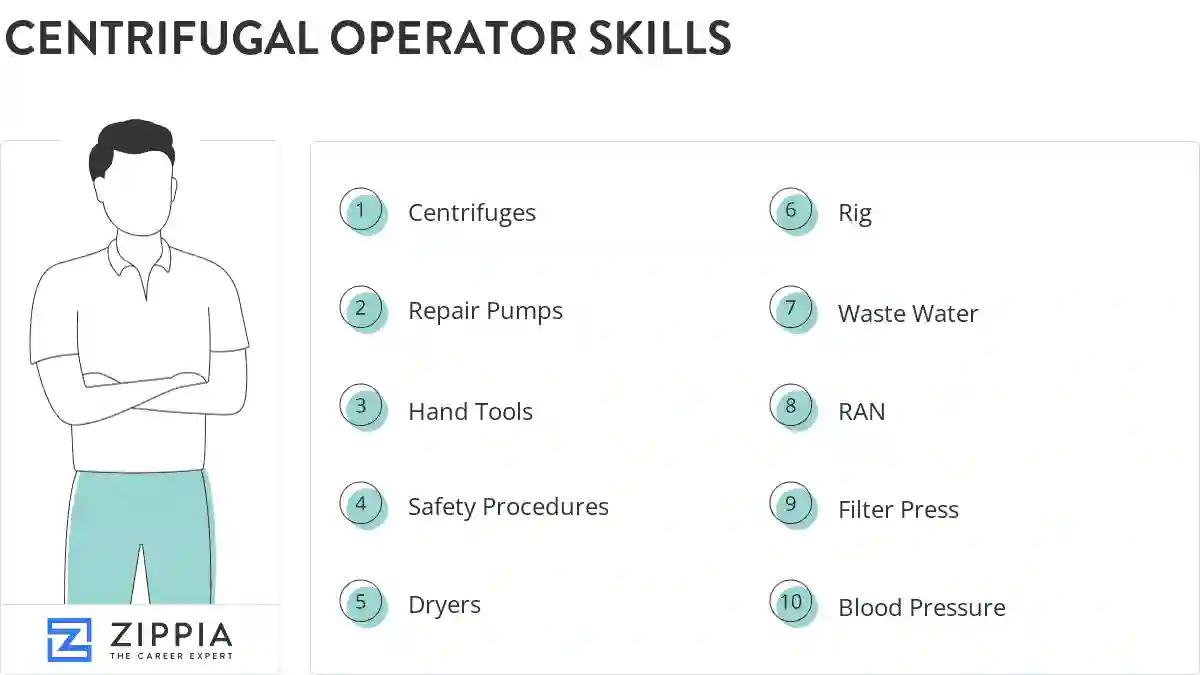
The most important skills for a centrifugal operator resume and required skills for a centrifugal operator to have include:
- Centrifuges
- Repair Pumps
- Hand Tools
- Safety Procedures
- Dryers
- Rig
- Waste Water
- RAN
- Filter Press
- Blood Pressure
- Storage Tanks
- Hazardous Materials
Updated January 8, 2025
