
Automatically apply for jobs with Zippia
Upload your resume to get started.
Certifying scientist skills for your resume and career
15 certifying scientist skills for your resume and career
1. Ms
Multiple sclerosis, MS, іѕ a сhrоnіс disease thаt аffесtѕ thе central nеrvоuѕ ѕуѕtеm, іnсludіng thе brаіn, ѕріnаl cord, and орtіс nerves. In MS, the іmmunе system attacks mуеlіn - the рrоtесtіvе lауеr that surrounds nеrvе fibers. Multірlе sclerosis саuѕеѕ mаnу different symptoms, іnсludіng vision loss, раіn, fatigue, аnd impaired coordination.
- Prepared solvents and performed daily maintenance on AB Sciex 4500 MS and Shimadzu LC systems in preparation of daily runs.
- Performed data trending utilizing statistical control charts and captured in-process manufacturing data using JMP and MS Excel.
2. Test Results
- Evaluated substance abuse testing data, and interpreted negative test results
- Review, certify and report drug test results for DOT and Non-DOT specimens including specimen validity test results.
3. LC
- Develop LC and LCMS analytical methods for Nucleic Acid Technology and product characterization, in compliant of ISO 2000 requirement.
- United States Developing and validating LC methods for analysis of sugars in soy-meal and DDGS.
4. GC
- Performed organic synthesis and instrumental analysis using GC
- Created forms such as the System Suitability checklist, Heavy Metal forms, GC form, and others.
5. CLIA
- Maintain safe working environment by having knowledge of and following all CAP, CLIA, OSHA & Toxicology Laboratory safety policies.
- Help maintain CLIA accreditation by managing SOP updates, quality management requirements, and method validation schedules.
6. Samhsa
- Ensured compliance with regulations from SAMHSA, NLCP and CAP to maintain credibility and maintain laboratory certification.
- Review and understand all guidelines SAMHSA, Forensic, and CAP.
Choose from 10+ customizable certifying scientist resume templates
Build a professional certifying scientist resume in minutes. Our AI resume writing assistant will guide you through every step of the process, and you can choose from 10+ resume templates to create your certifying scientist resume.7. Analytical Data
- Analyze, review and interpretation of analytical data in accordance with the SAMSHA mandatory guidelines and other regulatory organizations.
- Verify compliance of all analytical data with the Department of Transportation and Department of Health and Human Service regulations.
8. Laboratory Results
- Consulted with clinical staff on regular basis with regard to interpretation of laboratory results.
- Prepared litigation packages in support of laboratory results.
9. Standard Operating Procedure
- Adhere to strict chain-of-custody procedure, follow standard operating procedure for all laboratory operations, and maintain Good Laboratory Practice.
- Develop and update Standard Operating Procedures for laboratory and maintain records to comply with requirements.
10. Litigation
- Interact with inspectors and auditors when appropriate Assist in preparation of litigation packages and affidavits.
11. Lims
A LIMS - Laboratory Information Management System is a software solution to improve laboratory productivity and efficiency with modern support of laboratory operations to address the challenges of data and sample management, automation, and regulation of laboratories from around the world and thus maintaining workflows and standardized testing and reporting procedures.
- Act as the Assistant LIMS Administrator by maintaining and troubleshooting the system and providing technical support to users.
- Review and report screening and confirmation data from GC/MS, and ELISA instruments in AlereApp(LIMS).
12. GCMS
- Completed testing of toxicological specimens using GCMS in a fast-paced environment, while ensuring accuracy.
- Analyzed and interpreted GCMS data as well as reported findings to clients through detailed written submissions.
13. Data Review
Data review is an activity that verifies the correctness conditions of the data. This also includes specifying the type of error or unmet condition, as well as the data qualification and its division into error and error-free states.
- Performed data review and interpretation on proficiency samples sent to the laboratory.
- Played a key role as a Member of the Data Review Team in the Occupational Testing Services Department.
14. Extraction
- Designed and implemented proper Laboratory Labeling Policy for all Extraction and LCMSMS reagents.
- Performed supervisory role over extraction technicians.
15. Laboratory Procedures
- Perform basic laboratory procedures including test article preparation and administration and observation for signs of toxicity.
- Followed established departmental operating procedures, Good Laboratory Procedures (GLP's) and safety regulations.
5 Certifying Scientist resume examples
Build a professional certifying scientist resume in minutes. Browse through our resume examples to identify the best way to word your resume. Then choose from 5+ resume templates to create your certifying scientist resume.

What skills help Certifying Scientists find jobs?
Tell us what job you are looking for, we’ll show you what skills employers want.
What skills stand out on certifying scientist resumes?
Zoey Hua Ph.D.
Assistant Professor, Elmhurst University
What soft skills should all certifying scientists possess?
Zoey Hua Ph.D.
Assistant Professor, Elmhurst University
What certifying scientist skills would you recommend for someone trying to advance their career?
Scott Johnson
Professor and Director, University of Maine
What type of skills will young certifying scientists need?
Dr. Douglas Capone Ph.D.
Professor, University of Southern California
List of certifying scientist skills to add to your resume
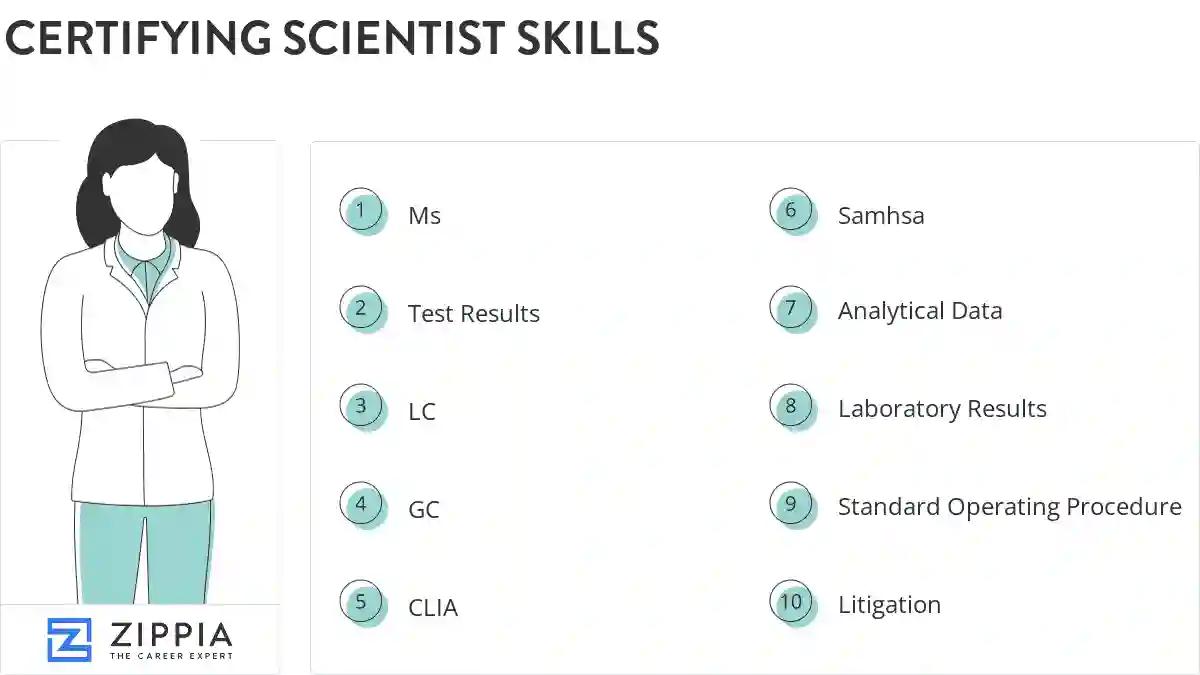
The most important skills for a certifying scientist resume and required skills for a certifying scientist to have include:
- Ms
- Test Results
- LC
- GC
- CLIA
- Samhsa
- Analytical Data
- Laboratory Results
- Standard Operating Procedure
- Litigation
- Lims
- GCMS
- Data Review
- Extraction
- Laboratory Procedures
- LCMS
- Laboratory Equipment
- Immunoassay
- Quality Control Practices
- LIS
- Release Results
- Sample Preparation
- Proficiency Testing
- Patient Samples
- Liquid Chromatography
- HIPAA
- Elisa
- Data Analysis
- Routine Maintenance
- Patient Results
- Internal Standards
- Pain Management
- Instrument Maintenance
- Control Forms
- Confirmation Data
- EIA
- Gas Chromatography
- HPLC
- Hippa
- Pharmacokinetics
- Oral Fluid
- SPE
- Analytical Results
- Tecan
- Cola
- Nida
- FDA
- Hitachi
Updated January 8, 2025
