
Automatically apply for jobs with Zippia
Upload your resume to get started.
Chemist lead skills for your resume and career
15 chemist lead skills for your resume and career
1. Laboratory Instruments
- Calibrate and perform Quality Control checks of laboratory instruments.
- Perform maintenance for laboratory instruments for HPLC.
2. Analytical Methods
An analytical method is a method used to determine the chemical or physical property of a substance. It is a procedure to determine the relationship between different variables. This method can be conducted by combining scientific methods with any kind of formal process to solve a problem or prove a fact.
- Train chemists and laboratory technicians on analytical methods.
- Oversee and optimize analytical methods.
3. R
R is a free software environment and a language used by programmers for statistical computing. The R programming language is famously used for data analysis by data scientists.
- Used R, SSL, and SQL programming to identify and fix multiple processing and GUI problems with StarLIMS v9.
- Guide & support Energy Services R, D&E to meet and prioritize business goals.
4. Method Development
- Conducted GC and GC/MS troubleshooting, maintenance, and method development on a routine basis.
- Assisted with Method Development for the TPAs.
5. Lab Equipment
- Performed lab equipment maintenance, daily check and scheduled monthly and annual calibration.
- Designed and fabricated pilot scale lab equipment simulating specific industrial processes to demonstrate the feasibility of novel chemical application concepts.
6. HPLC
- Conducted over 250,000 analysis using HPLC, GC/MS, GC/ECD, NMR, and other advanced scientific equipment.
- Lead the Wet Chemistry, GC, HPLC and LCMS department.
Choose from 10+ customizable chemist lead resume templates
Build a professional chemist lead resume in minutes. Our AI resume writing assistant will guide you through every step of the process, and you can choose from 10+ resume templates to create your chemist lead resume.7. Analytical Procedures
Through analytical procedures, auditors access and evaluate the financial information showcased by the financial statements, keeping in mind the concept that the provided financial information has a plausible relationship with the other's financial or non-financial data. It helps auditors pay more attention to sensitive areas and help them detect the risks of material misstatement.
- Performed and interpreted analytical procedures as necessary to support of the projects from various customers.
- Analyzed potable and non-potable water samples for microbiological and chemical parameters according to methods, implemented analytical procedures and interpreted/reported results.
8. GC
- Performed routine maintenance/troubleshooting on 5890 GC's with FID, PID, and ECD detectors.
- Change columns on GC's based on the requirements of different blends.
9. Ms
Multiple sclerosis, MS, іѕ a сhrоnіс disease thаt аffесtѕ thе central nеrvоuѕ ѕуѕtеm, іnсludіng thе brаіn, ѕріnаl cord, and орtіс nerves. In MS, the іmmunе system attacks mуеlіn - the рrоtесtіvе lауеr that surrounds nеrvе fibers. Multірlе sclerosis саuѕеѕ mаnу different symptoms, іnсludіng vision loss, раіn, fatigue, аnd impaired coordination.
- Studied etching products via ICP/MS for classification of chemicals and elemental composition through calculation and mathematical adjustments.
- Develop an MS ACCESS database to list all laboratory chemicals/standards/equipment/MSDS, and monitor inventory.
10. Analytical Support
Analytical support consists of categories that include logical reasoning, critical thinking, communication, research, data analysis, and creativity to break down information or something into parts or smaller categories to enhance understanding in order to draw conclusions.
- Conducted analyses of automatic transmission fluids and provided analytical support and expertise for development engineers.
- Delivered intermediate level of analytical support for raw materials, in-process and finished product testing.
11. Chemical Analysis
- Trained individuals and worked in all aspects of chemical analysis and handling of chemical warfare materials.
- Performed Chemical analysis on completed pharmaceutical products
12. Wet Chemistry
- Prioritize and manage raw material projects for all analysts in Wet Chemistry I.
- Run wet chemistry tests following all compendia (USP, EP, JP, ACS, BP).
13. Analytical Chemistry
- Provide technical support for the Analytical Chemistry Organization (ACO) Bioassay group.
- Provided subject matter expertise in analytical chemistry of chemical warfare agents and related compounds of interest for IC community client programs.
14. Sample Preparation
Sample preparation stands for the processes through which a sample is extracted from a bigger amount and prepared for analysis. The objective of sample preparation is to better analytical results without compromising the actual material's integrity.
- Provide effective training to Laboratory Technicians on Operating Instruments, Sample Preparation, Analysis, and reporting techniques.
- Conducted numerous environmental analyses including separation extractions, metals digestions, TCLP extractions, and volatile sample preparations.
15. GMP
GMP stands for Good Manufacturing Practice. It is a system that ensures that all products like food, beverages, and medicinal drugs that are produced comply with the quality standards. It helps in minimizing the risks and hazards that cannot be eliminated after the testing of final products.
- Performed work as a chemical analyst in a GMP production/ FDA regulated facility that manufactured pediatric and medical nutritional products.
- Performed calibration and qualification of equipment according to GMP procedures along with coordination of preventative and corrective maintenance work orders.
5 Chemist Lead resume examples
Build a professional chemist lead resume in minutes. Browse through our resume examples to identify the best way to word your resume. Then choose from 5+ resume templates to create your chemist lead resume.

What skills help Chemist Leads find jobs?
Tell us what job you are looking for, we’ll show you what skills employers want.
What skills stand out on chemist lead resumes?
Stephanie Hooper Marosek Ph.D.
Chair, Associate Professor, Methodist University
What soft skills should all chemist leads possess?
Dunwei Wang Ph.D.
Margaret A & Thomas A Vanderslice Chair in Chemistry, Professor of Chemistry, Chairperson of Chemistry Department, Boston College
What hard/technical skills are most important for chemist leads?
Dunwei Wang Ph.D.
Margaret A & Thomas A Vanderslice Chair in Chemistry, Professor of Chemistry, Chairperson of Chemistry Department, Boston College
What chemist lead skills would you recommend for someone trying to advance their career?
Peter Rosado
Associate Professor of Chemistry, Georgia College and State University
What type of skills will young chemist leads need?
Dr. Brian Augustine Ph.D.
Professor of Chemistry and Chair, High Point University
What technical skills for a chemist lead stand out to employers?
Dr. Paul Brandt
Professor of Chemistry, Chair, North Central College
List of chemist lead skills to add to your resume
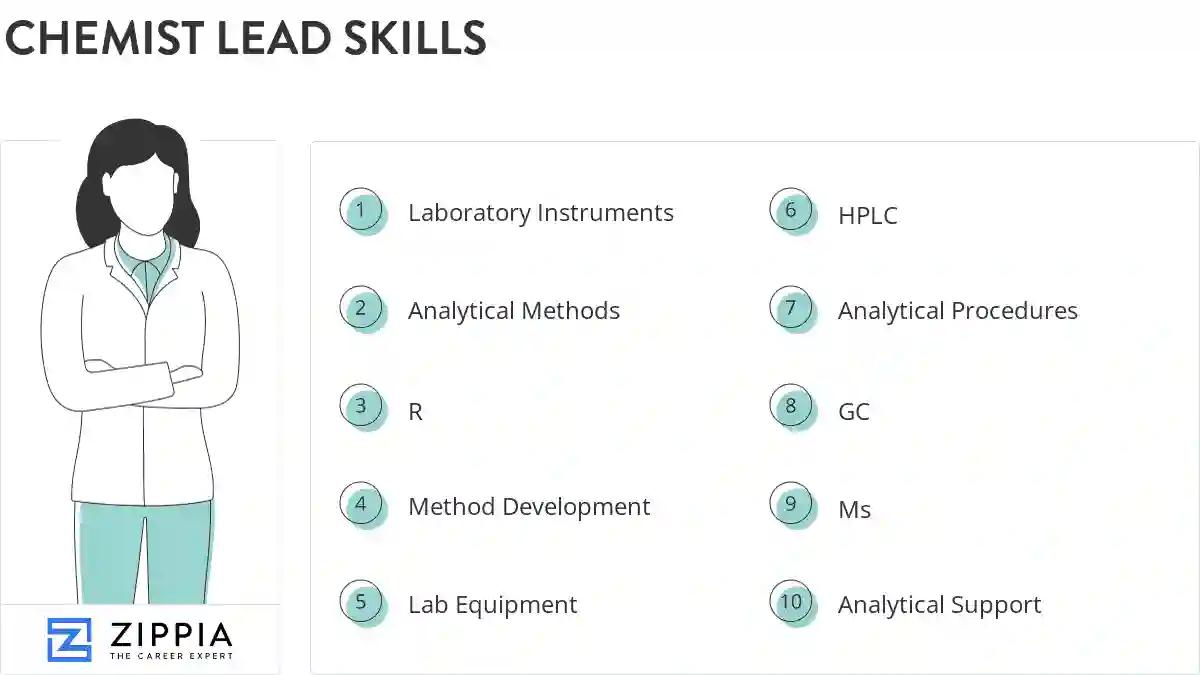
The most important skills for a chemist lead resume and required skills for a chemist lead to have include:
- Laboratory Instruments
- Analytical Methods
- R
- Method Development
- Lab Equipment
- HPLC
- Analytical Procedures
- GC
- Ms
- Analytical Support
- Chemical Analysis
- Wet Chemistry
- Analytical Chemistry
- Sample Preparation
- GMP
- Lims
- FTIR
- FDA
- ICP-MS
- USP
- ISO
- OOs
- Test Methods
- Analytical Data
- DOT
- GLP
- Analytical Laboratory
- ASTM
- AA
- Gas Chromatography
- Quantitative Analysis
- Stability Samples
- Absorption
- Hazardous Waste
- UV-Vis
- LC
- Analytical Instrumentation
- Method Validation
- Laboratory Operations
- Routine Maintenance
- IC
- FID
- IR
- Water Samples
- Regulatory Compliance
- Data Review
- Environmental Samples
- GDP
Updated January 8, 2025
