
Automatically apply for jobs with Zippia
Upload your resume to get started.
Circuit tester skills for your resume and career
12 circuit tester skills for your resume and career
1. Circuit Board Assembly
- Test electronic function of components preparatory to printed circuit board assembly for compliance to company standards using test equipment.
- Printed circuit board assembly and testing
2. Test Equipment
Test equipment is a mechanical tool or a device which is used create signals and gather response from an electronic device under test. It helps in detecting any faults in the device and it also proves the proper operation of the electronic device.
- Align specified test fixture in test equipment, secure PCBs on pins of test fixture.
- Test electronic circuits of Printed Circuit Boards (PCBs) using computerized test equipment.
3. RF
- Used RF system design, EMC, motor control, design team collaboration, and decision making abilities.
- Employed RF system, loop antenna design, data analysis, Excel, and Visual Basic skills.
4. Trouble Tickets
A trouble ticket is another term for a support/help ticket. At the point when a client or worker has an issue, they present a record, or ticket, to the IT group depicting their issue. The group records significant data on the ticket and uses it for correspondence between the client and the group.
- Resolved issue by assessment with questions, make trouble ticket, troubleshoot by isolating issues remotely using software tools i.e.
- Performed remote system circuit for the project in addition to completed remote testing for trouble ticket resolution.
5. In-Circuit
- Transitioned to in-circuit testing of completed circuit boards.
6. Test Fixtures
- Review test specifications to determine test fixtures required to test PCBs.
- Build test fixtures and assist engineers as needed.
Choose from 10+ customizable circuit tester resume templates
Build a professional circuit tester resume in minutes. Our AI resume writing assistant will guide you through every step of the process, and you can choose from 10+ resume templates to create your circuit tester resume.7. Test Results
- Reported test results back to management for further escalation.
- Furnish written and/or printouts of test results.
8. PCB
The PCB (Printed Circuit Board) refers to the hardware part housing all of the device's electrical connections.
- Operated large PCB Grid and Flying Probe testing machines and performed routine maintenance throughout production-related facilities.
- Performed testing PCB on HP 3070 Board test system, accomplished weekly test target, maintained on the ICT test fixture.
9. T1
- Salt Lake City, Utah Provided T1 and T3 troubleshooting, testing and maintenance to customers and field technicians.
- Organized daily schedule for assigned T1 circuit migrations into remote test units.
10. RAN
RAN stands for "revenue anticipation note," which refers to a practice where an organization (often the government) borrows money to support a specific project. When these funds are then repaid, the money given to the lenders comes from the profits generated by the business originally funded.
- Tested cell phone software, ran and maintained test plans.
- Programed circuit boards, and ran tests to verify the quality of the circuit boards.
11. Gauges
- Used handheld computers and pressure gauges.
12. Routine Maintenance
- Performed routine maintenance on machines nightly.

What skills help Circuit Testers find jobs?
Tell us what job you are looking for, we’ll show you what skills employers want.
List of circuit tester skills to add to your resume
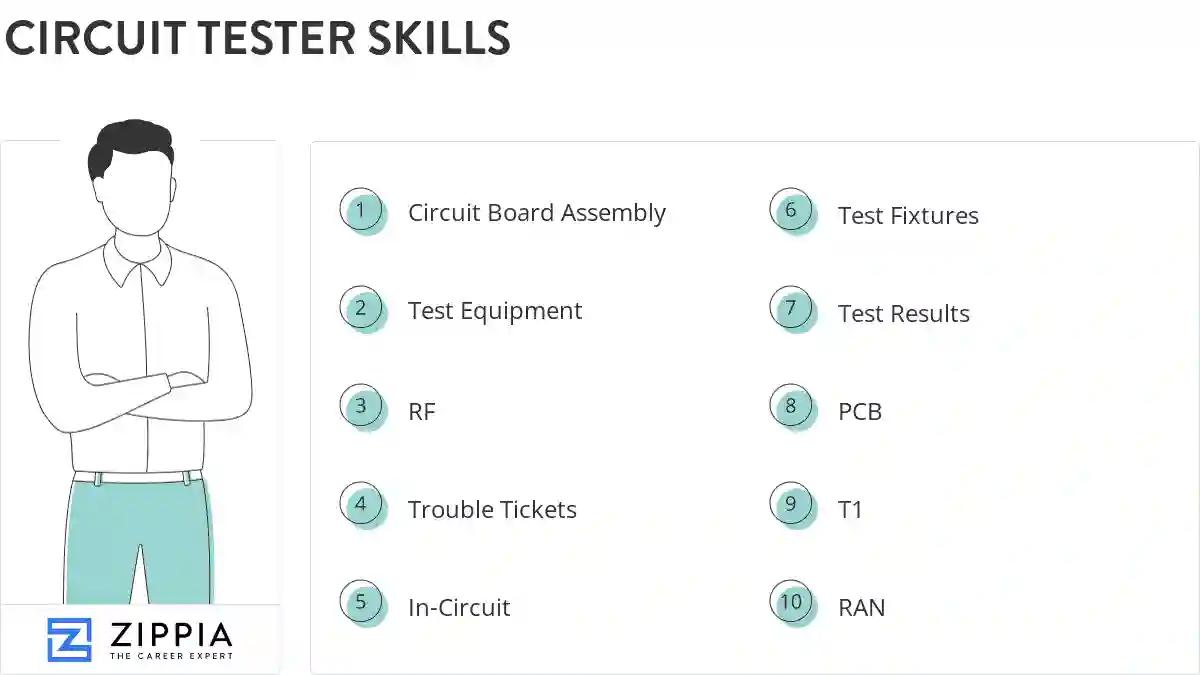
The most important skills for a circuit tester resume and required skills for a circuit tester to have include:
- Circuit Board Assembly
- Test Equipment
- RF
- Trouble Tickets
- In-Circuit
- Test Fixtures
- Test Results
- PCB
- T1
- RAN
- Gauges
- Routine Maintenance
Updated January 8, 2025
