
Automatically apply for jobs with Zippia
Upload your resume to get started.
Claims reviewer skills for your resume and career
15 claims reviewer skills for your resume and career
1. Home Health
- Reviewed Home Health claims prior to payment from Medicare.
- Work from home reviewing home health charts for Medicare
2. Insurance Claims
- Reviewed Insurance claims received from providers for accuracy in spelling and assurance of all required Insurance company payment submission requirements.
- Reviewed life insurance claims to determine eligible beneficiaries and benefit amount.
3. Data Entry
Data entry means entering data into a company's system with the help of a keyboard. A person responsible for entering data may also be asked to verify the authenticity of the data being entered. A person doing data entry must pay great attention to tiny details.
- Direct data entry of patient demographics and secondary insurance information to aid in the coordination of benefits process.
- General office duties including filing, copying, faxing, data entry and financial balancing of tax deferred accounts.
4. Medical Terminology
- Researched medical terminology, pharmaceuticals and prepared correspondence to communicate benefit determinations.
- Research of financial documents, medical terminology and pharmaceuticals.
5. CPT
CPT is a medical term that stands for Current Procedural Terminology. Whenever a procedure like surgery or diagnosis occurs or some other medical service is rendered to a patient, it is reported to the concerned physician, insurance company, or organization. The aforementioned practice is widely referred to as CPT.
- Requested further explanations or revisions of CPT codes of treatment from physicians; requested necessary paperwork or alternative insurance of patients.
- Analyze denials and partial payments and resubmit with appropriate ICD-9 and CPT codes to Insurance Carrier or Third Party Administrator.
6. Claims Submission
- Evaluated claims submissions and administered the completeness criteria to determine the expected outcome of required documentation.
- Reviewed claims submissions and made eligibility determinations based on information provided at time of review.
Choose from 10+ customizable claims reviewer resume templates
Build a professional claims reviewer resume in minutes. Our AI resume writing assistant will guide you through every step of the process, and you can choose from 10+ resume templates to create your claims reviewer resume.7. BP
- Review varies claims due to the BP oil incident submissions and applies completeness criteria to determine completeness of required documentation.
- Support BP Oil Settlement Litigation Claims by providing claims and quality assurance reviews for Coastal Real Property Damage Claims.
8. Medical Claims
- Review medical claims billed by various providers including anesthesiologists, physical therapists, radiologists, physicians and hospital inpatient/outpatient.
- Worked in a team environment to appropriately pay medical claims as related to automobile accident injuries.
9. Regular Quality Control
- Perform regular quality control of client databases through secondary review of claims information which may include correspondence to communicate benefit determinations.
- Perform regular quality control of client databases through secondary review of claims information.
10. CMS
A Content Management System or CMS is computer software that works as a framework where content can be assembled and managed by using a database. CMS is an important asset in web development. This platform enables users to create, edit, collaborate on, publish and store digital content. It helps users to manage their content and modify it from a single system.
- Maintain HIPAA Privacy and Security Rules and CMS security requirements.
- Reviewed and edited CMS 1500 forms with appropriate modifiers.
11. Loss Statements
- Reviewed tax documents, profit and loss statements, state sales and use records, rental property statements, commission statements.
- Reviewed financial documents such as Income Statement, Rental Statement, and Profit and loss statements to evaluate claims.
12. Oil Spill
- Analyze and enter financial documentation submitted in support of claims resulting from major environmental oil spill.
- Review policies and procedures related to tracking generated notices and performing quality control measures on Deep Water Horizon Oil Spill.
13. Computer System
- Enter claim payments, reserves and new claims with accompanying file documents into company computer system.
- Use of multiple computer systems simultaneously while providing customer service via phone.
14. Medical Necessity
- Review claims for medical necessity and ensure that they meet NCCI clinical editing requirements.
- Used Milliman medical necessity criteria to validate medical necessity and appropriateness of charges.
15. Medicaid
- Prepared claims for coordination of benefits with Medicare and Medicaid secondary payers.
- Reviewed incoming documentation for Medicaid reimbursement on a per batch basis.
5 Claims Reviewer resume examples
Build a professional claims reviewer resume in minutes. Browse through our resume examples to identify the best way to word your resume. Then choose from 5+ resume templates to create your claims reviewer resume.

What skills help Claims Reviewers find jobs?
Tell us what job you are looking for, we’ll show you what skills employers want.
List of claims reviewer skills to add to your resume
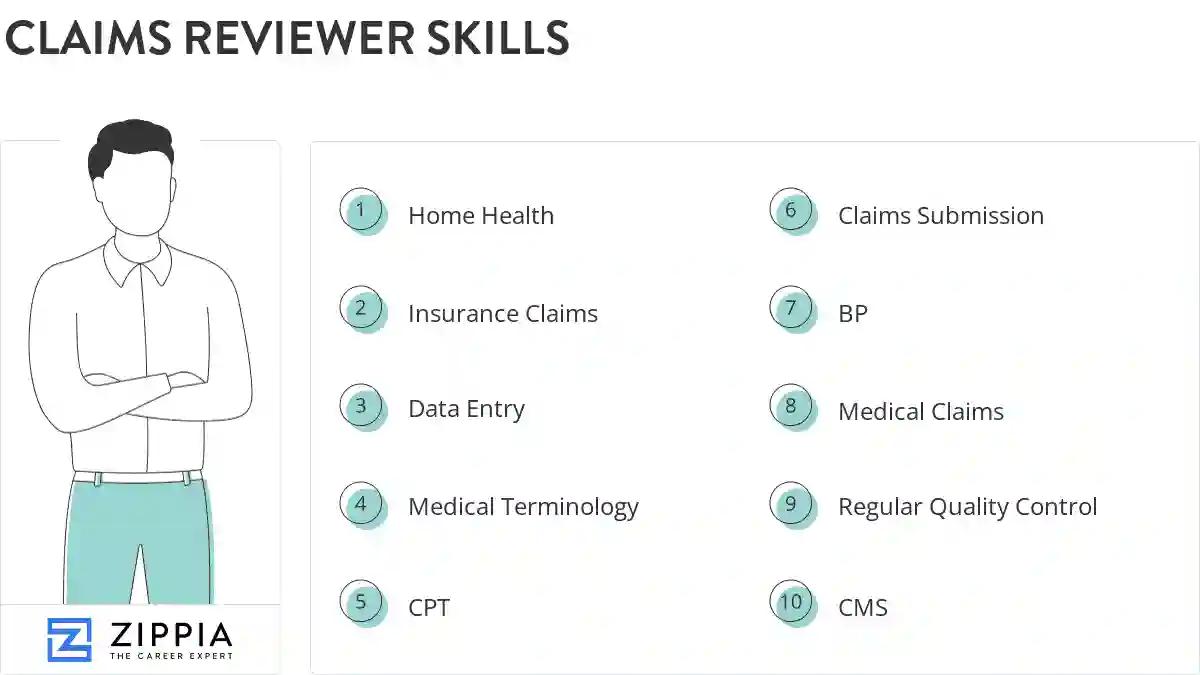
The most important skills for a claims reviewer resume and required skills for a claims reviewer to have include:
- Home Health
- Insurance Claims
- Data Entry
- Medical Terminology
- CPT
- Claims Submission
- BP
- Medical Claims
- Regular Quality Control
- CMS
- Loss Statements
- Oil Spill
- Computer System
- Medical Necessity
- Medicaid
- Client Database
- ICD-9
- Secondary Review
- Fee Schedules
- Value Claims
- Federal Laws
- Horizon
- Financial Data
- Claims Data
- Law Firm
- Complete Review
- Scra
- Tax Returns
- OCC
- AS400
- Medical Bills
- HMO
- Compensation Claims
- Dental Claims
- Financial Analysis
- Procedure Codes
- DRG
- Federal Regulations
- PPO
- Loss Mitigation
- Interrogatories
- LPS
Updated January 8, 2025
