
Automatically apply for jobs with Zippia
Upload your resume to get started.
Classification analyst skills for your resume and career
15 classification analyst skills for your resume and career
1. US Customs
The US Customs and Border Protection is the United State's most prominent law enforcement agency in charge of border control, security, travel, and trade. It is responsible for enforcing government regulations on border-related activities. Their jobs include enforcing laws on traveling overseas, luggage inspection, import/export monitoring, and border patrol. The agency is based in Washington DC and comprises over 4000 federals officers maintaining peace throughout the states.
- Performed extensive data entry and indexing of documents into the required cases in order to expedite US Customs clearance.
- Process shipments to cross the border within the time frames sent by Livingston and US Customs.
2. Data Entry
Data entry means entering data into a company's system with the help of a keyboard. A person responsible for entering data may also be asked to verify the authenticity of the data being entered. A person doing data entry must pay great attention to tiny details.
- File break/down, classifying data entry, photocopying, scanning and assembling of entries.
- Managed the quality control of these databases by implementing standard operating procedures in data entry and maintenance.
3. Government Agencies
- Coordinated with government agencies, transport companies and clients, both domestic and international, on numerous import and export topics.
- Work with Federal Express, Customs, and other government agencies to facilitate the release of imported merchandise.
4. CBP
Customs and Border Protection (CBP) is a law enforcement organization that is responsible for the regulation of all shipped goods to the United States. The CBP enables lawful trade by collecting necessary import duties and scrutinizing cargo when needed. The criminal fraud statute offers sanctions to those who submit false information to customs officers, in addition to the civil penalties.
- Prepare, Analyze, Submit Documentation to (U.S. Customs and Border Protection (CBP) agents, and Federal Gov.
- Interpreted regulations and provided divisional guidance for risk analysis with CBP.
5. HTS
- Review documents for accuracy prior to entry (Country of Origin, Value, HTS Codes, etc.
- Assist with HTS classification for 26 different countries (e.g.
6. Import Export
- Analyze import export documents received from carriers and submit to U.S. Customs Border Prrotection for the importation of goods/merchandise.
Choose from 10+ customizable classification analyst resume templates
Build a professional classification analyst resume in minutes. Our AI resume writing assistant will guide you through every step of the process, and you can choose from 10+ resume templates to create your classification analyst resume.7. Customs Regulations
- Handled manual preparation ensuring compliance with customs regulations and admissibility.
- Consult the HTSUS and Customs Regulations to define and back my findings on legal ground.
8. Tariff Schedule
- Analyze product information and assign Harmonized Tariff Schedule Numbers.
- Possess a working knowledge of the tariff schedules, classifications and billing records as well as input requirements and company policy.
9. Salary Surveys
- Complete, review, analyze, and interpret salary surveys pertinent to University of Florida.
- Prepare, create and complete salary surveys; analyze results.
10. Insurance Carriers
- Interfaced with insurance carriers, agents and insured's daily.
- Consulted with insurance carriers on worker's compensation rates
11. Bonds
- Transmit Bonds with and without FDA Prior Notice.
- Arranged for payments of duties, taxes, storage and transportation of imported goods and bonds.
12. FDA
The Food and Drug Administration (FDA) is a division of the US Department of Health and Human Services that regulates the production and sale of food, pharmaceutical products, medical equipment, and other consumer goods, as well as veterinary medicine. The FDA is now in charge of overseeing the manufacture of products like vaccines, allergy treatments, and beauty products.
- Developed a written procedure for associates handling FDA files.
- Generate our FDA report and submit required docs to FDA ports * Post faxes to secured website of statements/invoices.
13. Classification Determinations
- Hand-selected to review inspection reports, determine appropriate business operations based on inspection findings and update database with classification determinations.
- Processed inspection reports, classification correspondence, audit classifications, and classification determinations and disputes.
14. Compensation Data
- Prepared statistical reports, graphs, charts, and other analytical reports for compensation data and build complex spreadsheets.
15. ITAR
- Export specialist ITAR invoices Work with billing invoices and an Excel sheet with monthly process as backup.
5 Classification Analyst resume examples
Build a professional classification analyst resume in minutes. Browse through our resume examples to identify the best way to word your resume. Then choose from 5+ resume templates to create your classification analyst resume.

What skills help Classification Analysts find jobs?
Tell us what job you are looking for, we’ll show you what skills employers want.
What skills stand out on classification analyst resumes?
David Feldman Ph.D.
Professor of Urban Planning and Public Policy and Political Science, Director, Water UCI, Director, MPP Program, University of California, Irvine
List of classification analyst skills to add to your resume
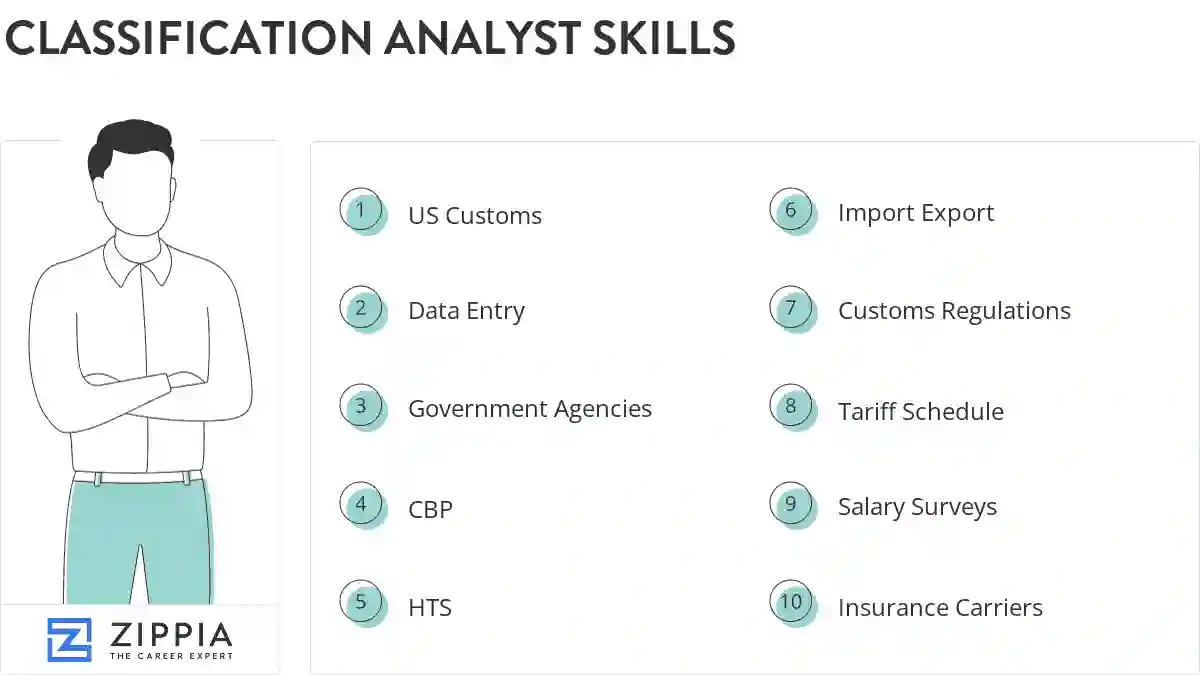
The most important skills for a classification analyst resume and required skills for a classification analyst to have include:
- US Customs
- Data Entry
- Government Agencies
- CBP
- HTS
- Import Export
- Customs Regulations
- Tariff Schedule
- Salary Surveys
- Insurance Carriers
- Bonds
- FDA
- Classification Determinations
- Compensation Data
- ITAR
- Forwarders
- Customs Brokers
- Classification System
- FTA
- ACE
- Export Compliance
- Classification Issues
- Equities
- Inspection Reports
- ECCN
- Position Classification
- FLSA
- Engineering Systems
- BOM
- Tariff Codes
- Quality Standards
- HR
- Customs Entries
- Government Regulations
Updated January 8, 2025
