What does a classification officer do?
A Classification Officer interviews, evaluates, and assesses the inmates' needs and risks and makes reliable housing assignments so that the jail can provide a safe environment. They question inmates to discover special needs like disability and more. Besides evaluating known risk factors, these professionals also monitor all risk status changes. They go through jail reports and criminal history records relating to the inmates' past safety concerns and behavior. Furthermore, Classification Officers keep accurate records for classification systems, monitoring, and proper documentation.
Classification officer responsibilities
Here are examples of responsibilities from real classification officer resumes:
- Analyze and send release/entry data to CBP via ABI.
- Develop a written procedure for associates handling FDA files.
- Balance and report daily inmate count for the correctional facility.
- Transmit accurate FDA information with and without FDA prior notice.
- Retrieve cmis agendas & process call-outs on Monday for Thursday committee.
- Organize and prioritize FTA requests provide by client and shipment reports.
- Enter all restraining orders process at the courts; knowledgeable in NCIC warrant system.
- Draft meeting agendas, supply advance materials, and execute follow-up for meetings and team conferences.
- Arrange for payments of duties, taxes, storage and transportation of import goods and bonds.
- Classify products and technical data as required by assigning HSUSN, ECCN, and country of origin.
- Write complex reports to define appropriate job classification, FLSA, and other job factors depending upon client need.
- Determine FLSA exemption for non-faculty staff positions.
- Conduct warrants checks, run criminal histories, and conduct FCIC/NCIC checks.
- Monitor correctional counselor caseloads to ensure timely and proper completion of inmate classification.
- Perform basic first aid procedures and cardiopulmonary resuscitation on the floor as needed.
Classification officer skills and personality traits
We calculated that 20% of Classification Officers are proficient in Telephone Inquiries, Correctional Facilities, and Background Checks. They’re also known for soft skills such as Physical strength, Interpersonal skills, and Detail oriented.
We break down the percentage of Classification Officers that have these skills listed on their resume here:
- Telephone Inquiries, 20%
Responded to inmate requests, correspondence and telephone inquiries from family, law enforcement and attorneys.
- Correctional Facilities, 9%
Maintain the safety of inmates and staff at correctional facilities and detention centers.
- Background Checks, 9%
Performed approved criminal history background checks both inter and intrastate levels.
- Mental Health, 8%
Coordinated security, medical, mental health, educational, religious, and work assignment issues with appropriate department personnel.
- Classification System, 7%
Assisted in the implementation of a new fact based classification system to house inmates more objectively.
- Law Enforcement Agencies, 7%
Communicated effectively with federal, state, and local law enforcement agencies to verify pending and closed charges.
Common skills that a classification officer uses to do their job include "telephone inquiries," "correctional facilities," and "background checks." You can find details on the most important classification officer responsibilities below.
Physical strength. The most essential soft skill for a classification officer to carry out their responsibilities is physical strength. This skill is important for the role because "correctional officers and bailiffs must be able to physically subdue people as necessary, including those in or visiting penal institutions and those attending court proceedings." Additionally, a classification officer resume shows how their duties depend on physical strength: "examine custodies ability to adjust to incarceration based on past and present charges, mental health issues, and physical health. "
Interpersonal skills. Another essential skill to perform classification officer duties is interpersonal skills. Classification officers responsibilities require that "correctional officers and bailiffs must be able to interact and communicate effectively with people in custody, visitors, and other officers of penal institutions and the court to maintain order." Classification officers also use interpersonal skills in their role according to a real resume snippet: "developed interpersonal relationships with juvenile offenders in educational, recreational and other growth or therapeutic activities. "
Detail oriented. Another skill that relates to the job responsibilities of classification officers is detail oriented. This skill is critical to many everyday classification officer duties, as "correctional officers and bailiffs follow and enforce procedures in correctional facilities and courts to ensure safety." This example from a resume shows how this skill is used: "recommend appropriate work detail, rehabilitation programs, activities, social services and psychological treatments required by the inmates/residents. "
The three companies that hire the most classification officers are:
- My Florida Regional Mls6 classification officers jobs
- ManTech5 classification officers jobs
- Parsons4 classification officers jobs
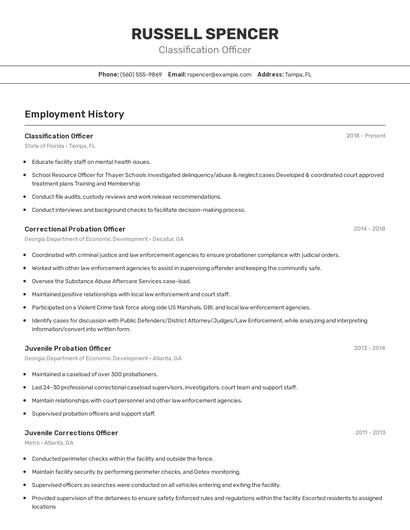
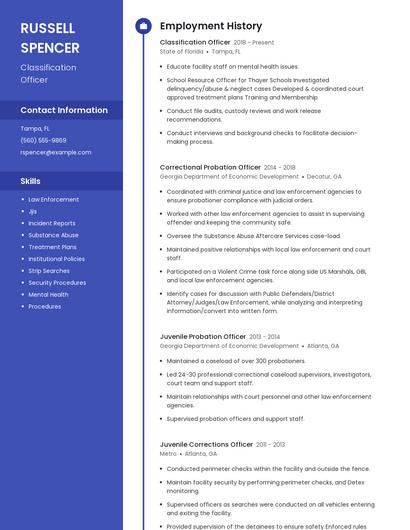
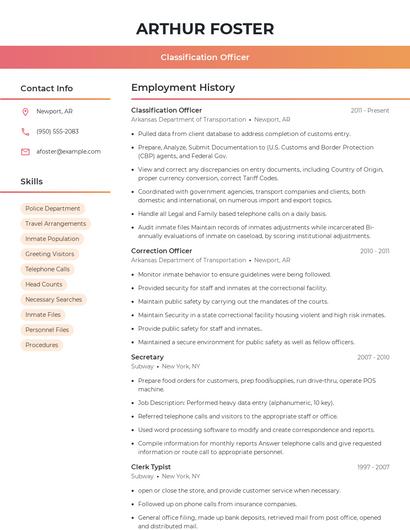
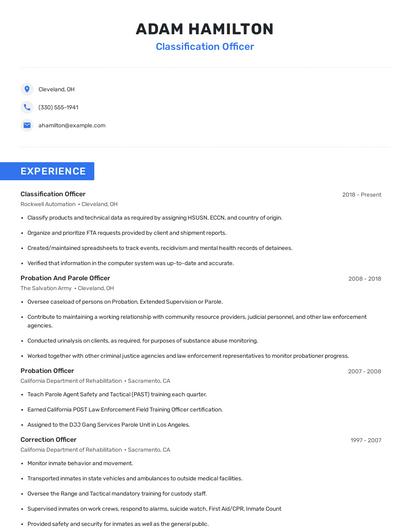
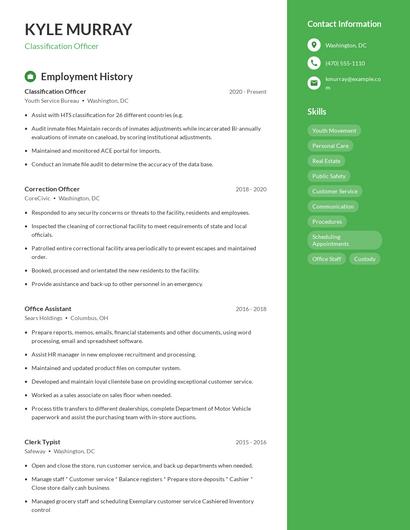
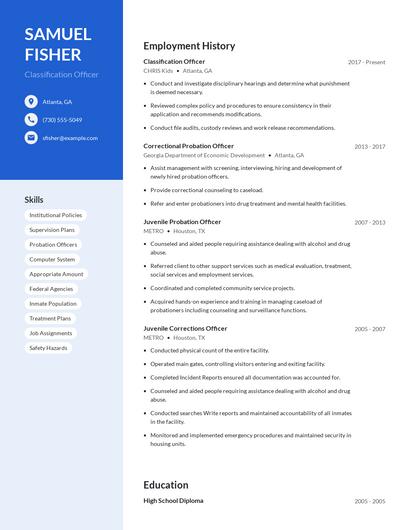
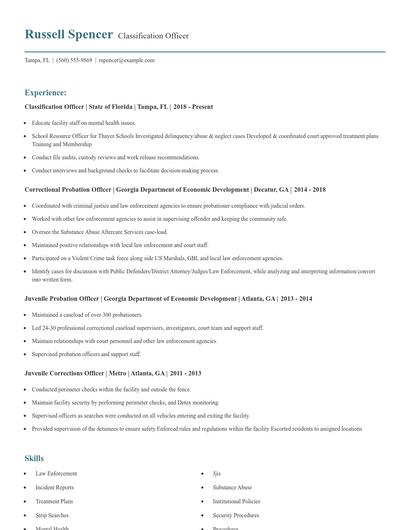
Choose from 10+ customizable classification officer resume templates
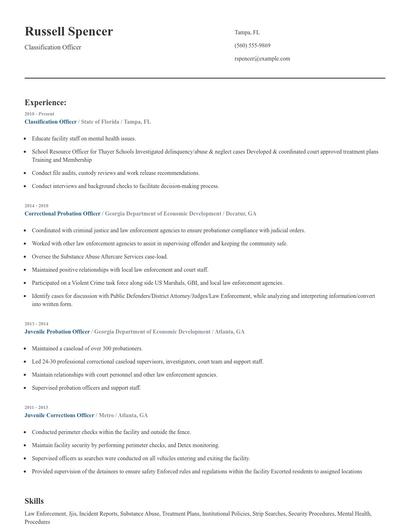
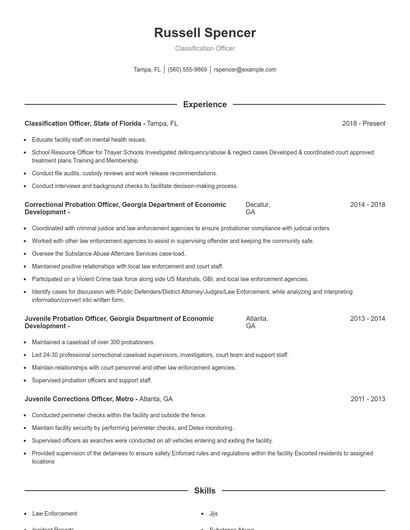
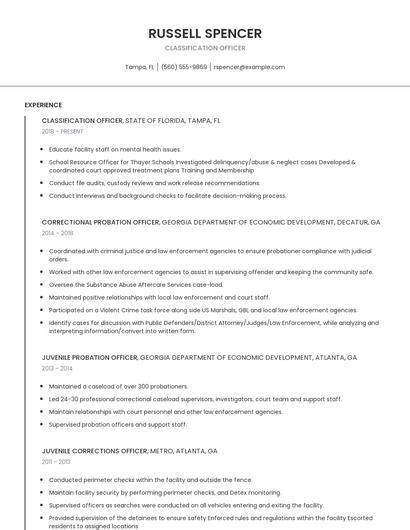
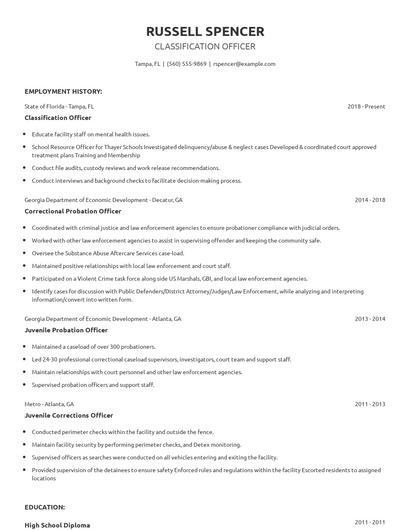
Build a professional classification officer resume in minutes. Our AI resume writing assistant will guide you through every step of the process, and you can choose from 10+ resume templates to create your classification officer resume.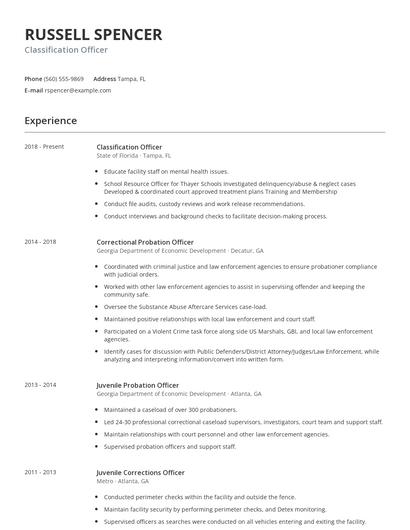
Compare different classification officers
Classification officer vs. Corporal
A police corporal is a person who leads a team or squad depending on how many corporals are there in a platoon. Police corporals supervise the performance of the police personnel assigned under their command. They are tasked to oversee, train, organize, and direct the activities of law enforcement personnel. It is their duty to take care of and observe the conduct of soldiers. Their leadership role is necessary and maintained on and off the battlefield.
There are some key differences in the responsibilities of each position. For example, classification officer responsibilities require skills like "telephone inquiries," "criminal justice," "federal laws," and "correctional facilities." Meanwhile a typical corporal has skills in areas such as "public safety," "combat," "non," and "vehicle maintenance." This difference in skills reveals the differences in what each career does.
Corporals tend to make the most money working in the government industry, where they earn an average salary of $54,916. In contrast, classification officers make the biggest average salary, $39,972, in the energy industry.On average, corporals reach lower levels of education than classification officers. Corporals are 5.5% less likely to earn a Master's Degree and 0.8% less likely to graduate with a Doctoral Degree.Classification officer vs. Deputy jailer
Each career also uses different skills, according to real classification officer resumes. While classification officer responsibilities can utilize skills like "telephone inquiries," "criminal justice," "federal laws," and "background checks," deputy jailers use skills like "booking," "emergency situations," "control room," and "incident reports."
Deputy jailers earn lower levels of education than classification officers in general. They're 8.2% less likely to graduate with a Master's Degree and 0.8% less likely to earn a Doctoral Degree.Classification officer vs. Jailer
Some important key differences between the two careers include a few of the skills necessary to fulfill the responsibilities of each. Some examples from classification officer resumes include skills like "telephone inquiries," "criminal justice," "federal laws," and "mental health," whereas a jailer is more likely to list skills in "transport inmates," "booking," "security checks," and "emergency first aid. "
Jailers typically earn lower educational levels compared to classification officers. Specifically, they're 8.3% less likely to graduate with a Master's Degree, and 0.9% less likely to earn a Doctoral Degree.Classification officer vs. Matron
Types of classification officer
Updated January 8, 2025
