Explore jobs
Find specific jobs
Explore careers
Explore professions
Best companies
Explore companies
Job outlook for client technical specialists in the United States
Are client technical specialist jobs in demand?
Client technical specialist job and salary trends over time
Client technical specialist jobs over time
Client technical specialist job growth rate over time
| Year | # of jobs | % of population |
|---|---|---|
| 2021 | 150 | 0.00% |
| 2020 | 151 | 0.00% |
| 2019 | 182 | 0.00% |
| 2018 | 96 | 0.00% |
| 2017 | 94 | 0.00% |
Average client technical specialist salary over time
Client technical specialist salary by year
| Year | Avg. salary | Hourly rate | % Change |
|---|---|---|---|
| 2026 | $83,205 | $40.00 | +3.4% |
| 2025 | $80,464 | $38.68 | +2.3% |
| 2024 | $78,642 | $37.81 | +1.5% |
| 2023 | $77,454 | $37.24 | +1.7% |
| 2022 | $76,189 | $36.63 | +1.6% |
Client technical specialist jobs by state
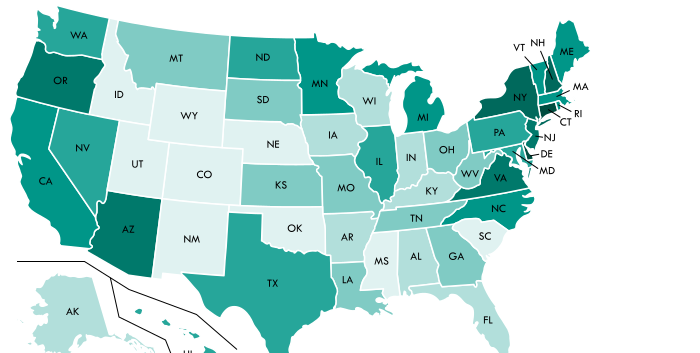
Most common states for client technical specialists
| Rank | State | Population | # of jobs | Employment/ 1000ppl |
|---|---|---|---|---|
| 1 | District of Columbia | 693,972 | 557 | 80% |
| 2 | Delaware | 961,939 | 292 | 30% |
| 3 | Minnesota | 5,576,606 | 1,589 | 28% |
| 4 | North Dakota | 755,393 | 214 | 28% |
| 5 | Wyoming | 579,315 | 160 | 28% |
| 6 | Colorado | 5,607,154 | 1,477 | 26% |
| 7 | Nebraska | 1,920,076 | 502 | 26% |
| 8 | Vermont | 623,657 | 157 | 25% |
| 9 | Illinois | 12,802,023 | 3,117 | 24% |
| 10 | Massachusetts | 6,859,819 | 1,665 | 24% |
| 11 | Alaska | 739,795 | 181 | 24% |
| 12 | Iowa | 3,145,711 | 732 | 23% |
| 13 | Kansas | 2,913,123 | 656 | 23% |
| 14 | Maine | 1,335,907 | 301 | 23% |
| 15 | Georgia | 10,429,379 | 2,284 | 22% |
| 16 | Montana | 1,050,493 | 227 | 22% |
| 17 | South Dakota | 869,666 | 193 | 22% |
| 18 | Virginia | 8,470,020 | 1,772 | 21% |
| 19 | Utah | 3,101,833 | 640 | 21% |
| 20 | Connecticut | 3,588,184 | 725 | 20% |
Most common cities for client technical specialists
| Rank | City | # of jobs | Employment/ 1000ppl | Avg. salary |
|---|---|---|---|---|
| 1 | Eugene | 1 | 1% | $102,908 |
| 2 | Chicago | 1 | 0% | $86,652 |
| 3 | Los Angeles | 1 | 0% | $90,465 |
| 4 | Orlando | 1 | 0% | $75,851 |
Client Technical Specialist job outlook: Expert opinions
Our panel of client technical specialist experts

California State University - Long Beach
Dominican University
What will help Client Technical Specialists increase their earning potential?
Jason Nichols PhD: Build your experience base through internships and industry projects, and brag about these experiences when you interview. Collect professional certificates to compliment your degree. Security and cloud computing are excellent areas to pursue these in right now. AI and machine learning as well, of course. Build a structured skillset in problem solving and critical thinking, and demonstrate this skillset in your discussions with future employers. Map all of these efforts into a coherent story about yourself in your applications, and how they have shaped you to be a tech-savvy business problem solver, with a strong understanding of both the business and the technology. This foundation prepares you for so very many roles in our field, and businesses recognize and actively seek out this profile in their job candidates. Use the resources available to you. If you need additional time for more formal training, join a masters program. Join us for a masters program, actually. Our AI in Business masters program is launching this Fall, and is open for enrollment currently. Visit us here to learn more: https://wpcarey.asu.edu/masters-programs/ai-business
What are the biggest trends we'll see in the Client Technical Specialist job market given the pandemic?
Dr. Lesley Farmer: Many employees have trouble pivoting to online work so in the short term, tech support and instructional design jobs are in high demand. Data privacy and security are also hot topics and need ed tech expertise. Tech maintenance, including cloud services and networks, continue to be needed, rather like car maintenance. Thinking forward, software development is another area of need, particularly with more online-based education. If grads have data analytics expertise, they can find jobs on data management and learning analytics.
Disabilities continue to be an issue, particularly in terms of equity, so jobs dealing with assistive technology and other ed tech supports are possible. Finally, grads should broaden their concept of educational settings; informal education is more important than ever: in business/HR, libraries and museums, recreational and youth-serving clubs, mass media, government and non-profit agencies. All of these entities are involved in training, outreach, PR, and public awareness/education. Be creative and persistent.
What general advice would you give to a Client Technical Specialist?
Dr. Lesley Farmer: Get to know the site before interviewing, and remember that even interviews are an opportunity to practice communication skills-and to see if there's a good match between you and the site. Once hired, learn about the organizational culture and develop trustful relationships. Make one memorable contribution the first month, but focus on becoming an expert before changing others. In addition, join a local and national professional association to keep current and network.
What Client Technical Specialist skills would you recommend for someone trying to advance their career?
Dr. Lesley Farmer: Internships are probably the best option, even if unpaid. Some institutions provide career placement services, and grads could contact their instructors about possible options. Companies, professional associations, and non-profits also advertise internships.
What are the biggest trends we'll see in the Client Technical Specialist job market given the pandemic?
Kate Marek Ph.D.: Probably an acceleration of existing trends - remote working, skill-set based job openings (rather than degree-specific), along with an ongoing need for necessary skills such as writing, problem-solving, collaboration, and project management.
What Client Technical Specialist skills would you recommend for someone trying to advance their career?
Kate Marek Ph.D.: If possible, find a paid internship in your area of interest, which will help expand your professional network and build your skillset. Use this time to keep scanning job ads to identify skill sets in demand; look for online mini-courses to make those skill sets.
What general advice would you give to a Client Technical Specialist?
Kate Marek Ph.D.: Choose an organization in tune with one's values. Look for a job in growth areas, such as data asset management, data analysis, etc.