
Automatically apply for jobs with Zippia
Upload your resume to get started.
Clinical audiologist skills for your resume and career
15 clinical audiologist skills for your resume and career
1. Patients
- Functioned as a Staff Audiologist in a University Hospital performing comprehensive diagnostic audiological service for in and out patients.
- Provided state-of-the-art amplification services for adult and geriatric patients in-house and in association with Connecticut Vocational Rehabilitation Services.
2. Rehabilitation
- Provided post sales assistance in auditory rehabilitation to necessary individuals.
- Provided habilitation / rehabilitation and determined candidacy potential for adult cochlear implant recipients for the three major implant manufacturers.
3. Hearing Loss
Ranging from mild to profound, hearing loss is the loss of hearing in one or both ears. This condition can affect a person of any age, and it has many causes, but it mainly affects individuals older than 60.
- Counseled parents of young children and adults about hearing loss and educated them on intervention and the aural rehab process.
- Treat and manage adults who have hearing loss and/or tinnitus with most current hearing aid technology and accessories.
4. Test Results
- Analyzed test results and wrote reports with findings, analysis and recommendations.
- Prepared written reports of diagnostic test results and recommendations and referred to the appropriate professionals regarding patient care and management.
5. Listening Devices
- Dispense appropriate amplification: hearing aids and assistive listening devices utilizing NOAH 3 software.
- Dispense assistive listening devices and hearing instrument accessories including Bluetooth compatible aids.
6. Nose
The nose is the primary body part involved in the breathing process and responsible for the sense of smell. When air comes into the human body through the nose, the brain can identify its smell. Since it is a passageway for the air, dust particles are also bound to get in. The nose hair tackles this issue and ensures only clean air passes by. Noses are also prone to some common problems. These include congestion and inflammation caused by allergies, flu, diseases, cold or other environmental or medical factors. Nosebleeds is another common issue experienced by around 60% of people.
- Worked in a hospital, private audiology practice and Ear, Nose & Throat doctor's office.
Choose from 10+ customizable clinical audiologist resume templates
Build a professional clinical audiologist resume in minutes. Our AI resume writing assistant will guide you through every step of the process, and you can choose from 10+ resume templates to create your clinical audiologist resume.7. Audiological Evaluations
- Conducted comprehensive audiological evaluations for pediatric and adult populations.
- Provided medical audiological evaluations and hearing aid dispensing.
8. VNG
- Incorporated Dix Hallpike, Epley maneuver and videonystagmography (VNG) testing to effectively diagnose and treat balance disorders.
- Assess the function of the vestibular system by performing Videonystagmagraphy (VNG) and Electrocochleography (ECOG).
9. ENG
- Conducted auditory brainstem response (ABR) and electronystagmography (ENG) testing.
- Administered and analyzed ABR and ENG tests.
10. Audiometry
- Performed audiologic evaluations including COR, VRA, play audiometry and Auditory Processing tests.
- Conducted basic diagnostic testing procedures including pure tone audiometry, play audiometry, VRA, immittance, and DP OAE testing.
11. Audiological Services
- Provided clinical in-patient and out-patient audiological services to pediatric through geriatric population.
- Schedule appointments for audiological services.
12. Balance Disorders
- Perform electrophysiological testing on adults to assess hearing and balance disorders.
- Educate medical residents & other professionals on the identification & (re)habilitation of hearing & balance disorders.
13. Pure Tone
- Performed diagnostic hearing evaluations including video otoscopy and pure tone and speech audiometry.
- Executed pure tone, speech, behavioral observation and immittance audiometry to measure hearing acuity.
14. Auditory Brainstem
- Conducted comprehensive hearing evaluations and auditory brainstem response in a private practice setting.
- Conducted diagnostic auditory brainstem response tests upon referral from physicians.
15. Otoacoustic Emissions
- Performed audiometric testing in a family owned hearing aid center including otoacoustic emissions, tympanometry and acoustic reflex testing
- Performed otoacoustic emissions on newborns and infants.
5 Clinical Audiologist resume examples
Build a professional clinical audiologist resume in minutes. Browse through our resume examples to identify the best way to word your resume. Then choose from 5+ resume templates to create your clinical audiologist resume.

What skills help Clinical Audiologists find jobs?
Tell us what job you are looking for, we’ll show you what skills employers want.
What skills stand out on clinical audiologist resumes?
Susan Naidu Ph.D.
AuD Program Director, Professor (Clinical), Assistant Chair, University of Utah
What soft skills should all clinical audiologists possess?
Susan Naidu Ph.D.
AuD Program Director, Professor (Clinical), Assistant Chair, University of Utah
What hard/technical skills are most important for clinical audiologists?
Susan Naidu Ph.D.
AuD Program Director, Professor (Clinical), Assistant Chair, University of Utah
What clinical audiologist skills would you recommend for someone trying to advance their career?
Sadie Braun
Clinical Assistant Professor – Audiology Clinic Coordinator and Coordinator of AuD Student Experiences, University of Illinois at Urbana-Champaign
Marketing/business skills and ability to connect with/volunteer in the local community.
A good understanding of reimbursement/insurance models in Communication Sciences and Disorders
List of clinical audiologist skills to add to your resume
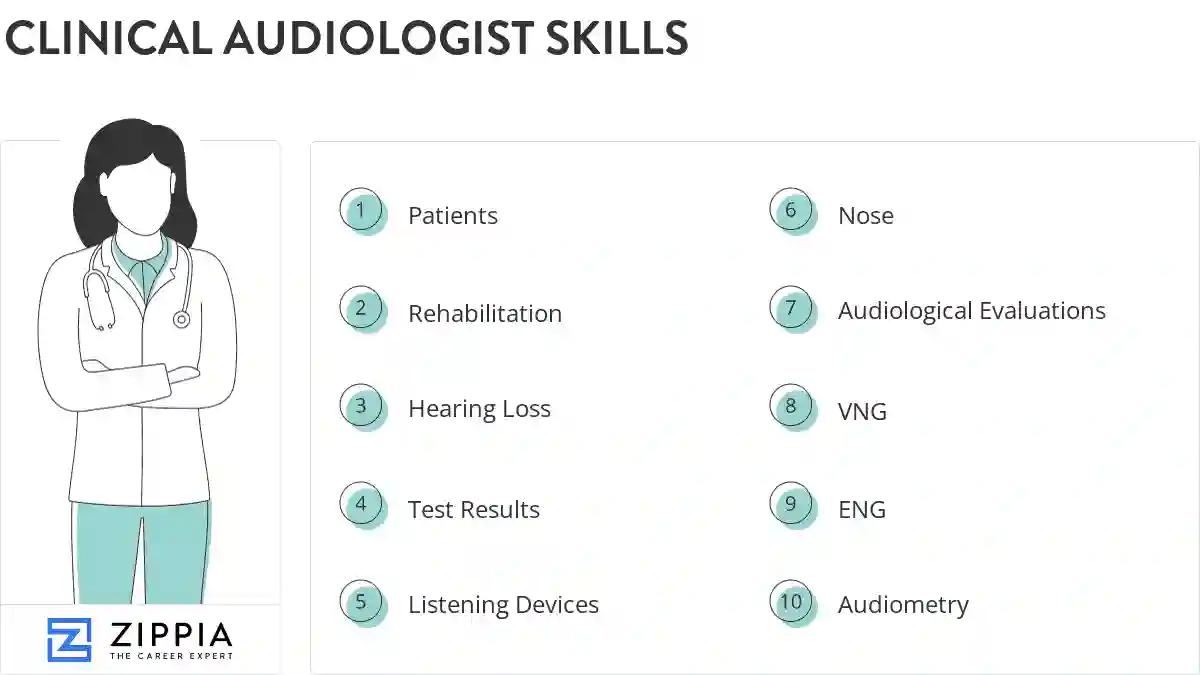
The most important skills for a clinical audiologist resume and required skills for a clinical audiologist to have include:
- Patients
- Rehabilitation
- Hearing Loss
- Test Results
- Listening Devices
- Nose
- Audiological Evaluations
- VNG
- ENG
- Audiometry
- Audiological Services
- Balance Disorders
- Pure Tone
- Auditory Brainstem
- Otoacoustic Emissions
- Hearing Aid Selection
- Hearing Aid Evaluations
- Direct Patient Care
- Ecog
- Hearing Screenings
- Private Practice
- VRA
- Diagnostic Evaluations
- FM
- Noah
- Veterans
- Diagnostic Services
- Aid Services
- Rotary Chair
- Aid Technology
- Vemp
- Communication Strategies
- Hearing Aid Fittings
- CFY
- Hearing Aid Sales
- Field Testing
- APD
- Early Intervention
Updated January 8, 2025
