
Automatically apply for jobs with Zippia
Upload your resume to get started.
Clinical laboratory scientist internship skills for your resume and career
15 clinical laboratory scientist internship skills for your resume and career
1. Patients
- Evaluated specimen integrity and identified ID patients before testing.
- Entered patients data and updated the records accordingly.
2. Data Entry
Data entry means entering data into a company's system with the help of a keyboard. A person responsible for entering data may also be asked to verify the authenticity of the data being entered. A person doing data entry must pay great attention to tiny details.
- Assisted with data entry and analysis for research projects as necessary.
- Perform Venipunctures, Capillary Punctures and Blood Cultures -Respond and Assist in Code Blues -Data Entry -Maintained Health and Sanitation Standards
3. Body Fluids
Body fluid can be described as any fluid produced by a living organism e.g. human body. In the human body, the fluid can be classified into two major types according to their location: the intracellular fluid and the extracellular fluid. The extracellular fluid is located outside the cell(s) while the intracellular fluid is located within the cell(s).
- Performed standard, complex, and specialized testing on blood and other body fluids according to SOP.
- Rotate through Microbiology, Hematology, Urinalysis and Body Fluids, Chemistry, and Blood Bank.
4. Patient Samples
- Diagnosed in-patient samples in compliance with GLP & GCP; reported results to physicians.
- Utilize aseptic and isolation techniques to perform microbiological testing on patient samples, specifically by working up positive initial test cultures.
5. Test Results
- Monitor test results to assure test quality and validity.
- Reported test results on clinical specimens.
6. Hematology
Hematology is the name of that branch of medicine that deals with all the matters pertaining to blood. The branch also deals with the treatment of blood-related diseases, predicting the outcome of developing diseases, the prevention of all such diseases, and their treatment.
- Provide consulting services applicable to surgical pathology, hematology, coagulation, blood banking, microbiology and other related services.
- Perform Chemistry, Hematology, Coagulation, Urinalysis, Microbiology and Blood Banking procedures according to laboratory policies.
Choose from 10+ customizable clinical laboratory scientist internship resume templates
Build a professional clinical laboratory scientist internship resume in minutes. Our AI resume writing assistant will guide you through every step of the process, and you can choose from 10+ resume templates to create your clinical laboratory scientist internship resume.7. Urinalysis
Urinalysis can be defined as a urine test that helps examine the physical and chemical properties of urine. A test of this nature is mostly conducted to help aid in various medical diagnoses. The examination is carried out through test strips and as well through microscopes. Factors such as odor, color, transparency, and even volume play a key role in forming a diagnosis.
- Operated major instruments: o Urinalysis: Iris iQ200/Aution Max AX-4280, Model 3320 Osmometer, QC-Auto 80 micro.
- Utilized instrumentation for CBC, Prothrombin and Sedimentation Rate testing.Chemistry Externship Completed Urinalysis testing.
8. Phlebotomy
- Performed Syphilis Serology and HIV testing and Phlebotomy practice.
- Organized and stocked phlebotomy collection station.
9. Laboratory Procedures
- study laboratory procedures along with lab upkeep.
- Performed general laboratory decontamination after completion of any laboratory procedures involving biological material.
10. Clinical Microbiology
- Gain practical experience in Clinical Microbiology reading plate and identify parasite and bacteria Routing Blood Bank Testing Procedures.
11. Clinical Chemistry
- Carried the role of clinical laboratory scientist supervisor in clinical chemistry laboratory.
- Promoted to Specialist Fifth Class; supervised the Clinical Chemistry and Microbiology departments.
12. Blood Bank
A blood bank is a place where blood is gathered, stored, and preserved for later use for blood transfusion. A blood bank is also referred to a department of a hospital where blood and plasma are stored after testing it. It is also responsible for separating blood components like platelets, red blood cells and plasma from that blood and returning the remaining components to the donor.
- Completed Chemistry, Microbiology, and Blood Bank-Transfusion Services departments.
- Observed and performed Blood Bank Laboratory standard operating procedures
13. Medical Laboratory
- Trained in all aspects of the computerized medical laboratory at a site consisting of 313 beds.
- Perform various medical laboratory tests Work hands on with current medical equipment
14. Blood Samples
A blood sample is a specimen of blood extracted from the body of an organism to run laboratory tests on it. Lab tests are conducted to determine if a person has optimum mineral content and has no illness. Blood is extracted from the vein with the help of a hypodermic needle. The blood is then analyzed to perform multiple tests such as; glucose tests, cholesterol tests, hemoglobin tests, blood count tests.
- Verified shipment of blood samples Prepared samples for laboratory testing Complied with and verified all standard operating procedures Completed general clerical services
- Maintain specimen organization by ensuring proper ID/labeling of specimens and routinely placing blood samples in centrifuge machines.
15. Lab Equipment
- Maintained lab equipment and assisted in troubleshooting/resolving laboratory instrument problems.
- Maintained lab equipment and resolved instrument problems.
5 Clinical Laboratory Scientist Internship resume examples
Build a professional clinical laboratory scientist internship resume in minutes. Browse through our resume examples to identify the best way to word your resume. Then choose from 5+ resume templates to create your clinical laboratory scientist internship resume.

What skills help Clinical Laboratory Scientist Interns find jobs?
Tell us what job you are looking for, we’ll show you what skills employers want.
What skills stand out on clinical laboratory scientist internship resumes?
Dr. Rainer Glaser
Professor and Chair, Missouri University of Science and Technology
What soft skills should all clinical laboratory scientist internships possess?
Patrick Tracy
MLT Program Coordinator, Wenatchee Valley College
-Work well alone
-Communicate calmly and clearly
What hard/technical skills are most important for clinical laboratory scientist internships?
Patrick Tracy
MLT Program Coordinator, Wenatchee Valley College
What clinical laboratory scientist internship skills would you recommend for someone trying to advance their career?
Gerald Bergtrom Ph.D.
Professor of Biological Sciences (Emeritus) & Teaching & Learning Consultant, University of Wisconsin-Milwaukee
- Thinking about a whole gap year, the student should make a long-term commitment to skills improvement and fill in gaps in a resume or job application.
-If the new graduate can afford it, spend some time traveling, to be exposed to different cultures and languages. If the student lives in an area with a growing LatinX population, learning some Spanish would be useful.
-If it looks like the gap year will not include activities related to the job they hope to get at the end of the year, then take at least one STEM course in their area of interest so as not to lose their edge. This could be an online course (for example, a MOOC). Do it for credit if necessary, to prove (to themselves and others) that they still love and want to succeed in science.
What type of skills will young clinical laboratory scientist internships need?
John Wilbur Ph.D.
Associate Professor of Practice, University of Arizona
List of clinical laboratory scientist internship skills to add to your resume
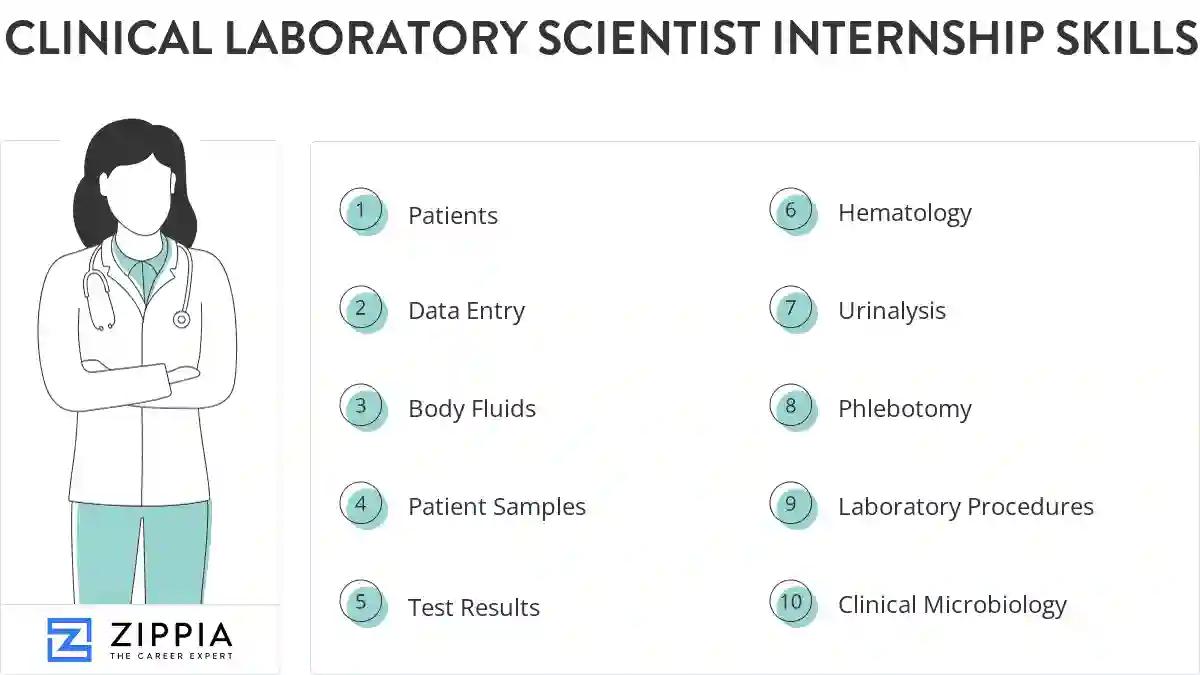
The most important skills for a clinical laboratory scientist internship resume and required skills for a clinical laboratory scientist internship to have include:
- Patients
- Data Entry
- Body Fluids
- Patient Samples
- Test Results
- Hematology
- Urinalysis
- Phlebotomy
- Laboratory Procedures
- Clinical Microbiology
- Clinical Chemistry
- Blood Bank
- Medical Laboratory
- Blood Samples
- Lab Equipment
- QC
- Routine Maintenance
- Laboratory Techniques
- Laboratory Tests
- Tissue Sections
- DNA
- Parasitology
- ASCP
- Blood Cultures
- RAN
- Iris
- RT-PCR
- LIS
- Immunology
- Serology
- Microorganisms
- Antibody Identification
- Electrophoresis
- Vital Signs
- Patient Results
- Data Collection
- Blood Counts
- Instrument Problems
- HIV
Updated January 8, 2025
