
Automatically apply for jobs with Zippia
Upload your resume to get started.
Clinical laboratory scientist trainee skills for your resume and career
15 clinical laboratory scientist trainee skills for your resume and career
1. Clinical Laboratory
- Perform various manual and automated clinical laboratory testing, maintain accuracy and quality of processes and equipment, communicate with caregivers.
- Performed all aspects of testing within clinical laboratory sections, including blood bank, Hematology, Microbiology, chemical pathology.
2. Laboratory Procedures
- Performed general laboratory decontamination after completion of any laboratory procedures involving biological material.
- Preformed standard laboratory procedures in chemistry, hematology, serology, and urinalysis * Performed routine instrument maintenance and routine quality control
3. CLS
Clinical Laboratory Science (CLS) is also called Medical Laboratory Science or Medical Technology. It is a stream of a health profession that delivers, laboratory information and services required for the diagnosis and treatment of diseases. CLS is also responsible for ensuring the authenticity of tests, performing tests, ensuring the quality of results, explaining the significance of tests, evaluating new methods and review the effectiveness of tests.
- Designated CLS in Library Preparation Module.
- Prepare patient reports for CLS to review and approve.
4. Molecular Biology
- Perform experiments including immunohistochemistry method development, tissue culture and molecular biology (cloning, PCR and transfection).
5. Lab Equipment
- Prepare chemical solutions, reagents and specimens for microscopic examination; perform maintenance and calibrations on chemistry analyzer and lab equipment.
- Prepared samples for routine testing with lab equipment including a microscope and automatic analyzers to detect any abnormalities or diseases.
6. QC
Quality control is a set of instructions or procedures to ensure a manufactured product or a service is up to the highest quality standards. This set of quality control criteria are either defined by the clients or the company itself.
- Initiate QC failure corrective action, participate in inventory control, perform instrument preventative maintenance and troubleshoot instrument and reagent problems.
- Performed daily QI/ QC ensuring operating parameters were within acceptable limits on chemistry analyzers.
Choose from 10+ customizable clinical laboratory scientist trainee resume templates
Build a professional clinical laboratory scientist trainee resume in minutes. Our AI resume writing assistant will guide you through every step of the process, and you can choose from 10+ resume templates to create your clinical laboratory scientist trainee resume.7. LIS
Libraries and Information Sciences, LIS, is the scientific and professional study of how information and information media are produced, disseminated, discovered, evaluated, selected, acquired, used, organized, maintained, and managed, either in physical or digital format. LIS careers include, but are not limited to, College Librarian, Legal Librarian, School Librarian, Data Curator, Teaching Librarian, and Emerging Technology Librarian.
- Led clinical diagnostic test preparation, data interpretation and data preparation / integration into Laboratory Information System (LIS).
- Ordered and accessioned laboratory tests using an electronic LIS.
8. Stat
Stat from the Latin word "Statim" meaning immediate, is a formal directive used by medical personnel for prescribing and administering medications instantly for some medical indications. This is opposed to PRN from the Latin word "Pro Re Nata" meaning when necessary, is used for dispensing medications when circumstances are required.
- Resulted laboratory samples for an extremely busy chemistry department for operating room and emergency room stat laboratory departments.
- Experienced working in a stat pediatric/OB laboratory as well as Hematology-Oncology & Bone Marrow outpatient clinic
9. Hematology
Hematology is the name of that branch of medicine that deals with all the matters pertaining to blood. The branch also deals with the treatment of blood-related diseases, predicting the outcome of developing diseases, the prevention of all such diseases, and their treatment.
- Completed clinical rotation in Blood Banking, Hematology and Urinalysis
- Managed Hematology Laboratory Department Inventory.
10. Urinalysis
Urinalysis can be defined as a urine test that helps examine the physical and chemical properties of urine. A test of this nature is mostly conducted to help aid in various medical diagnoses. The examination is carried out through test strips and as well through microscopes. Factors such as odor, color, transparency, and even volume play a key role in forming a diagnosis.
- Performed general routine clinical laboratory testing in the areas of clinical chemistry, hematology, coagulation, urinalysis and blood bank.
- Processed specimens in the areas of chemistry, toxicology, hematology, urinalysis, coagulation, serology, and microbiology.
11. ASCP
- Worked in an ASCP accredited laboratory owned and regulated by Sonora Quest Laboratories and Laboratory Sciences of Arizona.
- Provided tutoring/exam preparation or OJT students for categorical ASCP certification exams.
12. Body Fluids
Body fluid can be described as any fluid produced by a living organism e.g. human body. In the human body, the fluid can be classified into two major types according to their location: the intracellular fluid and the extracellular fluid. The extracellular fluid is located outside the cell(s) while the intracellular fluid is located within the cell(s).
- Determined normal and abnormal components of body fluids by conducting chemical analyses using microscopic techniques and procedures as ordered by physicians.
- Conducted chemical analyses of body fluids, using microscope or automatic analyzer to detect abnormalities or diseases and enter findings.
13. Blood Bank
A blood bank is a place where blood is gathered, stored, and preserved for later use for blood transfusion. A blood bank is also referred to a department of a hospital where blood and plasma are stored after testing it. It is also responsible for separating blood components like platelets, red blood cells and plasma from that blood and returning the remaining components to the donor.
- Performed ABO typing/screening, DAT on cord blood cells in Blood Bank department.
- Performed high volume blood banking procedures and molecular based assays Coordinated and managed blood donation drives Educated participants in tissue donation programs
14. Clinical Chemistry
- Operated and calibrated an assortment of laboratory/testing equipment in all areas and performed various clinical chemistry, microscopic and bacteriologic tests.
- Carried the role of clinical laboratory scientist supervisor in clinical chemistry laboratory.
15. Immunology
Immunology is a branch of medical service that deals with studying the immune system of a person. This particular specialization focuses on the function of the immune system and how it affects the entire body. It is usually an activity where it develops a mechanism that helps prevent and susceptibility of bacteria, infection, and other viruses that can enter the body.
- Skilled testing and reporting in all departments including Clinical Chemistry, Hematology, Coagulation, Immunology, Serology, and Urinalysis.
- Conduct a wide variety of chemistry test to include urinalysis and immunology using automated analyzers or by hands on techniques.
5 Clinical Laboratory Scientist Trainee resume examples
Build a professional clinical laboratory scientist trainee resume in minutes. Browse through our resume examples to identify the best way to word your resume. Then choose from 5+ resume templates to create your clinical laboratory scientist trainee resume.

What skills help Clinical Laboratory Scientist Trainees find jobs?
Tell us what job you are looking for, we’ll show you what skills employers want.
What skills stand out on clinical laboratory scientist trainee resumes?
Patrick Tracy
MLT Program Coordinator, Wenatchee Valley College
-Good problem-solving skills
-Able to prioritize tasks
-Pay attention to detail
-Take a process from beginning to end
-Maintain focus for periods
What hard/technical skills are most important for clinical laboratory scientist trainees?
Patricia Ellinger
Medical Laboratory Science Faculty, Saint Cloud State University
-Knowledge of quality control, ability to recognize when a test result looks wrong and what to do about it
What clinical laboratory scientist trainee skills would you recommend for someone trying to advance their career?
Angela Robinson MS MLS ASCP
Retired Assoc Admin of Pathology & Laboratory Medicine
AND - Do not let anyone or anything discourage you. Find the place that will support and value you in becoming the best you can be for patient care. Pursue life, including this profession to its utmost with purpose, pride and passion!
Finally - become part of the national movement of Laboratory Advocacy - become involved in making a positive difference and impact on Laboratory Medicine ie join a medical laboratory professional society and/or become vocal in acquiring media attention and public awareness and industry respect and legislative support.
While complaining and venting releases anxiety - only constructive criticism and action will resolve.
Better to try than succeed at doing nothing. Become part of the solution - not part of the precipitate.
What type of skills will young clinical laboratory scientist trainees need?
Chery Whipple Ph.D.
Assistant Professor of Biology, Colby-Sawyer College
What soft skills should all clinical laboratory scientist trainees possess?
Jennifer Larimore Ph.D.
Associate Professor, Agnes Scott College
List of clinical laboratory scientist trainee skills to add to your resume
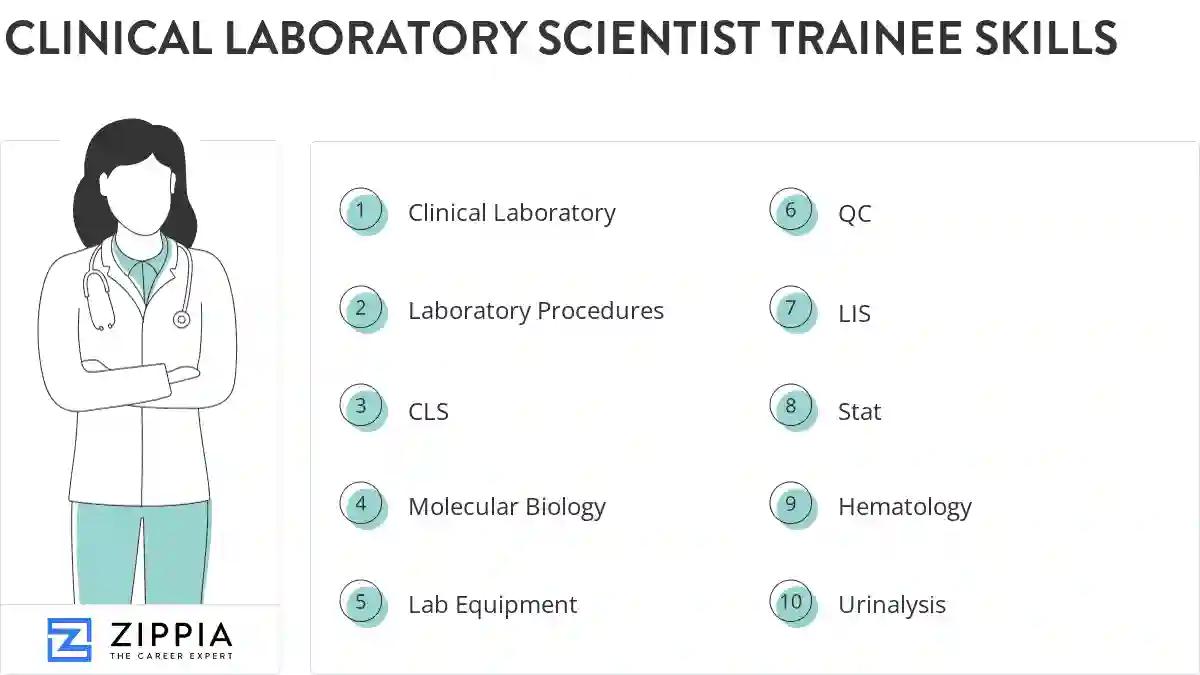
The most important skills for a clinical laboratory scientist trainee resume and required skills for a clinical laboratory scientist trainee to have include:
- Clinical Laboratory
- Laboratory Procedures
- CLS
- Molecular Biology
- Lab Equipment
- QC
- LIS
- Stat
- Hematology
- Urinalysis
- ASCP
- Body Fluids
- Blood Bank
- Clinical Chemistry
- Immunology
- PCR
- Iris
- Patient Care
Updated January 8, 2025
