
Automatically apply for jobs with Zippia
Upload your resume to get started.
Clinical nutritionist skills for your resume and career

15 clinical nutritionist skills for your resume and career
1. Patients
- Performed nutrition assessment and medical nutrition therapy for acute care patients in a 172-bed general medical and surgical community hospital.
- Participate in weekly interdisciplinary rounds to further evaluate patients at increased nutritional risk and discuss the appropriate route for recovery.
2. Medical Nutrition Therapy
- Provided individual medical nutrition therapy and group education to adult and pediatric populations.
- Conduct nutrition assessments and provide medical nutrition therapy in community health centers.
3. Nutrition Education
- Collaborated with patient discharge planning team to augment timeliness and individualization of patient nutrition education.
- Provided individual and group nutrition education, including high risk nutrition visits.
4. Diabetes
Diabetes refers to a disease of uncontrolled sugar levels in the body.
- Practice in the full scope of practice of an RD, CDE serving adults with diabetes.
- Developed and taught 6 classes providing education on Diabetes, High Cholesterol, and Weight Loss.
5. Nutritional Risk
- Conduct follow-up counseling to those program participants found to be at high nutritional risk.
- Interview and certify WIC Program applicants to determine eligibility based on defined nutritional risk criteria increasing monthly participant goal.
6. RD
A registered dietitian (RD) work with people who are having trouble losing weight or maintaining a proper diet and weight for health related reasons. Each patient's dietary habits are unique and a registered dietitian will help craft a plan tailored to their needs.
- Maintain awareness and take personal responsibility for the RD team role in the Health Education Department budget process.
- Worked as the RD for two WIC contract sites through the St. Charles Community Health Center.
Choose from 10+ customizable clinical nutritionist resume templates
Build a professional clinical nutritionist resume in minutes. Our AI resume writing assistant will guide you through every step of the process, and you can choose from 10+ resume templates to create your clinical nutritionist resume.7. Nutrition Services
Nutritionists and dieticians' nutrition services refer to dietary instructions, counseling, and recommendations offered to patients to improve their health.
- Direct activities of one or more workers who assist in preparing and serving meals Manage quantity food and nutrition services.
- Make recommendations to Nursing Services, Nutrition Services and physicians/nurse practitioners on residents' nutritional care and company standards and procedures.
8. Weight Loss
Weight loss is defined as a loss of mass in a person's body weight. Skills linked to wight loss are usually sought after in health and exercise industries; such skills might be involved in the creation of personalised weight loss goals and plans and exercise regimes, or they might more medical and scientific in nature, being used in work with patients who are irregularly or unusually suffering from negative side effects of weight loss.
- Average weight loss is an 18 pound loss within four months.
- Develop curriculum for prenatal, breastfeeding and weight loss programs.
9. Nutrition Assessments
- Conducted nutrition assessments and participated in treatment planning.
- Performed nutrition assessments, discharge diet teaching, participated in clinical medical rounds.
10. Therapeutic Diets
- Managed therapeutic diets and provided nutritional education to oncology patients while taking into account medication and treatment nutrition implications/side effects.
- Designed or internet obtained nutrition education materials, and provided education and counseling on therapeutic diets to residents and their families.
11. Meal Service
A Meal Service is a service provided by a company or an organization in which food is provided to a group of people. Homeless shelters provide a meal service, for example, but so do many education facilities, like high schools. Some companies provide their employees with meal service, though unlike for some of the other kinds of meal service, employees must pay for this food out of their own pocket.
- Assess delays and takes action to resume normal meal service.
12. Dietetic Interns
- Promoted to clinical nutritionist upon completion of dietetic internship.
- Served as preceptor to Columbia University Dietetic Interns.
13. In-Service Training
Inservice training is a professional training program that helps professionals acquire new skills relevant to their field. This training helps improve workers' output.
- Conducted an in-service training for nursing staff about enteral and parenteral nutrition.
14. Nutrition Support
- Participated on Nutrition Support Team.
- Calculated nutritional requirements and assessed the adequacy of diet andnutrition support.
15. Weight Management
- Developed several lectures for different key inpatient and outpatient cardiac, bariatric surgical & weight management groups.
- Developed a comprehensive interdisciplinary program including behavior-modification and medical weight management.
5 Clinical Nutritionist resume examples
Build a professional clinical nutritionist resume in minutes. Browse through our resume examples to identify the best way to word your resume. Then choose from 5+ resume templates to create your clinical nutritionist resume.

What skills help Clinical Nutritionists find jobs?
Tell us what job you are looking for, we’ll show you what skills employers want.
What clinical nutritionist skills would you recommend for someone trying to advance their career?
Anne Burdine MS, RDN, LDN
Director, Dietetic Internship, Website
List of clinical nutritionist skills to add to your resume
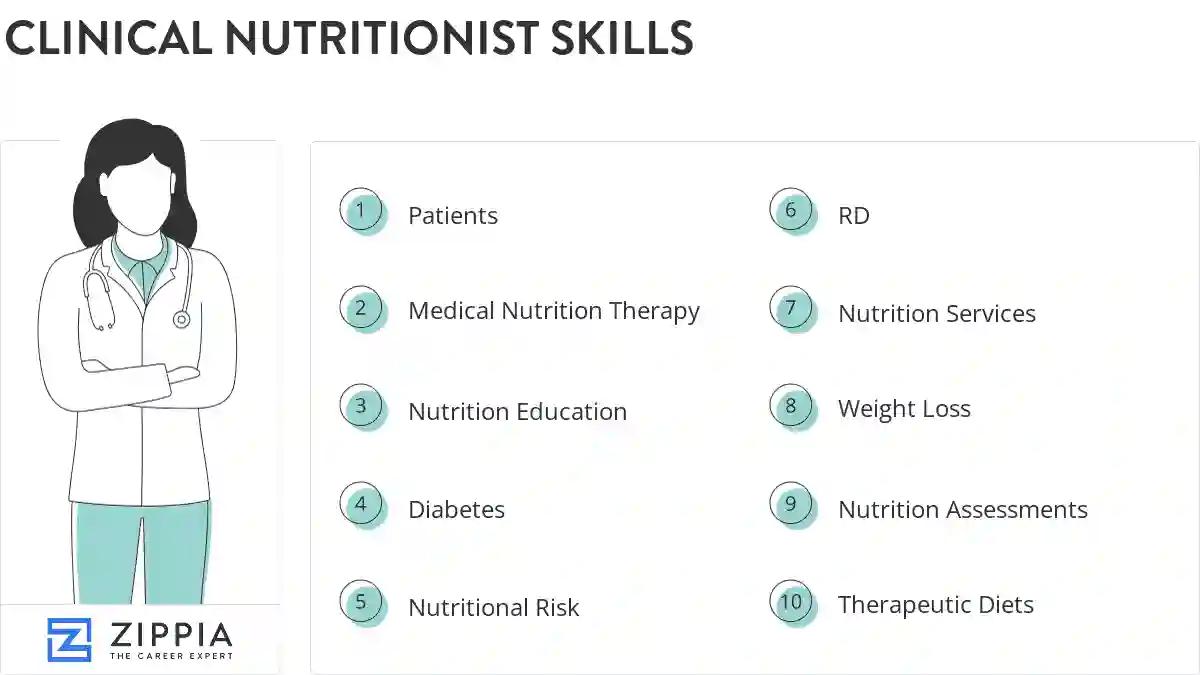
The most important skills for a clinical nutritionist resume and required skills for a clinical nutritionist to have include:
- Patients
- Medical Nutrition Therapy
- Nutrition Education
- Diabetes
- Nutritional Risk
- RD
- Nutrition Services
- Weight Loss
- Nutrition Assessments
- Therapeutic Diets
- Meal Service
- Dietetic Interns
- In-Service Training
- Nutrition Support
- Weight Management
- Hypertension
- Group Classes
- Critical Care
- Nutrition Care Process
- TPN
- Pediatric Nutrition
- Nutrition Programs
- WIC Program
- EMR
- Cardiovascular Disease
- GI
- ICU
- Allergies
- Tube Feedings
- Heart Disease
- Chronic Disease
- Disease State
- MDS
- Patient Education Materials
- Diet Restrictions
- Patient Care
- Writing Articles
- Eating Disorders
- Educational Programs
- Laboratory Values
- Assess Nutritional
Updated January 8, 2025
