
Automatically apply for jobs with Zippia
Upload your resume to get started.
Collator operator skills for your resume and career
15 collator operator skills for your resume and career
1. Collating
- Job Duties: Running and maintaining a print collating machine.
- Set up of all jobs, maintenance and repair, collating 3 to 10 parts simultaneously with inspection and quality checks.
2. Safety Inspections
Safety inspections are a vital procedure for all kinds of businesses. This may be a restaurant to ensure is properly cleaned and stored or a factory to confirm employees are not risking their safety during the manufacturing process. The goal of these inspections is to highlight any potential risks or hazards present that may lead to injuries, damages, or lawsuits.
- Perform safety inspections, document problems, and track production during operation.
3. Quality Checks
Quality checks are a component of quality control aimed at ensuring that quality requirements are met. Internally, quality checks provide assurance to managers, and externally, it provides assurance to clients, federal departments, authorities, and certifiers.
- Compile and complete paperwork for the work processed during my shift, Conduct quality checks on the material that I produced.
- Calibrate machinery every two hours and complete paperwork and self-quality check every hour.
4. Production Process
The production process is a series of events and industrial activities that come into play when raw material are delivered onto the production facility for manufacturing. The process involves different steps of production from start to finish such as; research, design formation, design testing, product manufacturing, and assembly according to the design, product experimentations, and supply.
- Ensured quality of product throughout production process, maintained inventory of supplies necessary to operate collator.
- Trained others on the fundamentals of the machine and production process, resulting in rapidly getting team up to speed.
5. Safety Procedures
Safety procedures are a set of standardized procedures, that ensures minimal to no risk to people, resources, and the work environment. A company follows the step-by-step safety procedures as it they not only keep the customers and the employees safe, but also help in avoiding legal claims.
- Keep machine and work area clean and organized and follow safety procedures.
- Assisted patrons entering and exiting rides, monitored activities to ensure adherence to safety procedures, shut-down and emergency evacuation procedures.
6. RAN
RAN stands for "revenue anticipation note," which refers to a practice where an organization (often the government) borrows money to support a specific project. When these funds are then repaid, the money given to the lenders comes from the profits generated by the business originally funded.
- Fort Worth, Texas, Anchorage, Alaska.Ran various web printing presses that were capable of doing 4 color jobs.
- Position Bindery Ran the collate Filled pockets for yearbook orders.
Choose from 10+ customizable collator operator resume templates
Build a professional collator operator resume in minutes. Our AI resume writing assistant will guide you through every step of the process, and you can choose from 10+ resume templates to create your collator operator resume.7. Business Forms
- Operated a 4-station roll collator and manufactured a variety of snap set and continuous business forms products.
- Printed and Collated, Business forms snap-out and continues, Business Checks, labels, and sheets.
8. Drill Press
A drill press refers to a device used to produce holes in hard substances. When drilling the holes, you need to clamp the workpiece on a table and hold the drill in a rotating spindle and feed it into the workpiece.
- Operated piranha shearing machine and Cincinnati drill press
- Operated routers, screw guns and other hand operated air tools, including rip saws, drill presses and freestanding equipment.
9. Machine Operation
- Monitor machine operation, and make adjustments as necessary to ensure proper operation.
- Operated and monitored equipment/line, removing or shifting materials and finished product as necessary to facilitate proper flow and machine operation.
10. Troubleshoot
Troubleshooting is the process of analyzing and fixing any kind of problem in a system or a machine. Troubleshooting is the detailed yet quick search in the system for the main source of an issue and solving it.
- Web Printing Press-Operate, set-up and troubleshoot Web Press.
- Paper Collator-Set up, operate and troubleshoot paper collator.
11. Color Press
- Model 500 22X17 three color, Model 800 17X20 two color and Model 1000 22X20 two color press.
12. Clamp Truck
- Coordinate with pressman on job production Drove Forklift, Clamp truck and pallet jacks.
- Completed Fork Truck, 2-Stage Lift and Clamp Truck Certification
13. Customer Specifications
A Customer Specification is a document that describes the general requirement of an expected service from a contractor. It outlines the key requirements of the customer. Customer specifications should be written in simple and general language so that the contractor clearly understands the expectations of the customer. It is also known as a User Specification.
- Set up of assigned printing press to print forms to customer specifications.
- Perform daily operation of injection molding machines Verify accuracy of documentation per work orders, machine programming, and customer specifications.
14. Routine Maintenance
- Perform routine maintenance on equipment by troubleshooting the equipment to meet established hourly production standards and perform preventative maintenance procedures.
- Forged participation on routine maintenance, ensured workplace safety workplace, and guaranteed security and maintenance of heavy equipment.
15. Quality Products
A quality product satisfies the client's intended need and matches the cost the consumer paid for it.
- Set up Collator per job specifications, produce quality products, and prepare for shipment.
- Operate machine to produce quality products.
5 Collator Operator resume examples
Build a professional collator operator resume in minutes. Browse through our resume examples to identify the best way to word your resume. Then choose from 5+ resume templates to create your collator operator resume.

What skills help Collator Operators find jobs?
Tell us what job you are looking for, we’ll show you what skills employers want.
List of collator operator skills to add to your resume
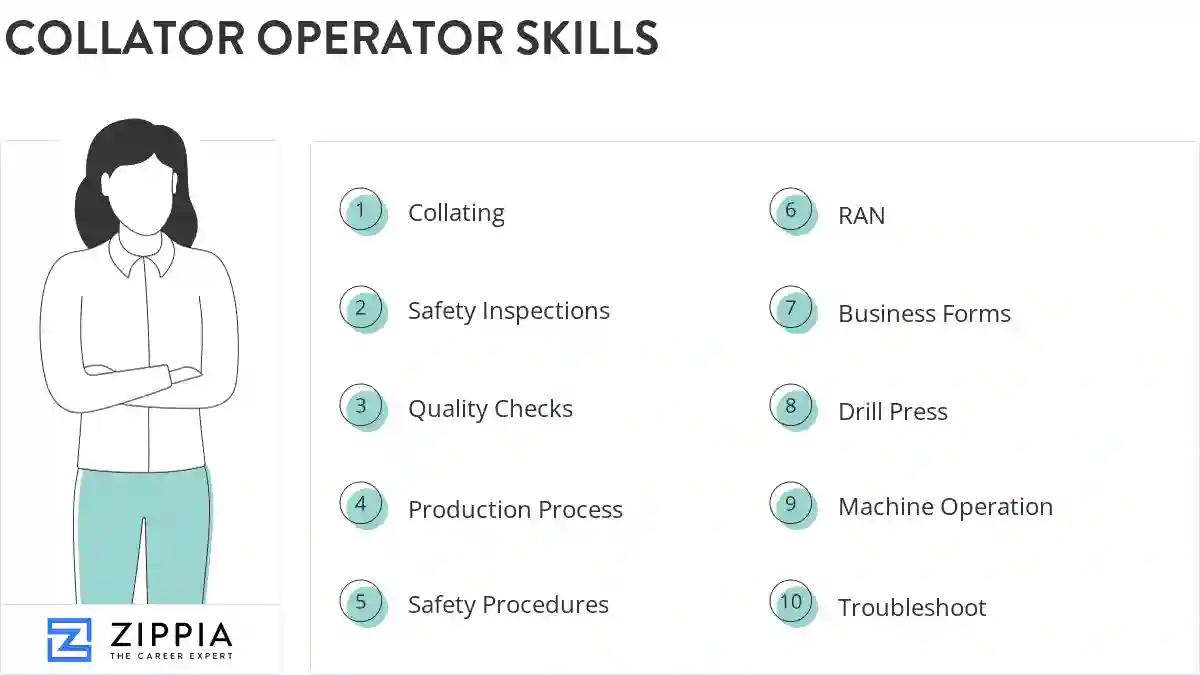
The most important skills for a collator operator resume and required skills for a collator operator to have include:
- Collating
- Safety Inspections
- Quality Checks
- Production Process
- Safety Procedures
- RAN
- Business Forms
- Drill Press
- Machine Operation
- Troubleshoot
- Color Press
- Clamp Truck
- Customer Specifications
- Routine Maintenance
- Quality Products
Updated January 8, 2025
