Explore jobs
Find specific jobs
Explore careers
Explore professions
Best companies
Explore companies
What is a commissioning engineer and how to become one
The primary function of a Commissioning Engineer is to provide engineering and technical support to projects in the interest of ensuring safety and staying within the budget. To do so, they will often write reports, conduct audits, help with troubleshooting, perform tests and keep track of progress for the entire life cycle of the project.
Essential duties and responsibilities that you will be performing in this capacity include but are not limited to maintaining client relationships, as this is a big part of the job. Nearly all projects will have a third-party client. You will also provide pre-construction guidelines, inspect sites, create relevant documentation about progress and problems, monitor finance, and keep things within the budget.
Essential skills needed for the position include organizational, technical knowledge, interpersonal, communication, problem-solving, and financial acumen. A bachelor's degree in mechanical engineering or a related field is desirable. Certain certifications such as taking the fundamentals of engineering (FE) exam and earning a professional engineer license may also aid in getting employment.
The average hourly salary for the position is $38.96, which amounts to $81,033 annually. The career is expected to grow in the near future.
What general advice would you give to a commissioning engineer?
Christopher Misorski FASM
Brunswick Technical Fellow-Materials Product Development & Engineering
Avg. Salary $97,374
Avg. Salary $59,228
Growth rate 2%
Growth rate 0.3%
American Indian and Alaska Native 0.11%
Asian 12.31%
Black or African American 3.41%
Hispanic or Latino 9.34%
Unknown 4.60%
White 70.24%
Genderfemale 4.61%
male 95.39%
Age - 39American Indian and Alaska Native 3.00%
Asian 7.00%
Black or African American 14.00%
Hispanic or Latino 19.00%
White 57.00%
Genderfemale 47.00%
male 53.00%
Age - 39Stress level is high
7.1 - high
Complexity level is advanced
7 - challenging
Work life balance is fair
6.4 - fair
Commissioning engineer career paths
Key steps to become a commissioning engineer
Explore commissioning engineer education requirements
Start to develop specific commissioning engineer skills
Skills Percentages HVAC 18.24% Test Procedures 10.08% MEP 6.78% Electrical Equipment 6.33% Plumbing 6.04% Complete relevant commissioning engineer training and internships
Accountants spend an average of 1-2 years on post-employment, on-the-job training. New commissioning engineers learn the skills and techniques required for their job and employer during this time. The chart below shows how long it takes to gain competency as a commissioning engineer based on U.S. Bureau of Labor Statistics data and data from real commissioning engineer resumes.Research commissioning engineer duties and responsibilities
- Lead subcontractors in the testing and troubleshooting of telemetry, hydraulic and SCADA systems before final hand-over.
- Develop database to manage project scheduling and man-hour tracking.
- Manage Jenkins security by providing specific access to authorize developers/testers using project base matrix authorization strategy.
- Enforce the NEC, OSHA, UL, IEEE, and other industry standards.
Prepare your commissioning engineer resume
When your background is strong enough, you can start writing your commissioning engineer resume.
You can use Zippia's AI resume builder to make the resume writing process easier while also making sure that you include key information that hiring managers expect to see on a commissioning engineer resume. You'll find resume tips and examples of skills, responsibilities, and summaries, all provided by Zippi, your career sidekick.
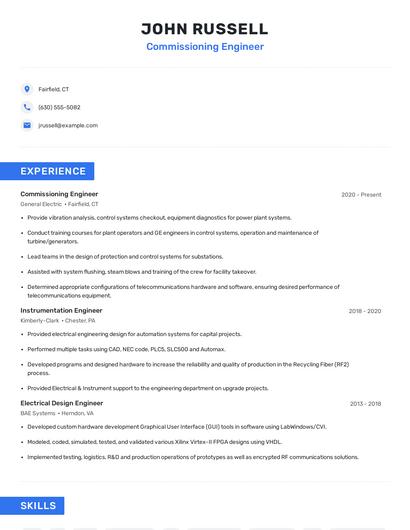
Choose from 10+ customizable commissioning engineer resume templates
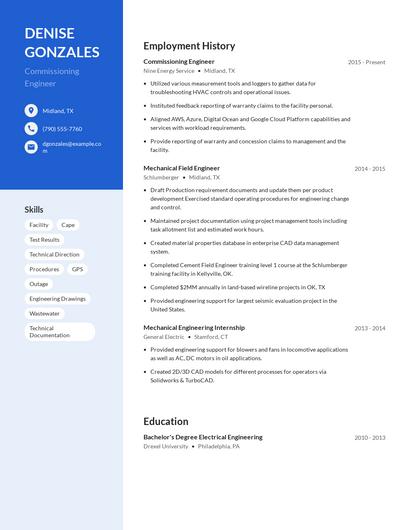
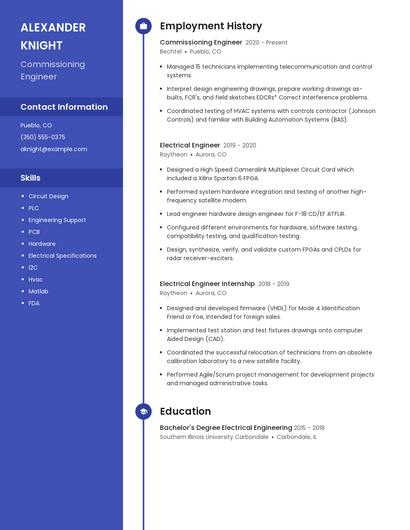
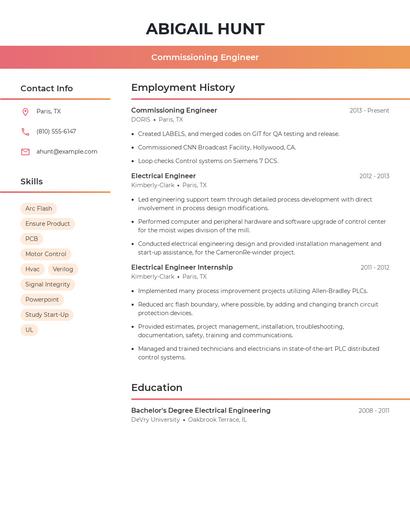
Build a professional commissioning engineer resume in minutes. Browse through our resume examples to identify the best way to word your resume. Then choose from 10+ resume templates to create your commissioning engineer resume.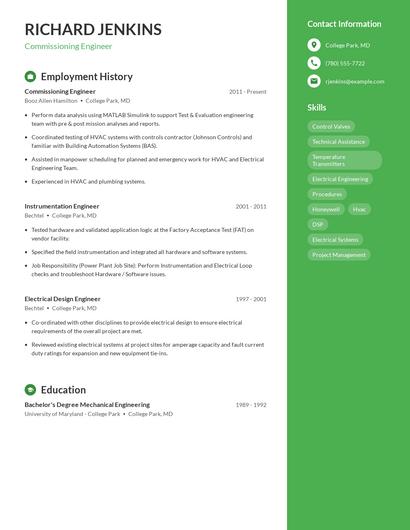
Apply for commissioning engineer jobs
Now it's time to start searching for a commissioning engineer job. Consider the tips below for a successful job search:
- Browse job boards for relevant postings
- Consult your professional network
- Reach out to companies you're interested in working for directly
- Watch out for job scams
How did you land your first commissioning engineer job

Are you a commissioning engineer?
Share your story for a free salary report.
Average commissioning engineer salary
The average commissioning engineer salary in the United States is $97,374 per year or $47 per hour. Commissioning engineer salaries range between $65,000 and $144,000 per year.
What am I worth?

How do commissioning engineers rate their job?
Commissioning engineer reviews

Repairing rebuilding and diagnosising laptop and desktop computers. Along with trouble shooting and giving sound advice
At times software development team questions on hardware design without looking the code running the stuff irritates Must have some knowledge of coding as well
Updated January 8, 2025
