Explore jobs
Find specific jobs
Explore careers
Explore professions
Best companies
Explore companies
What is a communications operator and how to become one

It often goes without saying that communication is very important. It affects how we do our work. To some people, their work is all about communications - coordinating with other people, managing schedules, and creating communication plans.
To others, their role is all about ensuring that communications will never fail. This may involve fixing communication line problems or ensuring that the calls they receive will be properly relayed to concerned individuals or teams. Communications operators usually work on radio or frequency-related communication lines.
They are often involved in emergency dispatching organizations. They receive calls through a central system and communicates the needs of the callers to responders on site. They also log these calls and ensure proper documentation. This implies that communications operators should be organized and should also be calm in the face of challenging situations. This role may be daunting, and it is, without question, a crucial role. As such, if you want to pursue this career, you should be able to exhibit grace under pressure and quick decision-making skills.
Avg. Salary $31,491
Avg. Salary $59,228
Growth rate 4%
Growth rate 0.3%
American Indian and Alaska Native 1.28%
Asian 3.81%
Black or African American 14.62%
Hispanic or Latino 15.67%
Unknown 3.75%
White 60.86%
Genderfemale 60.35%
male 39.65%
Age - 57American Indian and Alaska Native 3.00%
Asian 7.00%
Black or African American 14.00%
Hispanic or Latino 19.00%
White 57.00%
Genderfemale 47.00%
male 53.00%
Age - 57Stress level is high
7.1 - high
Complexity level is challenging
7 - challenging
Work life balance is excellent
6.4 - fair
Communications operator career paths
Key steps to become a communications operator
Explore communications operator education requirements
Start to develop specific communications operator skills
Skills Percentages Patients 14.46% Customer Service 13.95% Emergency Situations 5.84% PBX 4.99% Public Safety 3.89% Complete relevant communications operator training and internships
Accountants spend an average of Less than 1 month on post-employment, on-the-job training. New communications operators learn the skills and techniques required for their job and employer during this time. The chart below shows how long it takes to gain competency as a communications operator based on U.S. Bureau of Labor Statistics data and data from real communications operator resumes.Research communications operator duties and responsibilities
- Manage busy company switchboard, operating PBX or private branch exchange systems to facilitate connections.
- Perform NCIC, DMV, warrant and missing person checks for police officers in the field.
- Supervise telecommunication operations and reinforce the confidentiality in telecommunications.
- Dispatch ambulances, tow trucks, fire department, aid cars, and other aid as requested, maintain appropriate record.
Prepare your communications operator resume
When your background is strong enough, you can start writing your communications operator resume.
You can use Zippia's AI resume builder to make the resume writing process easier while also making sure that you include key information that hiring managers expect to see on a communications operator resume. You'll find resume tips and examples of skills, responsibilities, and summaries, all provided by Zippi, your career sidekick.
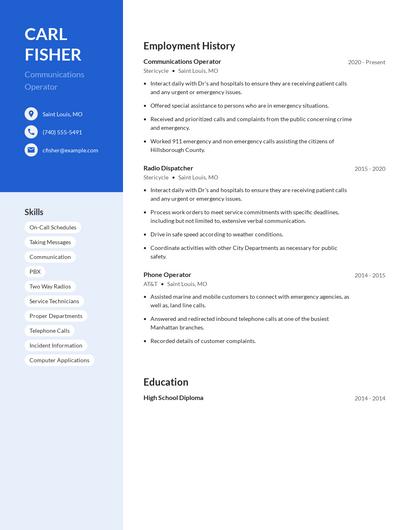
Choose from 10+ customizable communications operator resume templates
Build a professional communications operator resume in minutes. Browse through our resume examples to identify the best way to word your resume. Then choose from 10+ resume templates to create your communications operator resume.


Apply for communications operator jobs
Now it's time to start searching for a communications operator job. Consider the tips below for a successful job search:
- Browse job boards for relevant postings
- Consult your professional network
- Reach out to companies you're interested in working for directly
- Watch out for job scams
How did you land your first communications operator job

Are you a communications operator?
Share your story for a free salary report.
Average communications operator salary
The average communications operator salary in the United States is $31,491 per year or $15 per hour. Communications operator salaries range between $24,000 and $40,000 per year.
What am I worth?

How do communications operators rate their job?
Communications operator reviews

Being able to help people in need create clear and accurate communication
Isolation I guess which I anyway understand needed to effectively perform duties and responsibilities.
Not to upset my clients and the company reputation.
Updated January 8, 2025
