
Automatically apply for jobs with Zippia
Upload your resume to get started.
Concrete inspector skills for your resume and career
14 concrete inspector skills for your resume and career
1. Field Testing
- Collected water samples for distribution system analysis and performed field testing to gather chlorine residuals data.
- Provided field testing and inspection services during concrete placement, utility installation and roadway construction.
2. ACI
American Concrete Institute (ACI) is an institution known for its consensus-based standards, educational, technical, and training programs, certification programs, and adept individuals involved in construction in choosing quality materials to pursue the best use of concrete. ACI publishes more than 400 standards that can be used in the manufacturing, maintenance of concrete in different usage. These standards also determine systems or methods for inspection, test, and building code requirements. With ACI, the standards ensure the product reliability, adoption of new uses, and improved up keeping.
- Asphalt Plant VT ACI Concrete Field Tester Earthworks Technician Field Trainer
- Performed all required ACI test, ensured all construction and materials are per specifications and plans.
3. Shop Drawings
- Interpret and understand contract plans, proposal, standard specifications, manufacturers shop drawings and all other contract documents.
- Read Specification book and studied Shop Drawings to understand how steel repairs would be made.
4. Asphalt
- Calculated concrete, asphalt yields and material consistencies.
- Field Aggregate Testing Technician, Asphalt Plant Technician Level 1, Asphalt Plant Technician Level 2, Troxler Radiation Safety Certified.
5. Construction Safety
- Obtained certifications in construction safety and on- track safety.
- Obtained certifications in construction safety and on-track safety.
6. Rebar
- Inspect placing of concrete and rebar and responsible for making payment.
7. ASTM
- Conducted field inspections on concrete for compliance of ASTM standards.
- Performed soil compaction/density testing on multiple projects in accordance with ASTM and project specifications.
8. Reinforced Concrete
- Inspected all reinforced concrete forms, such as decks, walls, columns, stairs and walkways.
- Provided special inspection of reinforced concrete and structural masonry at various other commercial and institutional construction project locations.
9. Structural Steel
Structural steel is a type of steel material commonly developed or utilized to perform duties such as making tools to construct many structures and buildings. It usually forms in a different size, shapes, properties, and compositions for various industrial and manufacturing companies. These are often used in constructing buildings, aircraft, bridges and pipelines.
- Inspected placement of reinforcing steel & concrete structural steel & mortar grouts.
- Perform Structural Steel inspections and Secondary Containment inspections for client.
10. Construction Sites
A piece of land where constructional activities are to be conducted is termed as a construction site.
- Conducted, and recorded the results of, field tests on freshly mixed concrete at construction sites throughout New York City.
- Inspected concrete and soil samples from construction sites to make sure safety regulations were adhered to.
11. Unit Weight
- Evaluated batches of concrete for air content, temperature and unit weight.
- Tested the unit weight, yield, and air content (gravimetric) of freshly mixed concrete.
12. Construction Materials
Construction materials are equipment and objects that are used to construct buildings. Naturally occurring elements like clay, wood, and sand also come under construction materials. Man-made construction materials include concrete, bricks, tiles, etc. Using good quality construction materials helps in reducing maintenance costs and reduces the chances of frequent maintenance. The properties of artificial and natural elements determine the quality of construction material.
- Supervised construction work to ensure compliance with architectural and structural drawings and inspected construction materials to verify conformance to project specifications.
- Sampled and tested general construction materials to determine if materials conformed to specifications and approved/rejected material for intended use.
13. Concrete Pours
- Managed concrete pours and all concrete testing on buildings 8 to 15 stories high constructed entirely of concrete.
- Test and perform quality control during concrete pours
14. Moisture Content
- Conducted radiation analysis, checked moisture content, and printed out batch weights from concrete plant.
- Tested moisture content in sand and rock.

What skills help Concrete Inspectors find jobs?
Tell us what job you are looking for, we’ll show you what skills employers want.
List of concrete inspector skills to add to your resume
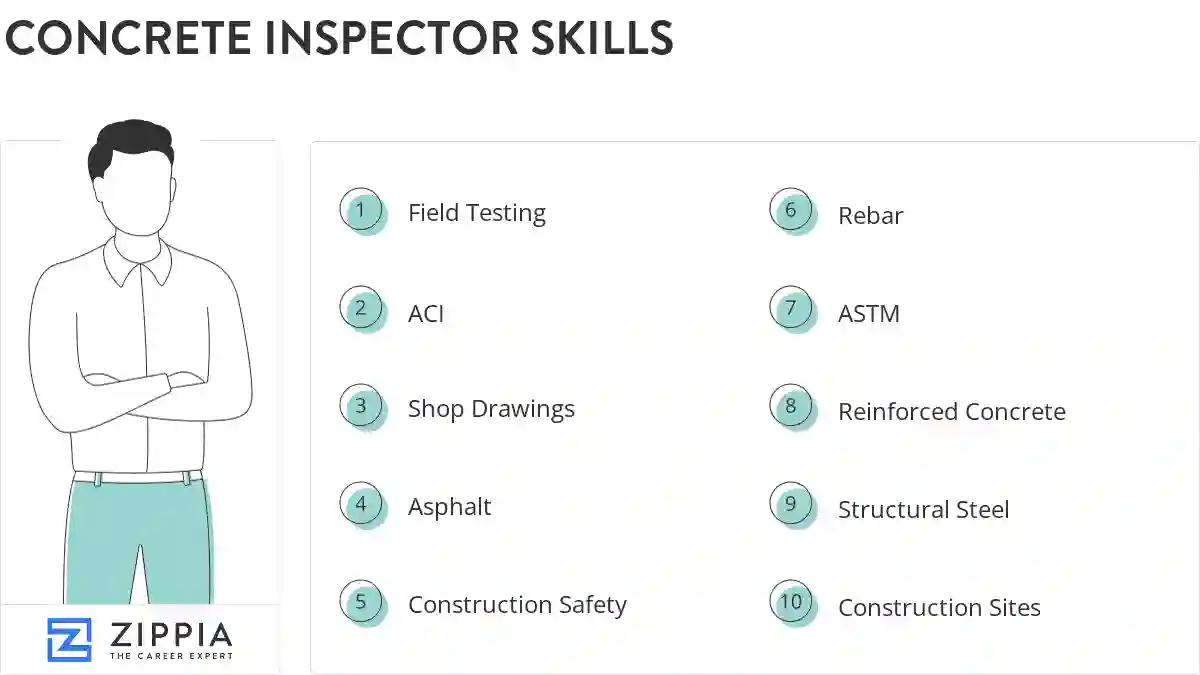
The most important skills for a concrete inspector resume and required skills for a concrete inspector to have include:
- Field Testing
- ACI
- Shop Drawings
- Asphalt
- Construction Safety
- Rebar
- ASTM
- Reinforced Concrete
- Structural Steel
- Construction Sites
- Unit Weight
- Construction Materials
- Concrete Pours
- Moisture Content
Updated January 8, 2025
