
Automatically apply for jobs with Zippia
Upload your resume to get started.
Contract chemist skills for your resume and career
15 contract chemist skills for your resume and career
1. Laboratory Equipment
- Maintain laboratory equipment, glassware, and supplies.
- Perform wet and instrumental analysis of dosage forms in new and finished pharmaceutical products by using computerized laboratory equipment.
2. Method Development
- Supported the Research and Development department by routine sample analysis and method development.
- Peer review QC data; Performed method development; Authored methods and SOP's for instrument use.
3. R
R is a free software environment and a language used by programmers for statistical computing. The R programming language is famously used for data analysis by data scientists.
- Used R, SSL, and SQL programming to identify and fix multiple processing and GUI problems with StarLIMS v9.
- Guide & support Energy Services R, D&E to meet and prioritize business goals.
4. Analytical Data
- Reviewed and Released of Analytical Data assuring the reliability and quality of data, meeting all internal and external quality standards.
- Follow quality assurance and quality control procedures to verify and validate analytical data, participate in proficiency testing program.
5. HPLC
- Developed HPLC methods for the analysis of drugs and related substances in a GMP environment.
- Developed, formulated, and HPLC analyzed proprietary nanotechnology delivery systems for insulin and other drugs in a cGMP environment.
6. Ms
Multiple sclerosis, MS, іѕ a сhrоnіс disease thаt аffесtѕ thе central nеrvоuѕ ѕуѕtеm, іnсludіng thе brаіn, ѕріnаl cord, and орtіс nerves. In MS, the іmmunе system attacks mуеlіn - the рrоtесtіvе lауеr that surrounds nеrvе fibers. Multірlе sclerosis саuѕеѕ mаnу different symptoms, іnсludіng vision loss, раіn, fatigue, аnd impaired coordination.
- Helped out Monsanto analytical sciences group by running metal analysis samples on, ICP, MS ExCell and IRIS.
- Maintained MS Access database to manage chemical raw material specifications and finished good batch analysis results.
Choose from 10+ customizable contract chemist resume templates
Build a professional contract chemist resume in minutes. Our AI resume writing assistant will guide you through every step of the process, and you can choose from 10+ resume templates to create your contract chemist resume.7. UV/Vis
- Performed assignments and testing in AbbVie Quality Lab, ranging from extraction to IR and UV/VIS Spectrophotometry.
- Supported manufacturing operation and Stability using HPLC and UV/VIS.
8. GC
- Performed all aspects of Micro GC and GC analysis and maintenance.
- Optimized and validated a GC method for residual solvents.
9. GMP
GMP stands for Good Manufacturing Practice. It is a system that ensures that all products like food, beverages, and medicinal drugs that are produced comply with the quality standards. It helps in minimizing the risks and hazards that cannot be eliminated after the testing of final products.
- Blended specialty carrier gases, completed GMP and safety checklists.
- Reviewed routine and validation projects under GMP guidelines.
10. FDA
The Food and Drug Administration (FDA) is a division of the US Department of Health and Human Services that regulates the production and sale of food, pharmaceutical products, medical equipment, and other consumer goods, as well as veterinary medicine. The FDA is now in charge of overseeing the manufacture of products like vaccines, allergy treatments, and beauty products.
- Documented experiments in FDA regulated lab.
- Served a point of contact for EPA, FDA and other third party auditors.
11. Wet Chemistry
- Used, gained experience in wet chemistry, Metrohm autotitrators, UV-Vis and Brookfield viscometers.
- Assessed and tested quality of incoming raw materials to validate analysis certificates using wet chemistry and instrumentation techniques.
12. Lab Notebook
- Prepared for QAU audits, maintained lab notebooks containing data generated during study.
- Maintained detailed lab notebooks and computed data storage of all research performed.
13. Titration
- Transferred method and technical support (from Italy) for the determination of digestive enzymes by regulated temperature automatic titration.
- Prepared solutions, performed calculation and good titration, measured the concentration, interpretation statistical analysis of data.
14. Sample Preparation
Sample preparation stands for the processes through which a sample is extracted from a bigger amount and prepared for analysis. The objective of sample preparation is to better analytical results without compromising the actual material's integrity.
- Perform routine residue analyses from established methods including sample preparations, extractions, sample clean-up and final detection using UPLC LC-MS/MS chromatography
- Designed toxicokinetic and pharmacokinetic studies using Watson and Millennium software and carried out the sample preparation and extraction section.
15. Analytical Test Methods
- Modified existing Analytical Test Methods and maintained Laboratory testing and documentation in a GMP/GLP environment.
- Involved in the validation/optimization of analytical test methods.
5 Contract Chemist resume examples
Build a professional contract chemist resume in minutes. Browse through our resume examples to identify the best way to word your resume. Then choose from 5+ resume templates to create your contract chemist resume.

What skills help Contract Chemists find jobs?
Tell us what job you are looking for, we’ll show you what skills employers want.
What skills stand out on contract chemist resumes?
Stephanie Hooper Marosek Ph.D.
Chair, Associate Professor, Methodist University
What soft skills should all contract chemists possess?
Dunwei Wang Ph.D.
Margaret A & Thomas A Vanderslice Chair in Chemistry, Professor of Chemistry, Chairperson of Chemistry Department, Boston College
What hard/technical skills are most important for contract chemists?
Dunwei Wang Ph.D.
Margaret A & Thomas A Vanderslice Chair in Chemistry, Professor of Chemistry, Chairperson of Chemistry Department, Boston College
What contract chemist skills would you recommend for someone trying to advance their career?
Peter Rosado
Associate Professor of Chemistry, Georgia College and State University
What type of skills will young contract chemists need?
Dr. Brian Augustine Ph.D.
Professor of Chemistry and Chair, High Point University
What technical skills for a contract chemist stand out to employers?
Dr. Paul Brandt
Professor of Chemistry, Chair, North Central College
List of contract chemist skills to add to your resume
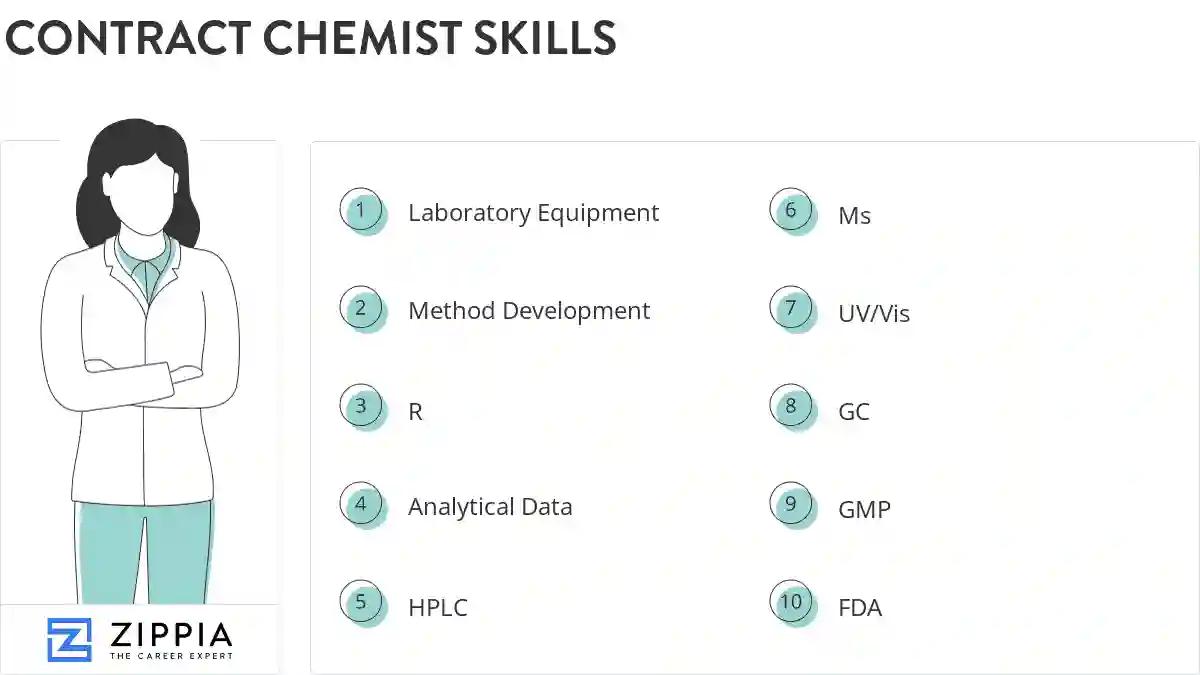
The most important skills for a contract chemist resume and required skills for a contract chemist to have include:
- Laboratory Equipment
- Method Development
- R
- Analytical Data
- HPLC
- Ms
- UV/Vis
- GC
- GMP
- FDA
- Wet Chemistry
- Lab Notebook
- Titration
- Sample Preparation
- Analytical Test Methods
- Lims
- IR
- GLP
- NMR
- ASTM
- FTIR
- Absorption
- Method Validation
- Gas Chromatography
- ISO
- API
- DSC
- Data Analysis
- UPLC
- Water Samples
- Stability Studies
- Chemical Analysis
- Pharmaceutical Products
- PH Meter
- LC-MS
- IC
- ICP-MS
- Water Content
- Environmental Samples
- Physical Properties
- Hazardous Waste
- Drug Products
- Liquid Chromatography
Updated January 8, 2025
