
Automatically apply for jobs with Zippia
Upload your resume to get started.
Contractor-design engineer skills for your resume and career
15 contractor-design engineer skills for your resume and career
1. CAD
- Designed allocation plant modifications to support service requirements utilizing specialized CAD software.
- Worked in the Engineering department as a Cad Engineer for a wave of remodel and conversion projects.
2. Solidworks
- Collaborated in the construction of manufactured products that were designed using SolidWorks.
- Created models and drawings using numerous configurations in SolidWorks.
3. Product Design
Product design can be described as a process of imagining, creating, and iterating products that solve user's problems and talk about the specific needs of users in the market. Product design is an engineering disciple and it is the basic design and idea that goes before the mass production of the product.
- Upgraded product design and documentation to streamline future development.
- Conceptualized, created, and developed wholly new product designs to replace aging product offerings.
4. R
R is a free software environment and a language used by programmers for statistical computing. The R programming language is famously used for data analysis by data scientists.
- Collaborate with R /D and Marketing to develop new products.
- Performed R &D. Created prints and assembly drawings.
5. Board Layout
- Perform electrical schematic capture and printed circuit board layout of digital and RF circuitry.
- Performed design entry using Mentor Graphics Design Capture and board layout using Expedition PCB.
6. Catia V5
- Position required design, modeling, and engineering using CATIA V5R12.
- Design Performed on CATIA V5.
Choose from 10+ customizable contractor-design engineer resume templates
Build a professional contractor-design engineer resume in minutes. Our AI resume writing assistant will guide you through every step of the process, and you can choose from 10+ resume templates to create your contractor-design engineer resume.7. Engineering Support
Engineering support means providing assistance to different engineers working in the company. It enables them to complete their tasks effectively and timely. Engineering support revolves around diagnosing and resolving software and hardware problems. They also look for network issues and resolve them in a timely manner.
- Provide Engineering Design/Engineering support to internal/external Manufacturing, Internal Assembly, Procurement, and inspection departments.
- Provide engineering support for manufacturing.
8. Analog
An analog system refers to a system that uses continuously variable signals.
- Designed and implemented Analog Devices AD739 10-bit video encoder-based medical video device.
- Performed layout of Analog Voltage Reference block.
9. BOM
BOM stands for a bill of materials in design drafting. This list outlines the raw materials, instructions, and components required to manufacture or construct a product or service.
- Created, revised, and released engineering drawings and documentation (BOM's, work instructions) for products.
- Develop BOM's in Excel and enter into AS400, track parts ordering and project progress with Excel.
10. Creo
- Created larger Creo FEA model of wider frame which notably sped up the design cycle.
- Design verification & optimization through CREO Simulation.
11. FAA
FAA (Federal Aviation Administration) is an aviation regulatory body in the USA.
- Coordinated with Project Engineering for FAA Development and Certification Compliance with regulations.
- Designed unique metal reflective surfaces to meet light output control requirements of the customer and FAA exterior lighting standards.
12. Design Software
Design software is used to create, edit, and display various types of graphics and images, including but not limited to photography, 3D design, and the website interface. It enables users to create a wide variety of visual files and offers various tools and functions to enhance the user's artistic skills and techniques. Some features include design, image editing, and digital illustration. Design software might also reference the actual act of creating a piece of software or application with a larger business or product goal in mind.
- Developed extremely complicated wiring meshes utilizing a variety of design software.
- Utilized Pro/Engineer design software to develop fully modeled parts and drawing to be used in production.
13. IP
An IP - Internet Protocol is a unique number assigned to all devices connected to information technology, such as printers, routers, modems, etc. Each device or domain that connects to the Internet is assigned an IP address, and as packets are directed to the IP address attached to them, the data goes where it is needed. IP addresses are the identifier used to send information between devices on a network. They contain location information and make devices accessible for communication.
- Joined the Physical IP Silicon Technology group (PIP).
- Designed IP Conceptual Ideas for Medical Project.
14. Aided Design
- Redesign of Boeing 737 trailing edge with the aid of CATIA computer aided design system.
- Correlate new design calculations, historical drawings, and physical examination to modern fabrication drawings using computer aided design software.
15. GD
GD refers to Grade Delay and is often mentioned on report cards or academic records when the instructor of a particular subject decides to hold the grade of a student. This is usually done if the instructor wants the student to improve their grade by retaking the exam or doing something for extra credit that will ultimately enhance their overall grade. Eventually, when the grade is assigned, the GD is then replaced with the original grade.
- Captured customer requirements for implementation into GD design documentation.
- Created drawings using computer aided design techniques and ASME Y14.5M GD & T drafting standards and generated materials lists.
5 Contractor-Design Engineer resume examples
Build a professional contractor-design engineer resume in minutes. Browse through our resume examples to identify the best way to word your resume. Then choose from 5+ resume templates to create your contractor-design engineer resume.

What skills help Contractor-Design Engineers find jobs?
Tell us what job you are looking for, we’ll show you what skills employers want.
What skills stand out on contractor-design engineer resumes?
Charles Jenckes
Assistant Professor, University of North Carolina at Charlotte
1.Where the candidate went to school and what was studied
2.GPA
3.Any successful internships
4.Projects completed by the student
What soft skills should all contractor-design engineers possess?
Bryant Harrison
Instructor, Murray State University
What hard/technical skills are most important for contractor-design engineers?
Bryant Harrison
Instructor, Murray State University
What contractor-design engineer skills would you recommend for someone trying to advance their career?
Dr. Richard Onyancha
Associate Professor of Mechanical Engineering and Department Head, Rose-Hulman Institute of Technology
- Technical hands-on skills such as CAD/CAM, simulation, design, and fabrication
- Global competency
- Public policy
- Job shadowing
- Preparing for and taking professional exams if, for example, considering medical school or law school
What type of skills will young contractor-design engineers need?
Andy Gerrick
Associate Professor and Chair, Embry-Riddle, Prescott
List of contractor-design engineer skills to add to your resume
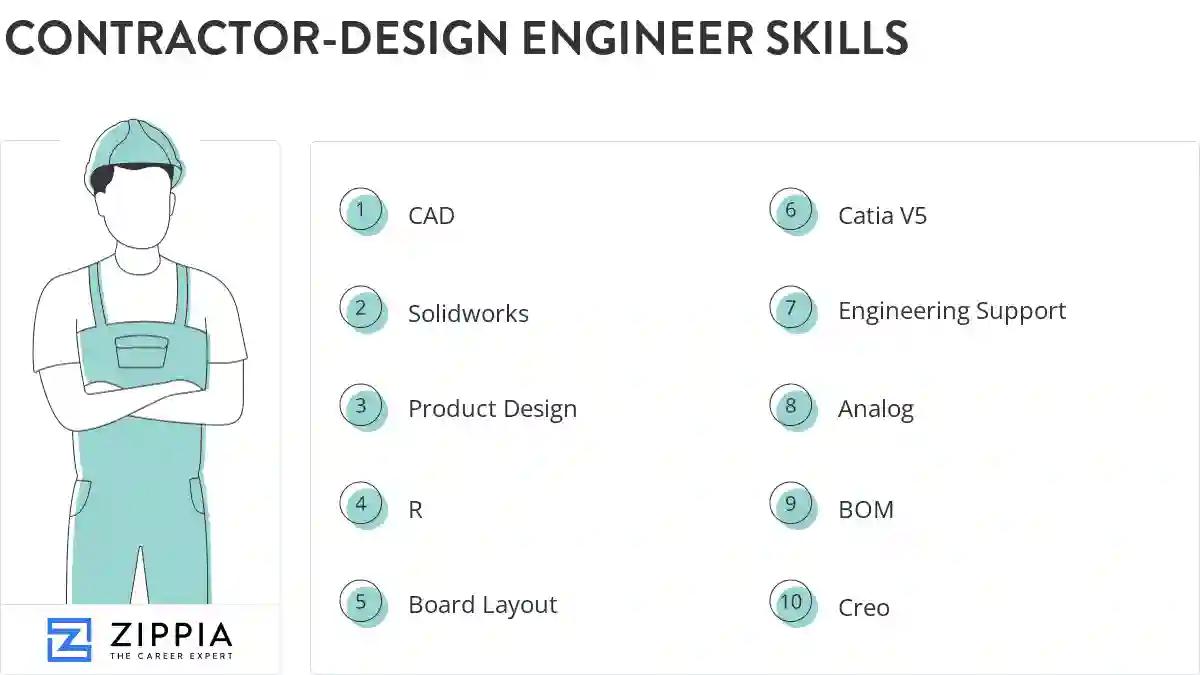
The most important skills for a contractor-design engineer resume and required skills for a contractor-design engineer to have include:
- CAD
- Solidworks
- Product Design
- R
- Board Layout
- Catia V5
- Engineering Support
- Analog
- BOM
- Creo
- FAA
- Design Software
- IP
- Aided Design
- GD
- Engineering Design
- FEA
- Circuit Design
- DFM
- HVAC
- Engineering Drawings
- FPGA
- Mechanical Design
- RF
- Design Changes
- PCB
- Perl
- Windchill
- Assembly Drawings
- E Wildfire
- Medical Devices
- Design Projects
- CNC
- OEM
- Design Reviews
- Circuit Boards
- Mechanical Components
- PDM
- Design Verification
- Enovia
- PowerPoint
- Test Fixtures
- Installation Drawings
- Lead Design
- Retrofit
- Electrical Components
- ECS
Updated January 8, 2025
