
Automatically apply for jobs with Zippia
Upload your resume to get started.
Control accountant skills for your resume and career
15 control accountant skills for your resume and career
1. Reconciliations
- Worked in Sacramento office to establish IBT controls environment and procedures for reconciliations related to conversion.
- Performed major reorganization of all accounting records, procedures, which entailed extensive reconciliations.
2. General Ledger Accounts
A general ledger account is a practice to keep a record of a company's total financial accounts. The accounts included in a general ledger lists the assets, liabilities, owners' equity, expenses, and income or revenue. It forms the basis of reporting a business's financial statements.
- Maintain payroll-related accounts for accuracy along with balancing of corporate salary/incentives general ledger accounts.
- Reconciled all general ledger accounts affected by treasury module implementation to zero balances.
3. Payroll Taxes
- Processed weekly union payroll, all quarterly payroll taxes, and union benefits.
- Reviewed FET taxes and payroll taxes and paid on timely basis
4. Account Reconciliations
- Prepare monthly balance sheet account reconciliations within the monthly closing cycle, providing excellent details and addressing any necessary corrections promptly.
- Handled monthly account reconciliations, including investigation and resolution of outstanding issues by working with multiple departments throughout the company.
5. Accruals
- Provided cost center auditing and monthly, quarterly, and year-end accruals for R&PD, advertising and patent departments.
- Completed all accounting entries for month end processing including sales accruals, prepaid insurance, depreciation, work-in-process.
6. Internal Controls
- Organized and administered a company-wide awareness program including classroom training to several hundred employees on internal controls and fraud awareness.
- Assist Lead Controller in establishing standard operating procedures including the development and maintenance of a system of internal controls.
Choose from 10+ customizable control accountant resume templates
Build a professional control accountant resume in minutes. Our AI resume writing assistant will guide you through every step of the process, and you can choose from 10+ resume templates to create your control accountant resume.7. External Auditors
- Facilitate proper documentation for internal and external auditors for semi-annual audits.
- Responded to data requests from external auditors including regulatory agencies.
8. CPA
- Coordinated financial information to CPA firm annually for tax return preparation.
- Prepare year-end financial and preliminary tax compilations; served as a liaison to outside CPA on tax planning and reporting.
9. GAAP
- Trained staff on QuickBooks to properly prepare monthly financial statements in accordance with Generally Accepted Accounting Procedures (GAAP).
- Ensured proper accounting in compliance with GAAP, regulatory reporting requirements and joint ownership contracts.
10. A/P
- Processed A/P invoices and disbursement requisitions.
- Frequent account analysis and audit of G/L, A/P and A/R to ensure proper coding, resolving any discrepancies.
11. Bank Reconciliations
- Complete daily bank reconciliation for the bank account to which deposits are made.
- Bank reconciliation, including checking, payroll, and investment accounts.
12. SOX
- Controlled regional account analysis, provided explanations and backup to SOX reporting department.
- Interact closely with the Corporate Financial Controls (CFC) unit which oversees SOX compliance guidelines for the company.
13. Cash Flow
- Eliminated excess sales capacity and increased first-tier technical support to improve customer service and increase operating cash flow.
- Completed detailed Cash Flow Forecasts and Analyses for reorganization decisions focusing on restricted and unrestricted funds.
14. Fixed Assets
- Maintained Fixed Assets Register and managed depreciation schedules.
- Maintain depreciation and amortization schedules for fixed assets.
15. QuickBooks
- Maintained accounting for a start-up corporation using QuickBooks.
- Created a custom detailed account structure in QuickBooks to better track actual job costs to budget for a 24-unit condo development.
5 Control Accountant resume examples
Build a professional control accountant resume in minutes. Browse through our resume examples to identify the best way to word your resume. Then choose from 5+ resume templates to create your control accountant resume.

What skills help Control Accountants find jobs?
Tell us what job you are looking for, we’ll show you what skills employers want.
What skills stand out on control accountant resumes?
Dr. Richard Hale
Associate Professor of Accounting, Berea College
-The ability to think critically about situations
-Good communications skills in writing
-The ability to speak in public and present ideas
-Working well with others
-The ability to work independently
Notice that these skills are not dependent upon any particular technology or discipline.
An advantage we have at Berea College, a liberal arts college, is that we incorporate these foundational skills into all we do.
Indeed, we also have our students master working with spreadsheets, develop skills in data analytics, and study all aspects of the business from Management, Economics, Finance, and Marketing.
As accounting is the business language, our students have more excellent business knowledge than other studies.
A key distinction for Berea College students is that all students must work for the college while they attend.
These jobs may vary from raising livestock to working in Accounts Payable. But all Berea graduates have years of practical work experience.
A core component of a Berea College education is to value the labor experience. We believe they enter the post-collegiate workforce with a significant advantage over their peers.
What soft skills should all control accountants possess?
Dr. Jennifer Thayer
Assistant Professor of Accounting, Socrates Award for Excellence in Teaching Recipient, Clarksville Chamber of Commerce APSU Distinguished Faculty Award for Community Service Recipient, Accounting Society at Austin Peay Advisor, Austin Peay State University
What hard/technical skills are most important for control accountants?
Dr. Jennifer Thayer
Assistant Professor of Accounting, Socrates Award for Excellence in Teaching Recipient, Clarksville Chamber of Commerce APSU Distinguished Faculty Award for Community Service Recipient, Accounting Society at Austin Peay Advisor, Austin Peay State University
What control accountant skills would you recommend for someone trying to advance their career?
Stephen Moehrle Ph.D.
Professor and Chairman of Accounting, University of Missouri - St. Louis
What type of skills will young control accountants need?
Delvin Grant
Associate Professor, DePaul University
What technical skills for a control accountant stand out to employers?
Dr. JP Krahel Ph.D.
Associate Professor of Accounting, Accounting Department Chair, Loyola University Maryland
Second, believe it or not, is writing. People think that accounting is all about numbers, but really, it's less about the math (which Excel does for you) and more about being able to explain the deeper meaning behind the results. Can you explain complex depreciation methods to an audit client? Give bad news to a tax client in an understandable way? These are big deals.
Third is data analytics. Given the immense volume of data now available to firms, someone who can extract, clean, and present that data using modern software tools will have an edge. It's really another form of communication, and one that early-career accounting professionals would do well to familiarize themselves with before entering the workforce.
List of control accountant skills to add to your resume
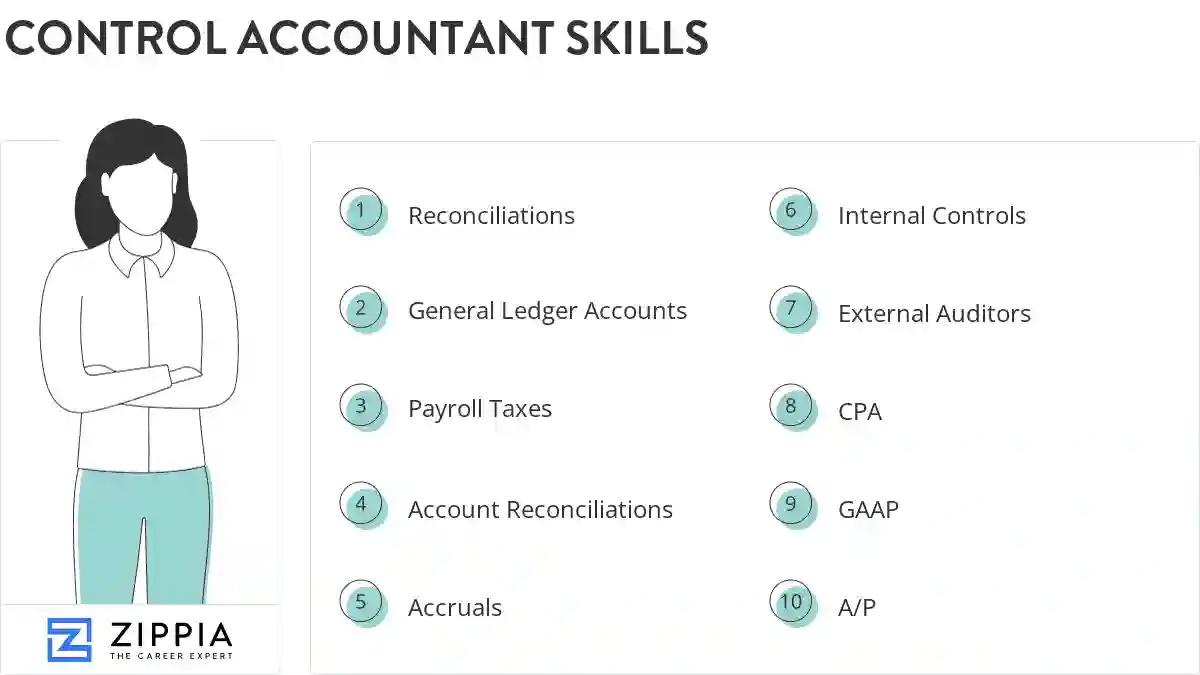
The most important skills for a control accountant resume and required skills for a control accountant to have include:
- Reconciliations
- General Ledger Accounts
- Payroll Taxes
- Account Reconciliations
- Accruals
- Internal Controls
- External Auditors
- CPA
- GAAP
- A/P
- Bank Reconciliations
- SOX
- Cash Flow
- Fixed Assets
- QuickBooks
- Income Statement
- Tax Returns
- Financial Data
- Sales Tax
- Bank Accounts
- ACH
- Variance Analysis
- Human Resources
- Financial Analysis
- Asset Value
- Financial Management
- Vendor Invoices
- Balance Sheet Accounts
- Bank Deposits
- Reconcile General Ledger
- Health Insurance
- Bank Statements
- Tax Filings
- Real Estate
- Financial Transactions
- W-2
- Inventory Control
- Logistics
- NAV
- ADP
- Payroll Processing
- Tax Reports
- Accounts Receivables
- Management Reports
- Cash Flow Analysis
- Account Analysis
- Revenue Recognition
- Trial Balance
- Wire Transfers
- Property Tax
Updated January 8, 2025
