Explore jobs
Find specific jobs
Explore careers
Explore professions
Best companies
Explore companies
What is a control analyst and how to become one

A control analyst studies the internal processes and operations within an organization to identify inadequacies and recommend strategies and policies to fix them and minimize risk. The work of a control analyst also includes supervising processes and providing technical guidance for personnel of an organization.
For this role, you will be involved in defining the work strategy for an organization, making improvements to processes, and informing or training personnel on these changes. You will also prepare incident reports, reconcile records and analyze documents like ledger accounts or balance sheets based on generally accepted accounting principles. A control analyst may also be part of an organization's audit process.
Individuals who work as control analysts typically have a bachelor's degree. But a high school or GED may suffice in some cases. Control analysts must have excellent analytical abilities and good technical abilities. Excellent communication skills and an ability to collaborate with others and liaise with external auditors may also be necessary for this role. The average annual income of a control analyst is $58,958.
What general advice would you give to a control analyst?
Erik Johnson Ph.D.
Assistant Professor of Economics, Carthage College
Avg. Salary $69,598
Avg. Salary $59,228
Growth rate 11%
Growth rate 0.3%
American Indian and Alaska Native 0.17%
Asian 11.74%
Black or African American 8.28%
Hispanic or Latino 9.04%
Unknown 4.52%
White 66.27%
Genderfemale 48.05%
male 51.95%
Age - 43American Indian and Alaska Native 3.00%
Asian 7.00%
Black or African American 14.00%
Hispanic or Latino 19.00%
White 57.00%
Genderfemale 47.00%
male 53.00%
Age - 43Stress level is high
7.1 - high
Complexity level is advanced
7 - challenging
Work life balance is very poor
6.4 - fair
Control analyst career paths
Key steps to become a control analyst
Explore control analyst education requirements
Start to develop specific control analyst skills
Skills Percentages Internal Controls 8.15% Risk Assessments 5.78% SOX 4.70% Internal Audit 4.07% Customer Service 4.03% Complete relevant control analyst training and internships
Accountants spend an average of 6-12 months on post-employment, on-the-job training. New control analysts learn the skills and techniques required for their job and employer during this time. The chart below shows how long it takes to gain competency as a control analyst based on U.S. Bureau of Labor Statistics data and data from real control analyst resumes.Research control analyst duties and responsibilities
- Manage the implementation and roll-out of SharePoint as a team collaboration and document management tool.
- Develop infrastructure to enable clients to better understand and manage risks associate with their decision environment to capture opportunities.
- Transform the month-end calculation methodology and analysis process to provide a more accurate and detail fuel accruals and variance analysis.
- Assist in SQL database applications development custom tailor for company s needs.
Prepare your control analyst resume
When your background is strong enough, you can start writing your control analyst resume.
You can use Zippia's AI resume builder to make the resume writing process easier while also making sure that you include key information that hiring managers expect to see on a control analyst resume. You'll find resume tips and examples of skills, responsibilities, and summaries, all provided by Zippi, your career sidekick.
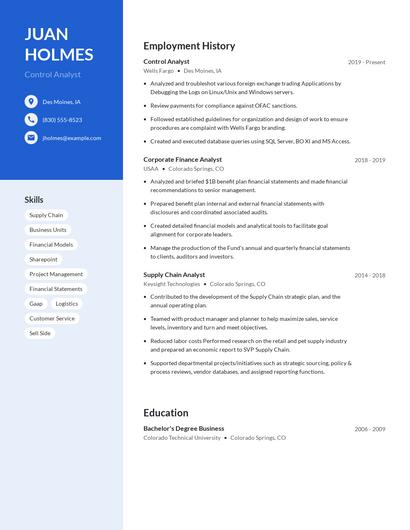
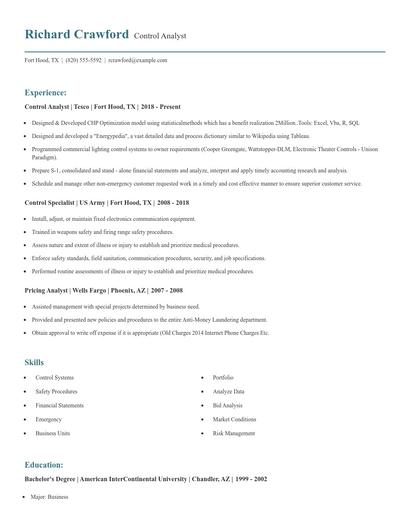
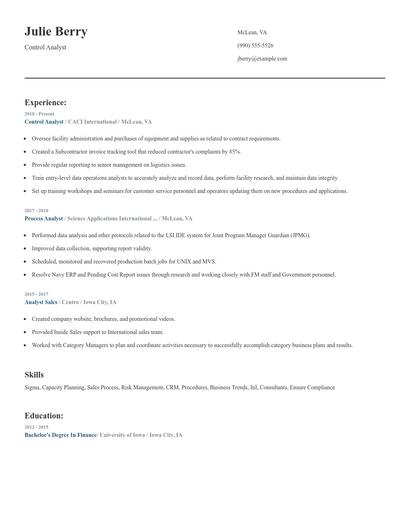
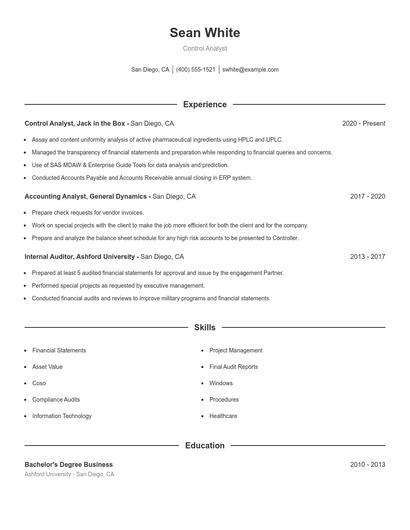
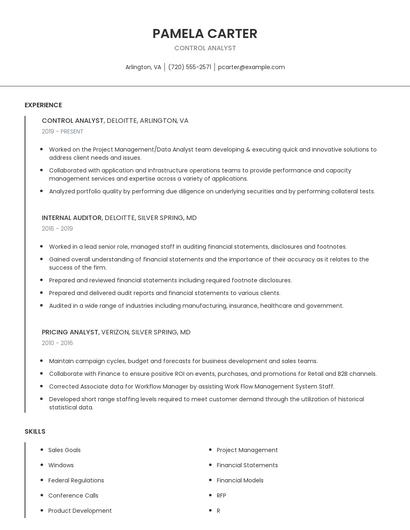
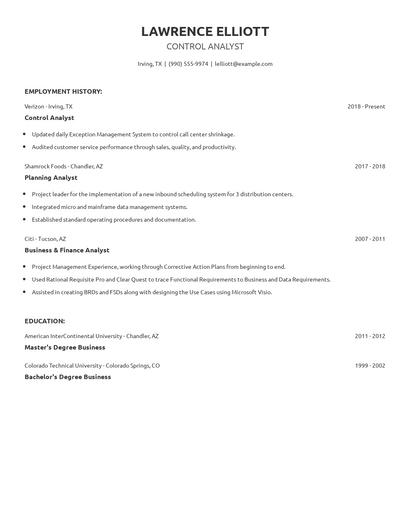
Choose from 10+ customizable control analyst resume templates
Build a professional control analyst resume in minutes. Browse through our resume examples to identify the best way to word your resume. Then choose from 10+ resume templates to create your control analyst resume.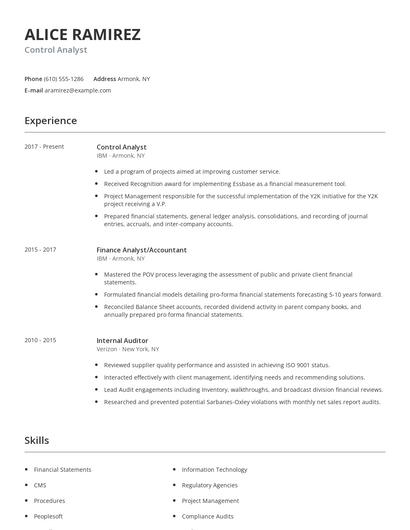


Apply for control analyst jobs
Now it's time to start searching for a control analyst job. Consider the tips below for a successful job search:
- Browse job boards for relevant postings
- Consult your professional network
- Reach out to companies you're interested in working for directly
- Watch out for job scams
How did you land your first control analyst job

Are you a control analyst?
Share your story for a free salary report.
Average control analyst salary
The average control analyst salary in the United States is $69,598 per year or $33 per hour. Control analyst salaries range between $50,000 and $95,000 per year.
What am I worth?

How do control analysts rate their job?
Control analyst reviews

Enjoy analyzing the projects. I like tracking and knowing how we are doing on the projects.
Flexibility of schedule and type of work in Organizational Development. Telecommute options are also superb.
There is a lot of critical thinking needed for the job.
Its all sitting, and you are unlikely to get a raise
Control analyst FAQs
Search for control analyst jobs
Updated January 8, 2025
