
Automatically apply for jobs with Zippia
Upload your resume to get started.
Controls designer skills for your resume and career

15 controls designer skills for your resume and career
1. PLC
- Designed and commissioned a plant-wide system to control extrusion and processing of foam material using networked PLC's and MMI's.
- Engineered, drafted, modified PLC programs and HMI programs, created schematics, tested software with customer to their satisfaction.
2. Control Panels
A control panel is a flat, enclosed unit, often the vertical part of a system in which the control or monitoring instruments are displayed and accessible to users. Control panels are typically closed-circuit boards with connections to all peripheral devices in their area. They can be found in factories to monitor and control machines or production lines and in places like nuclear power plants, ships, airplanes, and mainframe computers.
- Design of loop drawings, installation details, location plans, cable schedule, wiring diagrams, and control panel layout.
- Provided support with the installation and commissioning of control panels and device wiring on Rooftop Units.
3. IDS
An IDS (intrusion detection system) stands for a software application or device that monitors a network to identify policy violations or malicious activities.
- Developed loop drawings from P & IDs and wiring diagrams.
- Review and markup P and IDs.
4. Auto CAD
- Designed Hydraulic Cylinders for Manufacturing Worked with Auto CAD in design application.
- Designed carrier structural components and equipment foundations using Auto Cad.
5. I/O
- Control & design (and check-out), I/O assignment, Electrical details, Graphic design.
- Created customized databases specifying all trips, I/O points; and hardware alarms.
6. UL
- Established communication links and prepared machines for bench-testing to attain UL certification.
- Provide customer support that includes meeting with engineering and providing technical data based off of UL standards to build product specifications.
Choose from 10+ customizable controls designer resume templates
Build a professional controls designer resume in minutes. Our AI resume writing assistant will guide you through every step of the process, and you can choose from 10+ resume templates to create your controls designer resume.7. HMI
A human-machine interface is a dashboard or user interface that connects an operator to a device, system, or machine.
- Developed software and HMI programs.
- Led Operator HMI meetings and coordinated with operations for graphics development Designed and prepared Layout and Wiring Drawings
8. Electrical Schematics
- Designed control panel layouts and electrical schematics utilizing AutoCad.
- Designed electrical schematics for large projects utilizing AutoCAD 2006.
9. Electrical Design
Electrical design refers to the whole process and includes all the steps which are involved in the development of any electrical equipment. In electrical design, planning and managing the process of designing and development, creating the equipment, and testing it to evaluate the equipment's performance are all integral steps.
- Served as electrical designer, ensuring timely completion of design projects; design computer/PLC-based controls for remote handling equipment.
- Participated and provided electrical designs for the Electrical controls GAS redesign for the C.P.
10. System Design
System design refers to the electronic structural component of a system.
- Worked on System Design that eventually incorporates the User Requirements Specifications for the entire application.
- Develop system requirements, theory of operation and documentation system design.
11. Drawing Packages
- Developed Control drawing packages including loop and logic diagrams, BOM.
- Create drawing packages for new projects.
12. FTP
- Work done in file transferring using Connect Direct as well as FTP Client Software Tools.
13. Architecture
- Designed CATV system using various architecture and specification.
- Involved in Analysis and Design of the project, which is based on MVC (Model-View-Controller) Architecture and Design Patterns.
14. Panel Layouts
- Design, and review electrical control drawings and panel layout drawings for the Electrical production Department.
- Design and Drafting of instrument/control circuits and panel layouts for use in all types of Industry.
15. PC
- Build, setup, install, and troubleshoot PC's and Server classmachines.
- Created Pc board layouts and drawings using Orcad layout and Visual CAD.
5 Controls Designer resume examples
Build a professional controls designer resume in minutes. Browse through our resume examples to identify the best way to word your resume. Then choose from 5+ resume templates to create your controls designer resume.

What skills help Controls Designers find jobs?
Tell us what job you are looking for, we’ll show you what skills employers want.
What skills stand out on controls designer resumes?
Florian Solzbacher
Department Chair, Professor, Elect & Computer Engineering, University of Utah
Supplemental skills, such as Entrepreneurial or business training, can enhance and differentiate a student's resume. This shows that an engineer is not solely focused on the core technical engineering skills but does have an understanding of the driving forces and their interaction in a real-world business setting, that are not only part of the design requirements for a product (e.g., design to cost), but also often drive the selection of technical solution paths, after all, every development and product has to make business sense. Imagine two young engineers proposing a solution to their manager for a new product: one maybe even over-exceeds the technical requirements, but the development and/or manufacturing and servicing effort and cost is significantly higher than a colleagues solution that may only just about reach the requirements, or maybe even compromise on some specifications, but that is far cheaper to develop, make and service and that may allow entering a far larger market- chances are very high that the business may decide to go for the "inferior" solution from a technical point of view, that is, however, the better product. This supplemental skill set is a significant competitive advantage to have as an engineer.
What controls designer skills would you recommend for someone trying to advance their career?
Arie Nakhmani
Associate Professor of Electrical and Computer Engineering, University of Alabama at Birmingham
What type of skills will young controls designers need?
Michel Audette Ph.D.
Associate Professor, Dept. CMSE; Graduate Program Director, Biomedical Engineering Institute, Old Dominion University
This embrace of heterogeneity is even more relevant in that technical problems being solved are increasingly multi-disciplinary, so that an engineer may need to interact with biologists, physicians, clothing or furniture designers, mathematicians, lawyers, and so on: in my own case, I have to wear a multitude of different hats, while recognizing someone who is a perfect fit for one of those hats when I meet that individual, and making the most of that opportunity to build a truly competent team. Engineers must be able to hold a meaningful, respectful conversation with any of these counterparts, not just discuss code or circuit design. I would advocate that they spend time reading, to maintain their vocabulary and stay abreast of the world around them.
Another one that I advocate is the ability to tap into a revolution that has occurred in parallel with the advent of Internet and cellular technologies, these past 30+ years: the explosion of open-source software tools. I am a committed proponent of open source, as a former contributor to them while previously employed at Kitware (a pioneer in this area, behind VTK, ITK, CMake, and myriad others). I see job ads in Indeed.com that specifically ask for the ability to work with these tools, since they save work and make it possible to produce a prototype in much less time than developing it completely in-house. This ability does not just presuppose the ability to program at a competent level, but other abilities: the ability to track bugs that not be in the calling program, but in the open-source software library itself, the willingness to get answers in the community of developers, the eye for details that extends to graphical processor units that result in accelerations an order of magnitude or better, and so on. These go way beyond writing a self-contained algorithm. Hardware designers may also have similar tools, based on broad standards, Arduino, and the prevalence of 3D printers that make it possible to physically replicate digital models.
Finally, a vital skill is the willingness and ability to keep learning, while embracing revolutions that take place at breathtaking pace. The latest one is the reliance on deep neural networks (DNNs) to synthesize algorithms that can learn and adapt to their data, with much faster performances than feasible with the previous algorithms that DNNs have replaced. The point to make here is not to embrace neural networks in a proximal sense, but that we cannot anticipate what will come next, downstream of DNNs. Graduates of 2021 have to be willing to keep their curiosity and work ethic enough to be responsive to the next wave of technologies, and embrace them for the opportunities that they represent.
List of controls designer skills to add to your resume
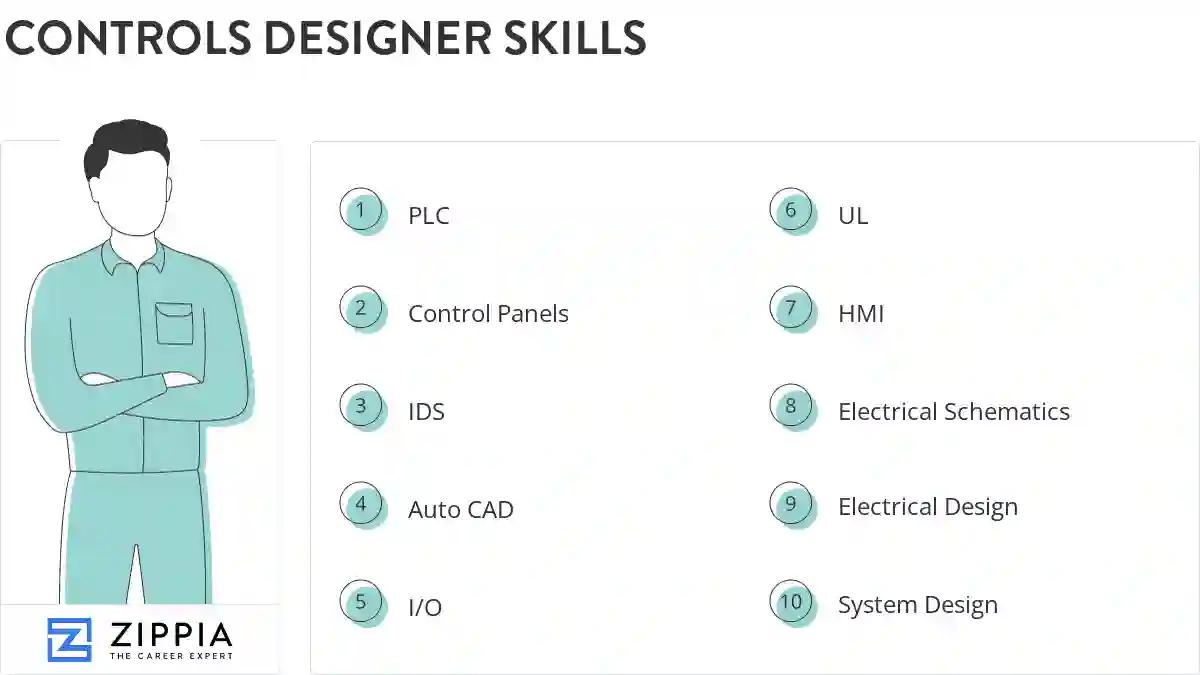
The most important skills for a controls designer resume and required skills for a controls designer to have include:
- PLC
- Control Panels
- IDS
- Auto CAD
- I/O
- UL
- HMI
- Electrical Schematics
- Electrical Design
- System Design
- Drawing Packages
- FTP
- Architecture
- Panel Layouts
- PC
- Solidworks
- BOM
- Aided Design
- Line Diagrams
- VFD
- Power Electronics
- Panel Drawings
- DCS
- HVAC
- PID
- Hmi Programming
- CNC
- C++
- Allen-Bradley
- Assembly Drawings
- Industrial Design
- R
- Data Sheets
- Block Diagrams
- MATLAB
- Simulink
- SPI
- Ethernet
- Machine Control Systems
- Electrical Components
- Electrical Drawings
- InTools
- Project Scope
Updated January 8, 2025
