
Automatically apply for jobs with Zippia
Upload your resume to get started.
Cooker operator skills for your resume and career
15 cooker operator skills for your resume and career
1. GMP
GMP stands for Good Manufacturing Practice. It is a system that ensures that all products like food, beverages, and medicinal drugs that are produced comply with the quality standards. It helps in minimizing the risks and hazards that cannot be eliminated after the testing of final products.
- Manufacture active pharmaceutical ingredients using GMP format and aseptic techniques.
- Learn and practice GMP, FDA, and environmental, health and safety regulations and wear the prescribed personal protective equipment.
2. Food Quality
- Report any food safety and food quality related issues to management immediately.
3. CIP
A Capital Improvement Plan (CIP) is a planning tool used to coordinate the timing and financing of capital improvements over a period of several years. It helps organizations make good budget decisions for large projects and purchases based on objectives and resources. The purpose of a CIP is to identify capital improvement projects, identify and forecast funding sources, prioritize improvements based on available funds, and estimate a timeline for completing the improvements.
- Monitor the CIP of any component that is washing and check the chemicals to make sure the strengths are in range.
- Pasteurize all cream to the butter room* CIP Processing / Evaporator* CIP lines* Maintain accurate and orderly production logs.
4. Processing Equipment
Processing Equipment refers to any form of machinery or equipment used in the manufacturing of goods or in processing raw materials used in later goods. Equipment for food processing, for example, may include meat saws and other knives and packaging materials, while equipment used in water or oil treatment may involve more complex machinery and chemical procedures.
- Operated cooking and processing equipment to produce Feather Meal products for grinding and further refinement.
- Operated processing equipment and an Ultra High Temperature pasteurizing unit in the manufacturing plant.
5. PPE
Personal protective equipment is an item of protective clothing such as goggles, helmets, or other garments meant to protect the body from injury.
- Perform quality checks Ensures safety by wearing PPE and reporting incidents.
- Shift safety auditor- safety audits, incident investigations, PPE verification
6. Safety Procedures
Safety procedures are a set of standardized procedures, that ensures minimal to no risk to people, resources, and the work environment. A company follows the step-by-step safety procedures as it they not only keep the customers and the employees safe, but also help in avoiding legal claims.
- Assisted patrons entering and exiting rides, monitored activities to ensure adherence to safety procedures, shut-down and emergency evacuation procedures.
- Provided yard traffic control and communicated instructions to drivers to ensure all operating and safety procedures were being followed.
Choose from 10+ customizable cooker operator resume templates
Build a professional cooker operator resume in minutes. Our AI resume writing assistant will guide you through every step of the process, and you can choose from 10+ resume templates to create your cooker operator resume.7. Bobcat
A bobcat is a utility vehicle that can be used at farms to facilitate transportation and help perform different tasks.
- Operated heavy machinery such as bobcat equipment and also operated and paved asphalt performed demolition work.
- Lead Chemical Operator Forklift and Bobcat Operator Shipping and Receiving Shift Maintenance and Electrical Inventory
8. Fryers
- Operate large-volume cooking equipment such as grills, deep-fat fryers, or griddles.
- Keep up proper amount of food, Filter and clean fryers
9. Food Products
Food products are the types of various food items that are created and processed to be sold as a product. These products are consumed by humans for nourishment and are mostly processed and created in a huge factory. Tinned goods, milk, meat, etc are the most common food products, and they are not limited to any specific kind except tobacco, beers, and alcohol as they are not considered food products.
- Inspected and assured the quality of raw materials and food products before production.
- Job duties, Operate and use HMI system Inspect and assure the quality of raw materials and food products before production.
10. FDA
The Food and Drug Administration (FDA) is a division of the US Department of Health and Human Services that regulates the production and sale of food, pharmaceutical products, medical equipment, and other consumer goods, as well as veterinary medicine. The FDA is now in charge of overseeing the manufacture of products like vaccines, allergy treatments, and beauty products.
- Job requires strict observance to all manufacturing and safety guidelines as implemented by the FDA and the state of Colorado.
- Complete all necessary transactions, report, and documentation in accordance with the Material Batch Record, FDA, and MDA.
11. Cooking Surfaces
- Clean food preparation areas, cooking surfaces, and utensils.
- Clean food preparation areas, cooking surfaces, and utensils.
12. RAN
RAN stands for "revenue anticipation note," which refers to a practice where an organization (often the government) borrows money to support a specific project. When these funds are then repaid, the money given to the lenders comes from the profits generated by the business originally funded.
- Ensured kitchen was staffed and ran efficiently in support of restaurant and banquet operations.
- Exchange information with the last shift and coming shift on how the products and machines ran that shift.
13. Quality Checks
Quality checks are a component of quality control aimed at ensuring that quality requirements are met. Internally, quality checks provide assurance to managers, and externally, it provides assurance to clients, federal departments, authorities, and certifiers.
- Calibrate machinery every two hours and complete paperwork and self-quality check every hour.
- Prepared, scanned, and quality checked documents/images being converted to electronic/digital format.
14. Test Results
- Maintain logs of instrument readings, test results, and shift production, and send production information to computer databases.
- Recorded gauge readings, test results, shift production.
15. Food Safety
- Clean cookers /filler area according to food safety standards.
- Help review and improve the gathering and recording of information as it relates to production and food safety for all departments.
5 Cooker Operator resume examples
Build a professional cooker operator resume in minutes. Browse through our resume examples to identify the best way to word your resume. Then choose from 5+ resume templates to create your cooker operator resume.

What skills help Cooker Operators find jobs?
Tell us what job you are looking for, we’ll show you what skills employers want.
List of cooker operator skills to add to your resume
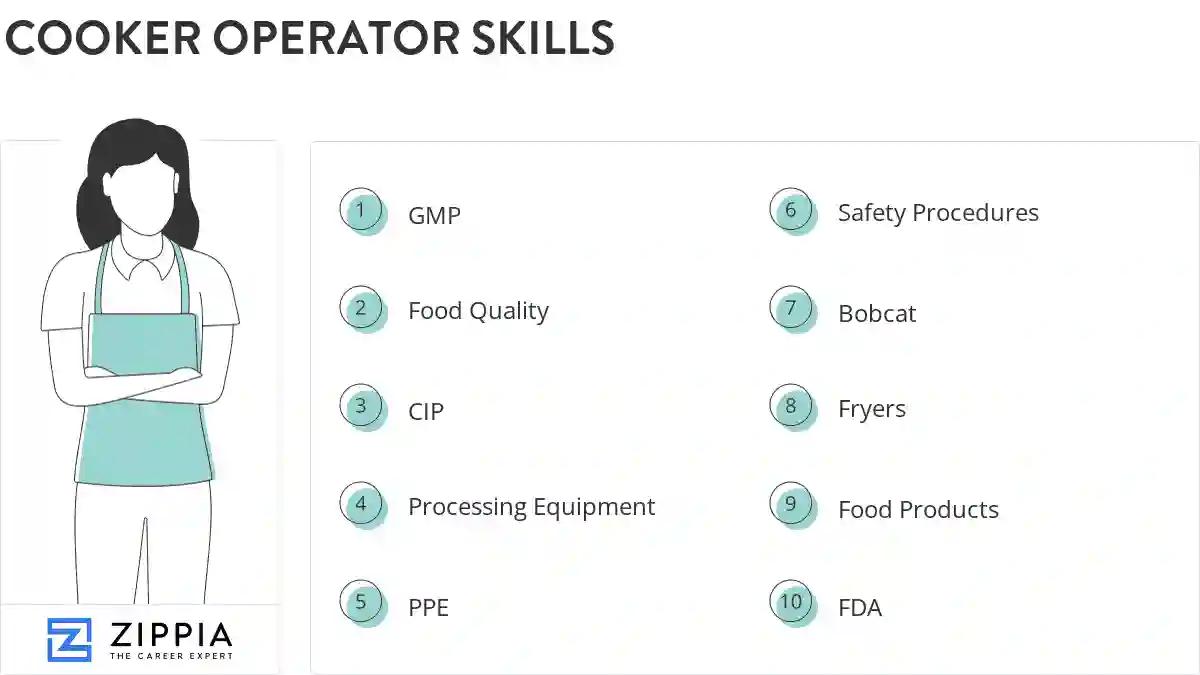
The most important skills for a cooker operator resume and required skills for a cooker operator to have include:
- GMP
- Food Quality
- CIP
- Processing Equipment
- PPE
- Safety Procedures
- Bobcat
- Fryers
- Food Products
- FDA
- Cooking Surfaces
- RAN
- Quality Checks
- Test Results
- Food Safety
- USDA
- Product Characteristics
- Food Orders
- Production Equipment
- Troubleshoot Equipment
Updated January 8, 2025
