
Automatically apply for jobs with Zippia
Upload your resume to get started.
Data keyer skills for your resume and career
15 data keyer skills for your resume and career
1. Data Entry
Data entry means entering data into a company's system with the help of a keyboard. A person responsible for entering data may also be asked to verify the authenticity of the data being entered. A person doing data entry must pay great attention to tiny details.
- Verified other data entry workers' information in computer
- Scanned, filed, research and indexed contract document as well as input data entry in computer system.
2. Subsequent Entry
- Read source documents, tickets, or bills, and enter data in computer for subsequent entry, using keyboard.
- Read source policy files documents and entered data in specific data fields in excel spreadsheet for subsequent entry using keyboards.
3. Data Entry Errors
- Stored completed documents in appropriate locations after locating and correcting data entry errors or reporting them to upper management.
- Participate in analyzing data entry errors and/or trends and helps to identify needed remedy actions.
4. Computer System
- Updated computer systems with pertinent collateral information, along with collateral exception information.
- Key information into computer systems for accuracy in database.
5. Detect Errors
- Compare or re-enter at least 400 tasks per hour in data verification format to detect errors.
- Deleted incorrect information and re-entered data in verification format on screen to detect errors.
6. Account Data
- Enter customer and account data by inputting alphabetic and numeric information on keyboard or optical scanner according to screen format.
- Verified and entered customer and account data by reviewing, correcting, deleting, or re-entering data.
Choose from 10+ customizable data keyer resume templates
Build a professional data keyer resume in minutes. Our AI resume writing assistant will guide you through every step of the process, and you can choose from 10+ resume templates to create your data keyer resume.7. Computer Database
A database or a computer database is a cluster of structured information stored in an electronic archive. This electronic data is administered through a database management system (DBMS), both (data and DBMS) of which are collectively referred to as a database system. The data is normally portrayed in the form of rows and columns for easy organization, management, alteration, and access. The organization of data in computer database enables users to write and query data efficiently.
- Edit existing account information in computer database.
- Input insurance information/data systematically into computer database.
8. Word Processing
- Use of spreadsheet software (MS Excel) and word processing software (MS Word).
- Maintained computerized records and database information by using word processing, spreadsheets and other applications to ensure accuracy of data.
9. WPM
WPM means words per minute, the average number of characters that a comment contains, which can also be referred to as keystrokes, against the time that person takes in keying them into the device. Mostly professional typists would type at a speed of 50 or 80 words per minute.
- Certified at WPM (words per minute): 40+.
- Call Center* Input information into computer* Inbound CallsSkills* Microsoft Office* Typing 60 WPM* Medical Terminology
10. Sales Reports
A sale report also known as the sales analysis report provides an overview of the situation of the sales within a company. It reveals various trends occurring in the sales numbers over a certain period. It also analyses the steps of the sales funnel, projects areas for improvement along with the performance of sales executives.
- Prepared weekly confidential sales reports for presentation to management.
- Assisted management with data entry of weekly sales reports and billing/collections documents.
11. Disk
- Entered information into database and backed up information to disk
- Created backup disks containing hospital information.
12. Verification Format
- Compared data source document to ensure accuracy and re-entered data in correct verification format.
- Re-entered data in verification format on screen to identify errors.
13. Input Data
- Input data from loans into MAC and Fred Systems in Custody.
- Input data in an accurate and efficient manner.Maintains complete confidentiality of records.
14. Proofread
Proofreading simply carefully checking your text for possible errors like typographical errors or mistakes in grammar, style, and spelling before it can be published or shared. This is generally known as the very last stage of any writing process when you need to fix minor spelling and punctuation mistakes, typos, formatting issues,
and inconsistencies.
- Transcribed data from source documents and proofread data entered with source documents for errors, missing/repeated data, and style rules.
- Proofread output generated for completeness, print quality, spelling, punctuation, and format.
15. Medical Insurance Claims
- Key medical insurance claims Verify medical insurance claims
5 Data Keyer resume examples
Build a professional data keyer resume in minutes. Browse through our resume examples to identify the best way to word your resume. Then choose from 5+ resume templates to create your data keyer resume.

What skills help Data Keyers find jobs?
Tell us what job you are looking for, we’ll show you what skills employers want.
List of data keyer skills to add to your resume
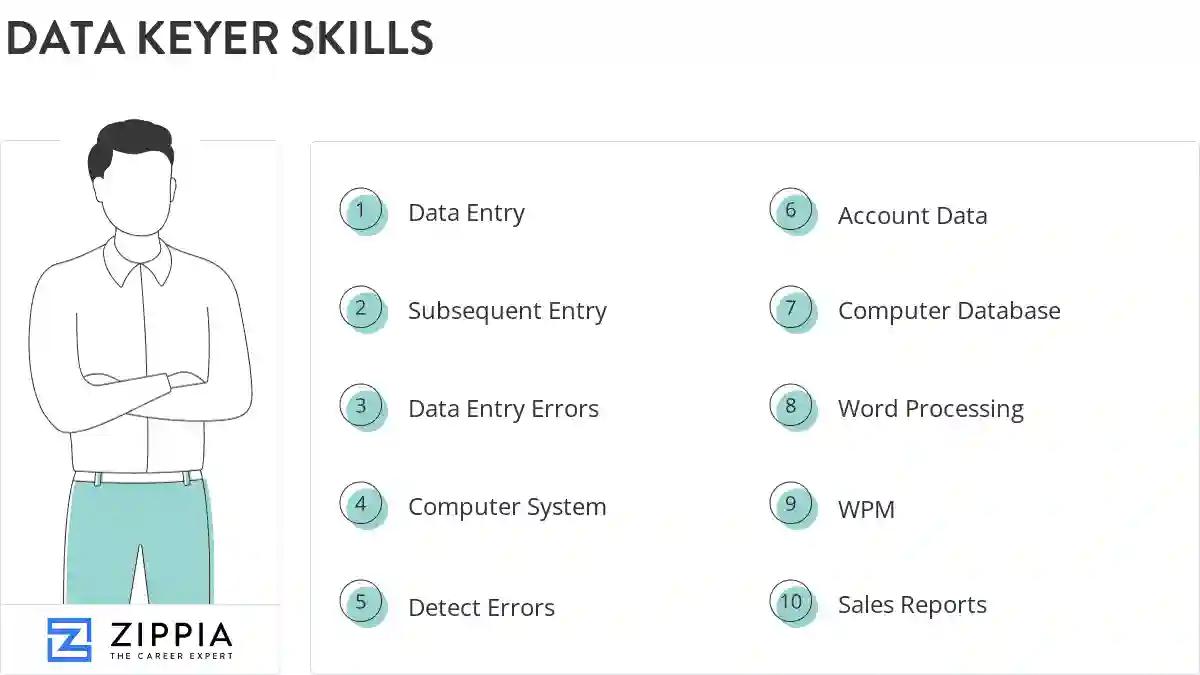
The most important skills for a data keyer resume and required skills for a data keyer to have include:
- Data Entry
- Subsequent Entry
- Data Entry Errors
- Computer System
- Detect Errors
- Account Data
- Computer Database
- Word Processing
- WPM
- Sales Reports
- Disk
- Verification Format
- Input Data
- Proofread
- Medical Insurance Claims
- Hippa
- Re-Enter Data
- AS400
- Insurance Verification
- Numeric Data
- Data Entry Devices
- Optical Scanner
- Healthcare
- Accuracy Rate
- Tax Returns
- CPT
Updated January 8, 2025
