
Automatically apply for jobs with Zippia
Upload your resume to get started.
Data security analyst skills for your resume and career
15 data security analyst skills for your resume and career
1. Data Security
- Maintained and documented internal data security controls consistent with audit requirements, including policies, procedures, and individual access authorizations.
- Provided technical support to client and management and staff in risk assessments and implementation of appropriate data security procedures and products.
2. Incident Response
Incident response is defined as the process by which a company or organization handles a cyber attack or a data breach. Along with dealing with the initial attack, this also deals with the possible consequences of the breach. The goal of incident response is to limit the damage caused by the attack.
- Participated in incident response, disaster recovery annual event and planning.
- Coordinate technical incident response and remediation activities for environment.
3. Access Management
Access management increases productivity while keeping the data of an organization secure. It ensures that the right users have access to appropriate technology resources.
- Serve as an administrator to the gateway utility tool for all account and access management requests for the company.
- Achieved complete user conversion to SAM Jupiter Identity Management software as a single point of user and access management.
4. Encryption
- Managed encryption software administration and support utilizing SafeGuard management center.
- Provided support of the enterprise workstations regarding our anti-virus, host intrusion, data protection, and end-point encryption security suite.
5. SQL
- Implemented patches through SQL scripts based on requirement changes or bug resolutions.
- Monitored SQL server reports on a weekly basis.
6. Security Procedures
A security procedure is a verification protocol used to check if an electronic signature, record, or performance belongs to that specific person. It is a set of necessary procedures that need to be performed to maintain security. These procedures are step-by-step guidelines on how to implement, enable, or enforce security.
- Documented security procedures/policies and practices and made recommendations for improvements.
- Applied standard security procedures associated with company policies and strategies.
Choose from 10+ customizable data security analyst resume templates
Build a professional data security analyst resume in minutes. Our AI resume writing assistant will guide you through every step of the process, and you can choose from 10+ resume templates to create your data security analyst resume.7. Risk Assessments
The process of analyzing and identifying the acts or events that have the potential to negatively affect an individual, asset, or business is called risk assessment. Risk assessments are important because they form an integral part of an organization as well as occupational safety plans
- Facilitated risk assessments by interviewing key business and technical people, documenting the process, and following up with audit recommendations.
- Conduct risk assessments in the evaluation and implementation for network security products, vendors, and services.
8. Security Systems
A security system refers to any device that can perform security operations such as surveillance, access control, alarm, or intrusion control in a facility or area through a system of components and multifunctional devices designed to protect people and the property against a variety of hazards including crime, arson, accidents, espionage, sabotage, subversion, and attack. A security system also detects several other threats, including smoke, carbon monoxide poisoning, and water damage.
- Provide off-hours support for information security systems during new system implementation or upgrades, if necessary.
- Upgraded security systems by monitoring security integrity, identifying security gaps, evaluating and implementing enhancements.
9. Data Analysis
- Performed data analysis and aggregation, event correlation and security threat definition.
- Conducted data analysis to logically identify opportunities for improvement of shrink reduction.
10. Firewall
- Test and evaluate new firewall technologies based on performance, security and suitability for corporate infrastructure.
- Worked with Network Engineers to implement firewall rules based on least-access principles for critical infrastructure environments.
11. Technical Support
Technical support or tech support are the services provided by any hardware or software company to users. They help in solving the technical difficulties the customers face with their products or services. Moreover, the tech support employees maintain, manage, and repair the IT faults. They are also responsible for resolving the network problems, installing and configuring hardware and software.
- Assisted users, management and other technical support personnel with analysis and resolution of security and network related access problems.
- Provide technical support on Information Protection related issues.
12. Mainframe
A mainframe is a high-performance digital computer used by large organizations for mission-critical applications, high transaction volumes, and reliable performance, designed for intensive high-speed computing for large-scale computing purposes that require greater availability and security which a smaller machine cannot offer.
- Performed security consulting and coordination for projects on mainframe application systems.
- Administered online security for global brokerage and mainframe production systems.
13. Security Issues
Security issues can be related to computer-based attacks, unauthorized physical access, and/or third-party breaches to either digital or physical locations. Security issue skills include locating, identifying, and eliminating the danger in time before any damage can be done.
- Monitored system usage and trending data to identify security risks, worked with management to resolve security issues.
- Resolved Sprint PCS user account security issues and facilitated implementation of security guidelines.
14. Data Loss Prevention
- Strengthened the Data Loss Prevention program by implementing new policies and standards to protect Enterprise data.
- Provided program management and team lead responsibilities in the MWHC Data Loss Prevention risk assessment and technology implementation.
15. Servers
Servers are computers or systems that provide services to other computers known as clients connected to them via a network. The services can range from data, resources, programs, or any other service that has to do with computing and computers.
It may also refer to someone at a restaurants that delivers the food to patrons from the kitchen.
- Managed automatic randomized password changes across Corporate and Branch workstations and servers utilizing Password Vault.
- Managed centralized and decentralized correlation servers for intrusion detection and log monitoring.
5 Data Security Analyst resume examples
Build a professional data security analyst resume in minutes. Browse through our resume examples to identify the best way to word your resume. Then choose from 5+ resume templates to create your data security analyst resume.

What skills help Data Security Analysts find jobs?
Tell us what job you are looking for, we’ll show you what skills employers want.
What skills stand out on data security analyst resumes?
Hanna Kim Ph.D.
Associate Professor, Chair, Adelphi University
I say "try to" as the reality is that having faculty in all 4 subfields is not possible for many reasons. (The 4 subfields are cultural anthropology, archeology, biological anthropology (sometimes physical anthropology), and anthropological linguistics. These subfields are mirrored in graduate school where students going for PhDs will be focused on 1 subfield.)
For undergraduates with an anthropology degree seeking employment, I can speak only from the faculty side, not the employer side. My students report these factors as relevant to their being hired (and accepted into competitive schools in museum studies, social work, law school, etc.:
Analytical skills; clear writing; ability to synthesize large amounts of reading and data into well-supported arguments and interpretations; open-mindedness toward different identities and ways of being.
A hugely important skill that anthropology graduates have is the ability to be presented with a complex situation or problem, and to be able to chart a plan on how to approach the problem, gather data and other necessary information to solve the problem, and then to come up with a solution or possible strategies. Too often, particularly in situations involving human behavior, what is needed is a stronger grasp of social and cultural factors that could impede the desired outcome. Students of anthropology know that ways of doing things, and even seeing and thinking, are profoundly influenced by categories of thought that are culturally situated. This means that problem solving has to consider a network of variables that have an impact on behavior. Anthropology students, I would argue, would embrace this complexity rather than be hesitant to acknowledge it in favor of a more expedient and, in the long run, less successful solution.
What hard/technical skills are most important for data security analysts?
Hanna Kim Ph.D.
Associate Professor, Chair, Adelphi University
What soft skills should all data security analysts possess?
David Feldman Ph.D.
Professor of Urban Planning and Public Policy and Political Science, Director, Water UCI, Director, MPP Program, University of California, Irvine
What data security analyst skills would you recommend for someone trying to advance their career?
Kit Cho
Associate Professor of Psychology, University of Houston - Downtown
Many employment-based websites such as Zippia provide a wealth of information on career-related trends. These websites also, conveniently, include information on the skills required for certain positions. Research the skills required to attain positions for which you are looking to advance in the near future and work on those skills. This will put you in a better position to seek a promotion or a raise.
What type of skills will young data security analysts need?
Mark Gibson
Clinical Associate Professor, Washington State University
List of data security analyst skills to add to your resume
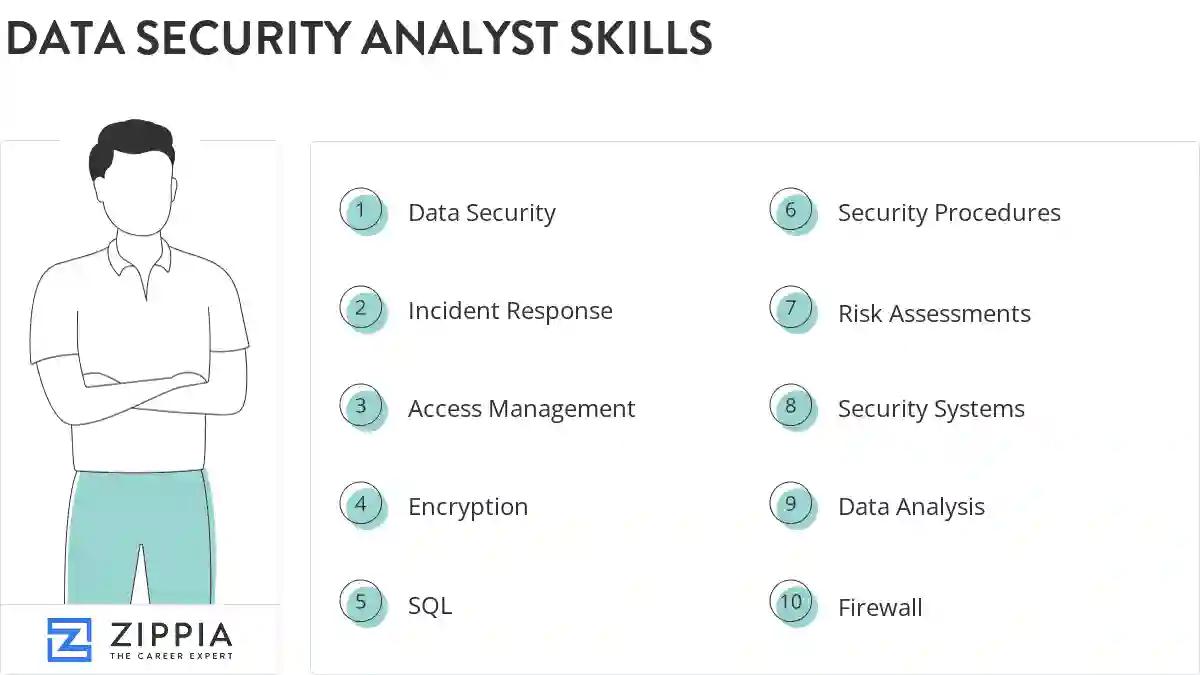
The most important skills for a data security analyst resume and required skills for a data security analyst to have include:
- Data Security
- Incident Response
- Access Management
- Encryption
- SQL
- Security Procedures
- Risk Assessments
- Security Systems
- Data Analysis
- Firewall
- Technical Support
- Mainframe
- Security Issues
- Data Loss Prevention
- Servers
- Provisioning
- Security Audits
- HIPAA
- SharePoint
- Linux
- IDS
- Security Incidents
- Key Management
- Security Awareness
- IP
- Application Security
- PCI
- Java
- Unix
- Security Measures
- SOX
- Switches
- VPN
- User Accounts
- Sarbanes-Oxley
- Security Administration
- Securities
- RACF
- Level Support
- Windows XP
- SAS
- Security Standards
- Gap Analysis
- Tcp Ip
- Phishing
- Security Violations
- LAN
- Technical Issues
- DOD
Updated January 8, 2025
