
Automatically apply for jobs with Zippia
Upload your resume to get started.
Database architect skills for your resume and career
15 database architect skills for your resume and career
1. Cloud
Cloud is a server that is accessed over the internet. There are different programs and software that also run on these servers. These clouds can be accessed from anywhere in the world as they are not present in your computer storage, but have their online servers. Cloud consists of data centers all across the world.
- Led several high profile customer engagements in the on premise and Cloud environments for install, cloning, migration and upgrades.
- Tried to implement Patch/Maintenance Plans using OEM 12c Cloud Control Patch Plan (company s rules prohibit such options).
2. Infrastructure
Infrastructure includes the organizational and physical structures needed to run an area or a society smoothly. It is a group of basic facilities required for any society or firm to run sustainably and efficiently. The infrastructural system is a high investing area and helps majorly in flourishing the economy and prosperity of a country. It is an underlying system needed for ensuring the safety and comfort of the public and to run a country smoothly. All the tasks needed to be performed for a flourishing economy and a happy and healthy public are included in infrastructure.
- Designed and implemented the database infrastructure of e-commerce and portal applications.
- Performed gap analysis on infrastructure architecture and its disaster recovery capabilities.
3. Java
Java is a widely-known programming language that was invented in 1995 and is owned by Oracle. It is a server-side language that was created to let app developers "write once, run anywhere". It is easy and simple to learn and use and is powerful, fast, and secure. This object-oriented programming language lets the code be reused that automatically lowers the development cost. Java is specially used for android apps, web and application servers, games, database connections, etc. This programming language is closely related to C++ making it easier for the users to switch between the two.
- Modified java code to redirect portal application to another database with different schema design.
- Developed data access level routines for Java programmers.
4. Database Design
- Work closely with Application team engineers to translate specific product requirements into database design and implementation.
- Directed and organized database design and client setup, and established back-up and recovery procedures.
5. Database Administration
- Provided database administration support for development and production database environments, including backup, recovery, and performance tuning.
- Reviewed database change requests from information technology development staff and prepared the database changes for the database administration staff.
6. ETL
- Developed ETL packages to migrate data between various data platforms, using SSIS, Hive, and Microsoft SQL Server.
- Produced dimensional data models and ETL processes to produce Navy's first Tobacco Cessation and Quit Rate tracking.
Choose from 10+ customizable database architect resume templates
Build a professional database architect resume in minutes. Our AI resume writing assistant will guide you through every step of the process, and you can choose from 10+ resume templates to create your database architect resume.7. Provisioning
- Develop Access application to automate billing reconciliation and account provisioning.
8. Data Architecture
- Collaborated with cross-functional groups to gather business requirements and translate needs into supportable platforms, including centralized data architectures.
- Mentored junior level analysts on methodologies / best practices on Data Architecture for Enterprise Data Warehouse development.
9. Data Warehouse
Data warehouse, often abbreviated as either DW or DWH is a system used in computing for data analysis as well reporting. The DW is also considered to be an integral component of business intelligence as they also provide storage facilities for both real-time and historical data. ETL and ELT are the two driving forces behind a data warehouse system.
- Transformed data in traditional normalized operational formats with SSIS to a data warehouse with data better suited for dimensional modeling.
- Researched billing and reporting requirements, and interviewed business analysts to design data warehouse tables.
10. Debugging
- Involved in system integration, debugging and troubleshooting of the development application and post implementations client site issue analysis and resolution.
- Provided guidance and support to junior developers while assisting in debugging problematic code and performance tuning operations as needed.
11. Microsoft SQL Server
- Led projects to migrate Ford's strategic relational database platform from Oracle to Microsoft SQL Server.
- Install and manage the corporate Microsoft SQL Server 2005 and 2008 database systems.
12. Linux
Linux is a Unix-like operating system. Just like Windows, Mac OS, and IOS, Linux is an operating system used by millions across the globe. Android itself is powered by the Linux operating system. Linux manages all the hardware resources that are associated with your computer. The software is famous because of the protection it grants from viruses, malware, and crashes. The Linux operating system is entirely free and is an open-source software meaning it can be altered by those equipped with the knowledge to code.
- Created a system to audit over 100,000 Linux / UNIX and Windows machines.
- Installed and configured Oracle 11gR2 on AIX, LINUX environments.
13. Cloud Computing
- Create, setup, configure instances in Amazon EC2 (Cloud computing).
14. Azure
- Completed Architecture/Migration to Azure using Queues/Blobs/Task Manager focusing on scalability and performance.
- Create administrative procedures, jobs, and code for managing the various SQL environments (Stand alone and Azure).
15. PL/SQL
- Mentored junior Database administrators (administration and backup/recovery) and PL/SQL developers (new database object techniques enhancing performance).
- Developed procedures, functions and packages, in Oracle PL/SQL, for data entry, verification and for complex query processing.
5 Database Architect resume examples
Build a professional database architect resume in minutes. Browse through our resume examples to identify the best way to word your resume. Then choose from 5+ resume templates to create your database architect resume.

What skills help Database Architects find jobs?
Tell us what job you are looking for, we’ll show you what skills employers want.
What skills stand out on database architect resumes?
Korydon Smith
Professor and Chair, University at Buffalo – The State University of New York
What soft skills should all database architects possess?
Randall Randall
Program Head Architecture, Professor, University of Idaho
What hard/technical skills are most important for database architects?
Randall Randall
Program Head Architecture, Professor, University of Idaho
What database architect skills would you recommend for someone trying to advance their career?
Dak Kopec Ph.D.
Associate Professor, Coordinator, BA Interior Architecture and Design and Master of Design Program, University Of Nevada, Las Vegas
Additionally, I would recommend learning about disease transmission and pathology. With a stronger foundation in these areas, the interior designer will be better equipped to address the infection control expectations that will likely be required of future Interior Designers.
What type of skills will young database architects need?
Michael Armstrong
CEO, NCARB
We also encourage graduates, and all who are considering the licensed practice as a career, to explore our newly-launched Destination Architect site, an interactive guide with video tutorials and useful tips.
List of database architect skills to add to your resume
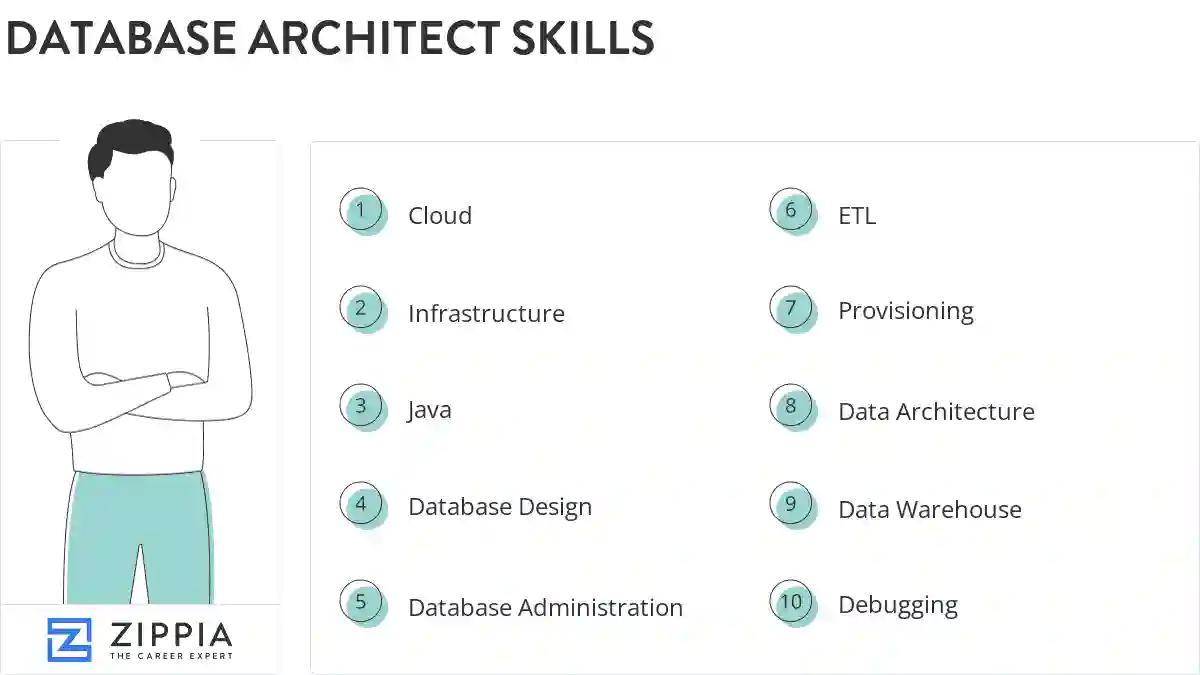
The most important skills for a database architect resume and required skills for a database architect to have include:
- Cloud
- Infrastructure
- Java
- Database Design
- Database Administration
- ETL
- Provisioning
- Data Architecture
- Data Warehouse
- Debugging
- Microsoft SQL Server
- Linux
- Cloud Computing
- Azure
- PL/SQL
- BI
- Data Analysis
- Database Systems
- Ssis
- Database Performance
- Data Warehousing
- DB
- Database Development
- Unix
- Data Quality
- DBA
- Oracle Sql
- Hadoop
- RMAN
- RAC
- Capacity Planning
- SSRS
- Backup Recovery
- Physical Data Models
- OLTP
- Data Migration
- OLAP
- T-SQL
- Extraction
- DB2
- Oracle 12C
- QA
- DR
- Visualization
- Oracle 11G
- Enterprise Architecture
- Windows Server
Updated January 8, 2025
