
Automatically apply for jobs with Zippia
Upload your resume to get started.
Database technician skills for your resume and career
15 database technician skills for your resume and career
1. Data Entry
Data entry means entering data into a company's system with the help of a keyboard. A person responsible for entering data may also be asked to verify the authenticity of the data being entered. A person doing data entry must pay great attention to tiny details.
- Worked with DBA to restructure database reducing data entry and increasing functionality.
- Trained temporary employees on data entry and error checking using MS-Access, MS-Excel, ArcGIS and the ADAMAS 3 application.
2. Database Management
- Managed online course registration for students each semester, including curriculum database management and programming of all registration rules and pre-requisites.
- Modify existing databases and database management systems or direct programmers and analysts to make changes.
3. Database Support
- Offered internal network administration and SQL database support.
- Provided operational and database support to the Global Status of Resources and Training Systems (GSORTS).
4. PL/SQL
- Developed AJAX, CSS, and HTML libraries wrapped in Oracle PL/SQL stored procedures to dynamically generate website content.
- Design and develop star schemas and data marts using OEM, SQL, IDS and PL/SQL.
5. Database Systems
- Utilize knowledge of database systems to assist operators in troubleshooting issues and optimization of testing process.
- Conducted meetings to inform the staff of weekly progress and developing a plan for future database systems.
6. Microsoft SQL Server
- Perform basic database administration task on Microsoft SQL server and Oracle.
- Produced daily database monitoring reports using Microsoft SQL Server reporting services and disseminate to management to report progress.
Choose from 10+ customizable database technician resume templates
Build a professional database technician resume in minutes. Our AI resume writing assistant will guide you through every step of the process, and you can choose from 10+ resume templates to create your database technician resume.7. Access Database
- Analyzed and optimized a problematic university HR department Microsoft Access database.
- Maintained and monitored a Microsoft Access database
8. Problem Resolution
A problem resolution refers to how a person identifies the problem, determining its cause, creating a reasonable solution, and implementing a conclusion. With the help of a client specialist, it is easier to handle such a situation. Problem resolution plays a vital role in helping resolve problems efficiently and effectively.
- Provided cross-functional training, support and problem resolution.
- Performed data enhancement functions and problem resolution for quality control.
9. Windows Server
- Installed and configured various versions of windows servers.
- Installed Windows Operating System, SQL Server 2000, SQL Server 2005, Windows Server 2003, and Virtual PC.
10. Troubleshoot
Troubleshooting is the process of analyzing and fixing any kind of problem in a system or a machine. Troubleshooting is the detailed yet quick search in the system for the main source of an issue and solving it.
- Provide IT support for the review, analysis, troubleshoot and repair of database issues.
- Build pc's for deployment using win batch scripts Troubleshoot connectivity issues for home and in-house users
11. Data Integrity
Data integrity denotes the consistency or accuracy validation of data in the whole lifecycle of data. It ensures the security of traceability and search-ability of all data in a person's device to the source.
- Managed and updated data integrity for internal database to ensure correct data is uploaded to minimize risk and exposure.
- Analyzed data sources, current process procedures to identify any data duplication and improvement of data integrity.
12. GIS
A geographic information system (GIS) is a tool for capturing, storing, manipulating, analyzing, managing and presenting various forms of geographic data.
- Analyzed potential suitability of various GIS data sources for data development projects.
- Supervised GIS data development team of four-to-thirteen direct reports.
13. Linux
Linux is a Unix-like operating system. Just like Windows, Mac OS, and IOS, Linux is an operating system used by millions across the globe. Android itself is powered by the Linux operating system. Linux manages all the hardware resources that are associated with your computer. The software is famous because of the protection it grants from viruses, malware, and crashes. The Linux operating system is entirely free and is an open-source software meaning it can be altered by those equipped with the knowledge to code.
- Participated in a Unix to Linux migration, including the coordination of user testing to ensure a smoother transition.
- Monitor Internal/External feeds from many systems platform Unix, Linux, AS/400, DEC, Mainframe.
14. Unix
UNIX is a computer operating system that was first created in the 1960s and has been constantly updated since then. The operating system refers to the set of programs that enable a machine to function. It is a multi-user, multi-tasking device that works on computers, laptops, and servers. UNIX systems also have a graphical user interface (GUI), similar to Microsoft Windows, that makes it simple to use.
- Engaged in extensive Unix scripting and some Perl scripting.
- Support the Basis Team activities in a ERP & ECC 6.0 environment Engaged in extensive Unix scripting and some Perl scripting.
15. Management System
A management system is a set of policies, processes, and procedures taken by an organization or a business to ensure it can fulfill its tasks and achieve its objectives. A management system makes sure that the company excels financially and improves the user experience. The management system also takes care of the worker's and employees' needs and manages their workload and oversees their performance. Apart from interior matters of the company, a management system also deals with exterior matters like legislations, tax matters, and law issues.
- Migrated data from MS Access to Head Start case management system and from SQL Server to Donor Perfectsoftware.
- Project Information Management System) for their review and approval.
5 Database Technician resume examples
Build a professional database technician resume in minutes. Browse through our resume examples to identify the best way to word your resume. Then choose from 5+ resume templates to create your database technician resume.

What skills help Database Technicians find jobs?
Tell us what job you are looking for, we’ll show you what skills employers want.
List of database technician skills to add to your resume
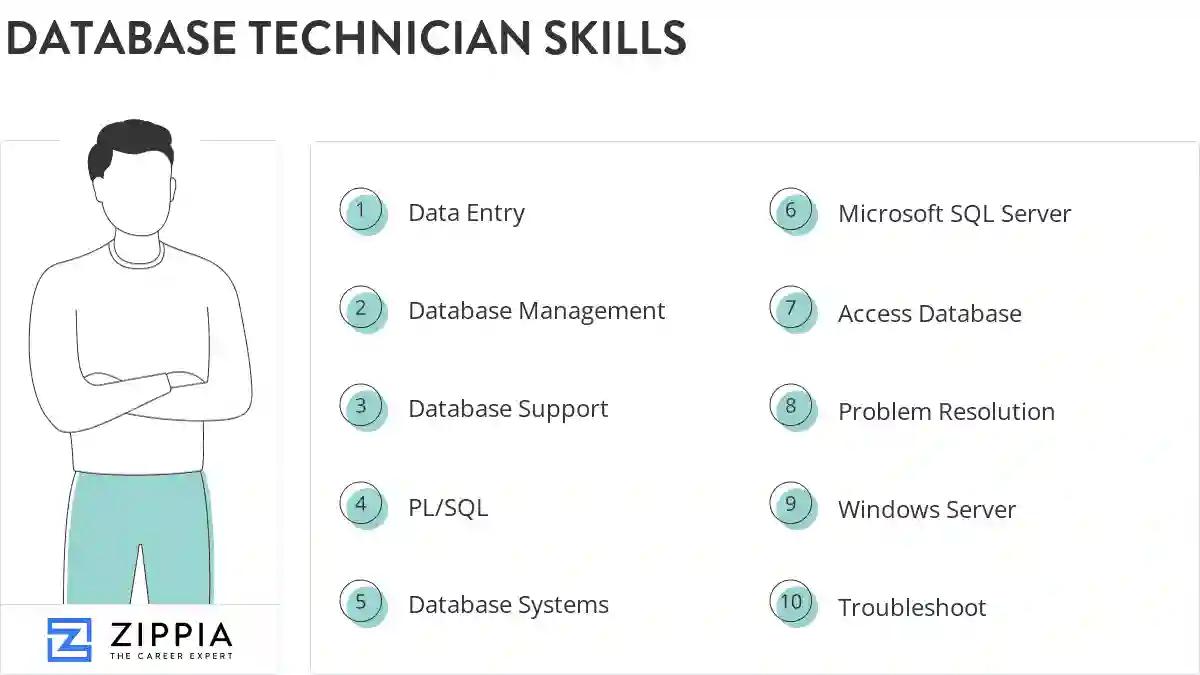
The most important skills for a database technician resume and required skills for a database technician to have include:
- Data Entry
- Database Management
- Database Support
- PL/SQL
- Database Systems
- Microsoft SQL Server
- Access Database
- Problem Resolution
- Windows Server
- Troubleshoot
- Data Integrity
- GIS
- Linux
- Unix
- Management System
- RAN
- Database Development
- Data Analysis
- ETL
- Customer Inquiries
- Database Maintenance
- HTML
- SharePoint
- New Database
- Software Upgrades
- Customer Database
- PowerPoint
- Infrastructure Changes
- Medicare
- Client Specifications
- AS400
- Connectivity Issues
- Financial Reports
- SLA
- CAD
Updated January 8, 2025
