
Automatically apply for jobs with Zippia
Upload your resume to get started.
Debug technician skills for your resume and career
15 debug technician skills for your resume and career
1. Debugging
- Utilized in-circuit test equipment for testing and debugging to component level.
- Performed system analysis, testing and debugging to defect root cause.
2. RF
- Analyze and clear difficulties on Analog, Digital, Fiber-Optic and RF printed wiring boards.
- Worked with test Engineering to improve board yields of all RF & Digital assemblies
3. Functional Test
- Performed thorough functional testing and cosmetic screening of product to component level while interfacing with computers and other electronic equipment.
- Monitored test status reports of burn-in and functional testing procedures to assist engineers and management.
4. Test Procedures
Test procedure i defined as a tool for conducting an experiment to analyze or observe the specifications of a process or application.
- Refine and confirm alternative test procedures, making recommendations for improvements to Engineering.
- Used Engineering documentation and Engineering Test Procedures to test, verify, and complete repairs.
5. IPC
IPC, Infection Prevention and Control is a practical, evidence-based approach that aids the prevention, transmission, or control of the spread of infections in patients and health workers.
- Lead Technician physically repairing and modifying PCB s using high skill levels to meet all IPC recognized standards and ESD requirements.
- Performed wiring, harnessing, cabling including wire stripping, crimping, layout and lacing per IPC 620.
6. Linux
Linux is a Unix-like operating system. Just like Windows, Mac OS, and IOS, Linux is an operating system used by millions across the globe. Android itself is powered by the Linux operating system. Linux manages all the hardware resources that are associated with your computer. The software is famous because of the protection it grants from viruses, malware, and crashes. The Linux operating system is entirely free and is an open-source software meaning it can be altered by those equipped with the knowledge to code.
- Distributed helpful information regarding technical topics of interest to the team, usually Linux related.
- Developed and created one-touch automated Microsoft Windows/Linux CD/DVD/Network operating system install for various GEHC products.
Choose from 10+ customizable debug technician resume templates
Build a professional debug technician resume in minutes. Our AI resume writing assistant will guide you through every step of the process, and you can choose from 10+ resume templates to create your debug technician resume.7. PCI
- Test and troubleshoot Digital/Compaq /HP Alpha Series EV4/5 based on CPU's and PCI devices to component level.
- Utilized Fiber Channel, SCSI, PCI, SPI technologies, and other proprietary protocols.
8. PCB
The PCB (Printed Circuit Board) refers to the hardware part housing all of the device's electrical connections.
- Showed technical leadership in investigation and troubleshooting of first articles, PCB's and customer returns.
- Follow the new ECO to upgrade PCB to current revision.
9. System Test
- Support with system test failure and product testing.
- Debug board and completed system test.
10. Technical Assistance
Technical assistance is the non-financial assistance provided by local or international specialists. The purpose of technical assistance is to maximize the project's implementation and quality of the final product. Technical assistance consists of sharing information, the transmission of working knowledge, and other transfer of technical data which would aid the administration, management team and help build the project. The technical assistance focuses on particular needs identified by the beneficiary country and is delivered in the form of missions.
- Provided technical assistance and guidance to other technical personnel.
- Provided technical assistance to test operators.
11. Test Fixtures
- Used various test equipment such as ICT machines, VOM's, oscilloscopes, and other test fixtures.
- Examined data of failed boards, then set up of test fixtures.
12. Failure Analysis
Failure Analysis is a step-by-step process of determining the reason for a particular machine or equipment failure by way of checking, identification, and examination. It means conducting a test within the system and perform a maintenance check that leads you to a conclusion. A failure analysis takes place to prevent further damages.
- Assisted Engineering with failure analysis.
- Debug Technician, Failure Analysis Inspected and examined cell phones to test for corrupt software.
13. JTAG
- Performed in-circuit emulation and boundary scan testing (JTAG).
- Use of spectrum analyzer, base station emulators, DMM, JTAG, various programming cables and harnesses.
14. R
R is a free software environment and a language used by programmers for statistical computing. The R programming language is famously used for data analysis by data scientists.
- Use of hardware and software in order to conform to R and D procedures.
- Assist R &D engineers to test and build new production.
15. PC
- Maintained accurate reports/performed general PC operations.
- Utilized Oracle data base software to keep record of the failure PC board.
5 Debug Technician resume examples
Build a professional debug technician resume in minutes. Browse through our resume examples to identify the best way to word your resume. Then choose from 5+ resume templates to create your debug technician resume.

What skills help Debug Technicians find jobs?
Tell us what job you are looking for, we’ll show you what skills employers want.
List of debug technician skills to add to your resume
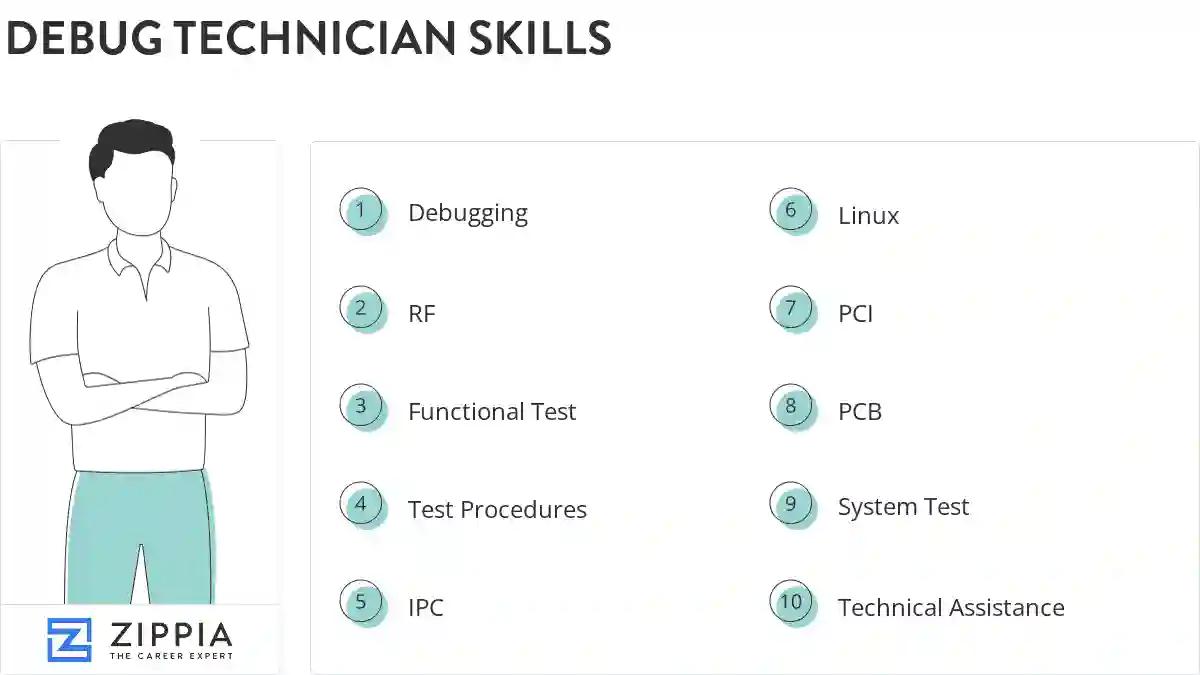
The most important skills for a debug technician resume and required skills for a debug technician to have include:
- Debugging
- RF
- Functional Test
- Test Procedures
- IPC
- Linux
- PCI
- PCB
- System Test
- Technical Assistance
- Test Fixtures
- Failure Analysis
- JTAG
- R
- PC
- ICT
- SMT
- Analog Circuits
- Windows
- Procedure Updates
- Equipment Logs
- RMA
- Electronic Test Equipment
- CPU
- Bios
- Product Line
- DVM
- Test Stations
- Test Failures
- QA
- DMM
- III
- ESD
- Compatibility
- FDA
- Electronic Components
- Computer Software
- Unix
- Logic Analyzers
- BGA
Updated January 8, 2025
