
Automatically apply for jobs with Zippia
Upload your resume to get started.
Decision analyst skills for your resume and career
15 decision analyst skills for your resume and career
1. Data Analysis
- Introduced regression analysis to the team as an additional tool for data analysis.
- Performed comprehensive clinical data analysis for a major pharmaceutical company for diabetes and depression benchmarking studies.
2. SQL
- Trained analysts on SQL topics such as correlated sub queries and Oracle's DECODE function.
- Collaborated with customers to create or modify complex customized Crystal Reports and SQL queries for rapid distribution to individual customer locations.
3. SAS
SAS stands for Statistical Analysis System which is a Statistical Software designed by SAS institute. This software enables users to perform advanced analytics and queries related to data analytics and predictive analysis. It can retrieve data from different sources and perform statistical analysis on it.
- Develop predictive models using SAS Enterprise Miner.
- Interpreted and analyzed statistical data using SAS computer programs providing valuable insight toward the development of banking clients marketing efforts.
4. PowerPoint
- Generated Executive PowerPoint reports aimed at summarizing the annual findings of periodic benchmark and trend analysis, and identifying discrepancies.
- Created interpretations of numerical analysis to be reviewed in Microsoft PowerPoint presentations for optimal pricing and customer retention.
5. Data Collection
Data collection means to analyze and collect all the necessary information. It helps in carrying out research and in storing important and necessary information. The most important goal of data collection is to gather the information that is rich and accurate for statistical analysis.
- Participated in development of written analysis, executive summary and talking points; developed recommendations for improved data collection and analysis.
- Coordinate with various measurement offices concerning electronic measurement data transfer, area balancing, and data collection activities system wide.
6. Credit Card
A type of card issued by banks and other financial institutions, that enable users to manage and borrow their finances is called a credit card. The funds borrowed from a financial institution through a credit card are meant to be paid back along with certain amounts of interest imposed by the bank.
- Managed software development projects and functional specifications for credit card related systems.
- Processed bank and credit card reconciliation along with all monthly entries.
7. BI
- Manage one staff (MIS Officer), who handles the basic functions of the BI Unit.
- Identified growth opportunities, areas of enhancement & investment, and defined training needs in ECM and BI.
8. Analytical Support
Analytical support consists of categories that include logical reasoning, critical thinking, communication, research, data analysis, and creativity to break down information or something into parts or smaller categories to enhance understanding in order to draw conclusions.
- Developed business with new customer, providing acquisition, modeling and simulation, and analytical support for four separate projects.
- Maintained accountability for technical activities and analysis; provided analytical support to project leadership and strategic input for program execution.
9. Data Quality
- Rule statements pertaining to data quality and credit score.
10. Credit Risk
Credit risk entails the risk experienced by a lender from the possibility of losing money due to a borrower failing to repay or meet their obligations set out in a loan contract. Credit risk manifests in many forms including loans (the most popular), letters of credit, foreign exchange and lines of credit.
- Performed ad hoc analysis of credit risk, product valuation and asset analysis.
- Served as Credit Risk Lead for Small Business Instant Prescreening Project.
11. Business Rules
- Formulate complex business policy and processes into Decision Models (business rules) and Business Process Models (BPM).
- Prepare reports to assist various business areas understand the business rules of various systems in order to conduct analysis.
12. Regression
- Created predicative models to forecast market demand using Generalized Linear Regression models.
- Selected appropriate binding models using a combination of physical arguments and regression.
13. Analytical Tools
- Developed analytical tools using AC Nielson scan and shipping tracking (EDI) data.
14. R
R is a free software environment and a language used by programmers for statistical computing. The R programming language is famously used for data analysis by data scientists.
- Enabled development of pricing models for clients (Home Depot, Lee), using Bayesian hierarchical models with R software.
- Worked on data extraction, validation, and Data Visualization of large data sets using, R Studio & Tableau.
15. SME
The term ‘small and medium-sized enterprises' is meant to describe businesses of varied sizes who fall below certain limits and targets set by various organizations, such as the World Bank and the UN. SMEs, as they are commonly known, are an important part of any economy and generally, in healthy economies, should vastly outnumber other forms of business, such as multi-level corporations, because they collectively employ more people, pay better, and produce more money.
- Provided support to developers and business as an application SME supporting product development, new investments and customer relationship management.
- Secured SME presenters, and developed evaluation process to determine proficiency of audience.

What skills help Decision Analysts find jobs?
Tell us what job you are looking for, we’ll show you what skills employers want.
What skills stand out on decision analyst resumes?
David Feldman Ph.D.
Professor of Urban Planning and Public Policy and Political Science, Director, Water UCI, Director, MPP Program, University of California, Irvine
What decision analyst skills would you recommend for someone trying to advance their career?
Lan Jiang Ph.D.
Associate Professor, Menlo College
2. Communication skill, both language arts and interpersonal social skills.
What type of skills will young decision analysts need?
Lise Abrams Ph.D.
Professor of Linguistics and Cognitive Science; Coordinator of Cognitive Science, Pomona College
What hard/technical skills are most important for decision analysts?
Jason Caudill Ph.D.
Professor of Business, King University
List of decision analyst skills to add to your resume
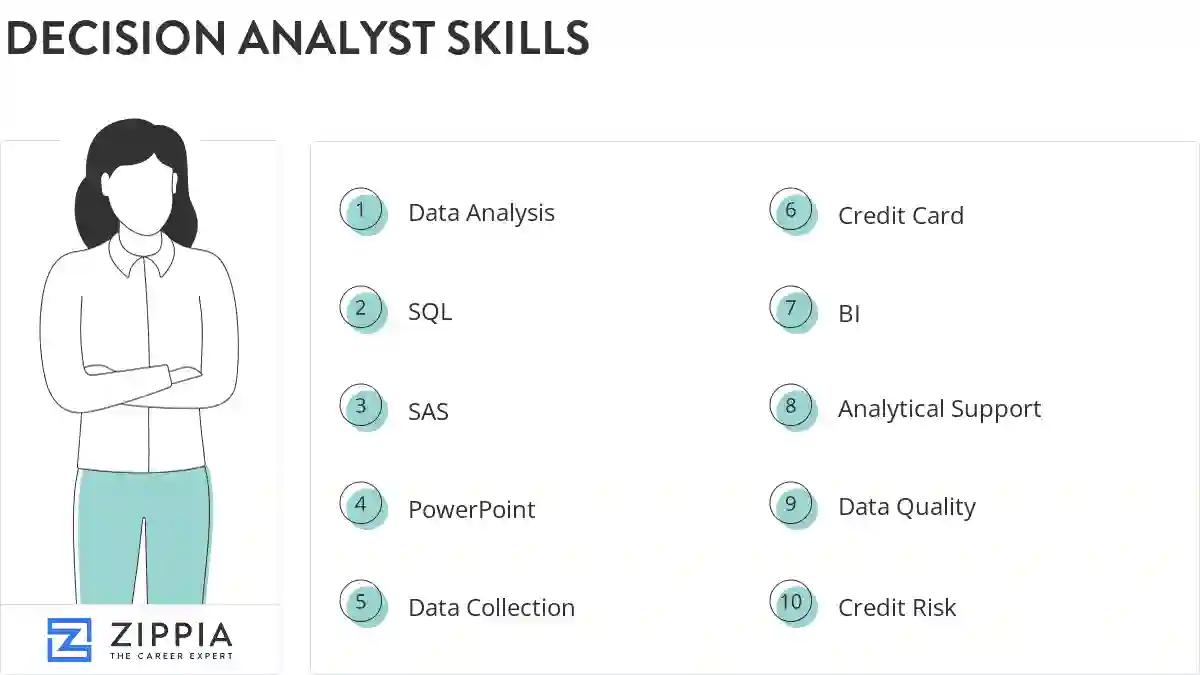
The most important skills for a decision analyst resume and required skills for a decision analyst to have include:
- Data Analysis
- SQL
- SAS
- PowerPoint
- Data Collection
- Credit Card
- BI
- Analytical Support
- Data Quality
- Credit Risk
- Business Rules
- Regression
- Analytical Tools
- R
- SME
- Statistical Analyses
- Statistical Models
- Business Analysis
- ROI
- Economic Models
- Economic Analysis
- Data Integrity
Updated January 8, 2025
