
Automatically apply for jobs with Zippia
Upload your resume to get started.
Deployment analyst skills for your resume and career
15 deployment analyst skills for your resume and career
1. Supply Chain
A supply chain is a network or a sequence by which finished products of a company are distributed to retailers and then supplied to the end-users. The distribution of products and services from the production line to the final buyers is carried out in a series of steps including; manufacturing, transportation, and their distribution. The whole supply chain consists of different entities including; manufacturers, transportation, warehouses, suppliers, and retailers. The entities ensure that the products retain their originality while also minimizing the cost of delivery.
- Managed the flow of finished stock inventory through the supply chain by utilizing SAP tools and detailed analysis.
- Managed the process to re-distribute inventory throughout the supply chain network.
2. Logistics
Logistics is a complete organization and implementation of a problem. Logistics are often considered in a complex business operation, as some works need detailed plannings. Logistics are also used in military action.
- Coordinated all logistics for program delivery (shipping, facility location, billing, hotel).
- Work with Logistics to resolve external constraints that impact inventory flow to distribution centers and stores.
3. Data Gathering
- Designed research plans for data gathering and analysis.
4. Technical Support
Technical support or tech support are the services provided by any hardware or software company to users. They help in solving the technical difficulties the customers face with their products or services. Moreover, the tech support employees maintain, manage, and repair the IT faults. They are also responsible for resolving the network problems, installing and configuring hardware and software.
- Offer technical support to users, to include connecting remotely for support.
- Conducted classroom and OJT training to professional end-users, administrative support staff and technical support staff on technical architecture and administration.
5. SQL
- Designed and Developed Data Conversion Program using AE with CI, Excel to CI and SQL Loader.
- Involved in various performance tuning of AE and SQL.
6. Distribution Centers
Distribution centers are vital to the supply chain industry. They feature a specialized center that deals with the storage and shipping of goods as well as other vital distribution processes concerned with stocks and inventory.
- Minimized product shelf-life devaluation by ensuring timely inventory movement throughout the network of distribution centers.
- Discovered cost-effective methods for moving finished goods from factories to distribution centers.
Choose from 10+ customizable deployment analyst resume templates
Build a professional deployment analyst resume in minutes. Our AI resume writing assistant will guide you through every step of the process, and you can choose from 10+ resume templates to create your deployment analyst resume.7. PC
- Maintain all training PC, Books 24/7, Virtual online courses and/or access, library and other channels of training.
- Managed the PC setup and transfer of end-user data from old Windows XP PCs to the Windows 7 PCs.
8. Inventory Management
- Performed automated transactions in the inventory management system of internal and external inventory movements with 100% accuracy.
- Analyzed past performance to identify opportunities to improve inventory management performance.
9. DOD
Definition of Done (DoD) is a set of deliverables that are needed to devise software. These deliverables are valuable to the system and can be exemplified by writing code, coding comments, unit testing, integration testing, design documents, release notes, and so on.
- Developed, designed and implemented automated spreadsheet and database applications for US DoD Navy agencies.
- Ensured individual personnel compliance with all DoD requirements and regulations.
10. Go-Live
The term ‘Go-live' is used to define a period when a product/service becomes ready to use. Going live is commonly used in the software industry to indicate that the software or the program has entered the production stage, where it is ready for the users.
- Provided Go-Live support for HMS Patient Care and software upgrades.
- Provided immediate Go-Live support for end-users after an Epic implementation.
12. Technology Deployment
- Engineered and developed strategic planning databases for store technology deployment tracking and corporate deployment projects.
13. Deployment Process
- Developed procedures and documentation regarding deployment process.
- Monitor production deployment process with system engineers.
14. Led Training
- Led training programsdesigned to implement new system development for locations throughout the country.
15. Epic
Epic is a private healthcare company which developed and continues to provide a software intended for healthcare professionals and the organization and management of medical records. It is by far one of the largest in its field, with over 50% of patients having a medical record present in their system. Patients, as well as clinics and various medical professionals and facilities are all able to use this system to keep medical history and information safe and easy to reach, alter, and share with the necessary people.
- Implemented Health Connect (EPIC Ambulatory Systems) in several medical facilities Across Southern California.
- Collected data, provided analysis and interpretation of the Epic Care Ambulatory system.
5 Deployment Analyst resume examples
Build a professional deployment analyst resume in minutes. Browse through our resume examples to identify the best way to word your resume. Then choose from 5+ resume templates to create your deployment analyst resume.

What skills help Deployment Analysts find jobs?
Tell us what job you are looking for, we’ll show you what skills employers want.
What skills stand out on deployment analyst resumes?
David Feldman Ph.D.
Professor of Urban Planning and Public Policy and Political Science, Director, Water UCI, Director, MPP Program, University of California, Irvine
What deployment analyst skills would you recommend for someone trying to advance their career?
Travis Grosser Ph.D.
Associate Professor of Management (@ UConn School of Business), University of Connecticut
1. Innovative and Critical Thinking: The ability to think creatively and critically to solve complex problems will be highly valued, especially in a rapidly changing business landscape.
2. Emotional Intelligence: The ability to understand and manage one's own emotions, as well as empathize with others, will be crucial for successfully navigating a workplace where change, diversity, and collaboration will continue to increase.
3. Leadership and Change Management: Skills in leading teams, managing change, and inspiring innovation will be essential as businesses navigate through transitions and transformations.
4. Digital Literacy and Technological Proficiency: As technology continues to evolve rapidly, proficiency in digital tools and platforms will be crucial. Understanding emerging technologies like artificial intelligence, blockchain/Web3, and data analytics will be increasingly valuable.
What soft skills should all deployment analysts possess?
Jason Imbrogno Ph.D.
Associate Professor, University of North Alabama
What hard/technical skills are most important for deployment analysts?
M. Douglas Berg
Associate Professor, Sam Houston State University
-Identify the data type
-Know which analytical techniques are appropriate for each data type
-Be capable of performing the appropriate analytical technique
-Be capable of communicating the outcome of the analytical procedure
A solid understanding of regression techniques, along with their limitations, is essential.
It almost goes without saying that a business analyst has good computer skills.
Beyond entry-level, with more experience, the analyst should be able to frame the research question(s) in a testable format.
List of deployment analyst skills to add to your resume
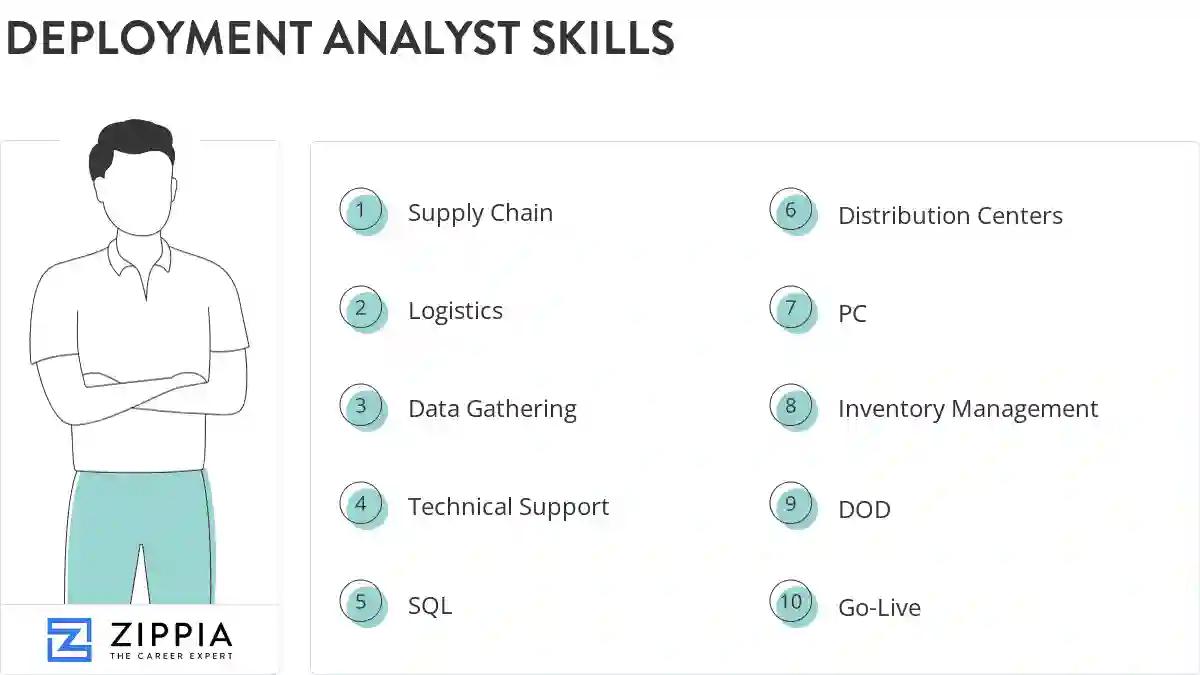
The most important skills for a deployment analyst resume and required skills for a deployment analyst to have include:
- Supply Chain
- Logistics
- Data Gathering
- Technical Support
- SQL
- Distribution Centers
- PC
- Inventory Management
- DOD
- Go-Live
- SharePoint
- Technology Deployment
- Deployment Process
- Led Training
- Epic
- SCCM
- SLA
- Inventory Control
- Deployment Strategy
- EDI
- MSI
- Software Installation
- POS
- UAT
- Windows XP
- Troubleshoot
- Data Analysis
- Training Sessions
- Post Deployment
- VPN
- Training Materials
- Legacy Systems
- Remote Desktop
- OS
- Distribution Network
- Surgery
- KPI
- PowerPoint
- Goods Inventory
- Remote Support
Updated January 8, 2025
