
Automatically apply for jobs with Zippia
Upload your resume to get started.
Design coordinator skills for your resume and career

15 design coordinator skills for your resume and career
1. Revit
Revit, also known as Autodesk Revit, is computer software used by architects, structural engineers, and designers to perform building modeling tasks. Revit was designed to facilitate users, draw building modeling structures in a 2D and 3D format. Creating such models allows architects and engineers to pre-planning, scheduling, estimating the life of the structure and the entire cost of construction.
- Specialized Law Enforcement Revit families.
- Set up, clean up and maintain Revit models and CAD drawings received from architectural, structural and civil engineers.
2. Sketch
- Received training on Shaw Cable Manager, Smart Plant, Smart Sketch, PDS Equipment modeling, and PDS EE raceway.
- Sketch and record changes requested on elevations, floor plans, and electrical plans by buyer.
3. BIM
BIM or Building Information Modelling is a process in which buildings, infrastructure, and other physical structures and places are translated into digital means, into various forms of computer files, 3D models, and digital plans.
- Created, revised and implemented new core process guidelines for BIM training purposes.
- Created processes and quality control programs for firms starting to use BIM programs.
4. Design Projects
Design projects are used to create a product or service to serve a specific customer or client need. They may entail thinking about the ideas, materials necessary for the idea and the steps that will be followed to realize the idea.
- Managed operational, financial, quote/bid, and administrative functions pertaining to all design projects
- Assigned gauge/fixture and miscellaneous design projects, assuring timely production.
5. Project Management
- Delivered outstanding project management for condo conversions and luxury high-rise buildings for a family-owned and operated real estate development company.
- Project Management and Design Coordination for all Capital Projects.
6. Graphic Design
Graphic design is the art of making visual content to communicate messages. Designers apply different page layout methods and visual hierarchy by using letters and pictures to meet the need of end-users. Most companies use graphic design to sell their product or services and to convey complicated information by using infographics.
- Distributed incoming information to expedite the completion of graphic design or production projects.
- Coordinated with graphic designers to ensure accuracy and quality of customer's advertisement.
Choose from 10+ customizable design coordinator resume templates
Build a professional design coordinator resume in minutes. Our AI resume writing assistant will guide you through every step of the process, and you can choose from 10+ resume templates to create your design coordinator resume.7. PowerPoint
- Created PDF application forms, edited photos and created PowerPoint presentations.
- Researched and developed multimedia presentations using PowerPoint, created numerous how-to handouts, and developed an audio-terminology dictionary.
9. MEP
MEP is generally a term used in construction, and it stands for Mechanical, Electrical, and Plumbing. MEP engineering refers to the process of developing, planning, and managing the mechanical, electrical, and plumbing system of a building or architecture.
- Developed strategies to deliver a complete well-coordinated project among not only MEP subcontractors but also architectural and structural subcontractors.
- Developed solutions to MEP problems and conflicts through timely and accurate interpretation of contract documents.
10. Autodesk Revit
- Use of Autodesk Revit Architeture, Revit Structure and Revit MEP.
11. Design Development
Design development is used to refer to a number of positions and skills in a number of different industries. In the architectural world, Design Development is used to refer to an architectural plan that is already halfway or more done but needs further development, alteration, and testing. In the automotive industry, it refers to the skills necessary to create and develop new car, engine, and other designs, as well as to ensure that all designs are safe and effective.
- Coordinate and prepare documentation for schematic design, design development and/or construction documents as assigned by the Project Manager.
- Worked closely with architect and builder on design development for core demographics, using aging in place and universal design principles.
12. Auto CAD
- Designed electrical distribution and transmission lines for new and existing systems using Auto CAD.
- Trained an entire drafting team using Auto Cad drafting programs.
13. Design Software
Design software is used to create, edit, and display various types of graphics and images, including but not limited to photography, 3D design, and the website interface. It enables users to create a wide variety of visual files and offers various tools and functions to enhance the user's artistic skills and techniques. Some features include design, image editing, and digital illustration. Design software might also reference the actual act of creating a piece of software or application with a larger business or product goal in mind.
- Sketched garments and designed prints using Computer Aided Design software.
- Design various strip ad and half page artwork for non-weekly Chronicle print advertisements using Indesign software.
14. Design Layouts
- Prepared design layouts and detail drawings pertaining to new concepts, conversions and modifications of packaging and processing equipment.
- Coordinate design layouts for space management to other related trades for accuracy.
15. Design Process
The process by which a product is formed is referred to as the design process. It requires the conceptualization of what the product may look like in terms of aesthetics, what it will be made of and most importantly, what it will do. A design process puts this process in order so that the creation of the product is seamless and has the least amount of errors and slack while it is being made.
- Developed a successful design process to meet quality management certification for the company.
- Worked with management to improve efficiency and streamline the design process and training of new associates.
5 Design Coordinator resume examples
Build a professional design coordinator resume in minutes. Browse through our resume examples to identify the best way to word your resume. Then choose from 5+ resume templates to create your design coordinator resume.

What skills help Design Coordinators find jobs?
Tell us what job you are looking for, we’ll show you what skills employers want.
What skills stand out on design coordinator resumes?
Katie Rothfield
FL Registered Interior Designer, Director of Career and Talent Development for CARTA, Associate Teaching Professor, Internship Coordinator, Florida International University
Internship experience will always set a candidate apart from the crowd. Given the pandemic's negative impact on the number of full-time interior design positions, a recent graduate could secure paid internship opportunities while looking for full-time employment. This would help boost their resume and could get their foot in the door at a company that may hire full-time positions as the vaccine becomes more widely available.
Most companies expect recent interior architecture/design graduates to be proficient in a variety of computer programs, such as AutoCAD, Revit, and SketchUp. Alumni can stay current and add software programs to their resumes by watching online tutorials and improving their projects for their portfolios.
Professional exams demonstrate leadership and help candidates rise to the top of the resume stack. Leadership in Energy and Environmental Design (LEED) and WELL accreditation demonstrate knowledge of sustainable design practices and a commitment to designing interiors that positively affect human health and wellbeing. In addition, passing the Interior Design Fundamentals Exam (IDFX - the first section of the National Council for Interior Design Qualification (NCIDQ) Exam) confirms acquisition of interior design knowledge that is essential to the profession. Interior architecture/design majors can take all three of these exams prior to graduation.
What design coordinator skills would you recommend for someone trying to advance their career?
Georges Fares
Assistant Professor, Website
What technical skills for a design coordinator stand out to employers?
James Adler
Adjunct Professor of Fine Arts, Saint Peter's University
(a) First, and foremost, is the quality of the artist to be engaged or hired
(b) Do they possess the performing "chops?"
(c) Has the artist or performer prepared and learned the music, in advance of the first rehearsal, or run-through?
(d) Does he/she/they show up on time?
As they say, one gets a first chance to make a "first impression." The above-listed components will go into a hire.
What soft skills should all design coordinators possess?
Eric Sung
Associate Professor, Providence College
Considering the market trend change during and past COVID, where more jobs will require specialized skills with less human interaction, the needs of having someone with communication skills, conflict resolution and mediation skills, negotiation skills would be far more preferred. Knowing that large part of what some of the current jobs require us to do eventually will be assisted or entirely replaced by AI, the skills that may be unique to humans will gradually became more important. Other critical soft skills would be adaptability, foundational problem-solving skills with diversified perspective on matters. and relatability to the other thoughts.
List of design coordinator skills to add to your resume
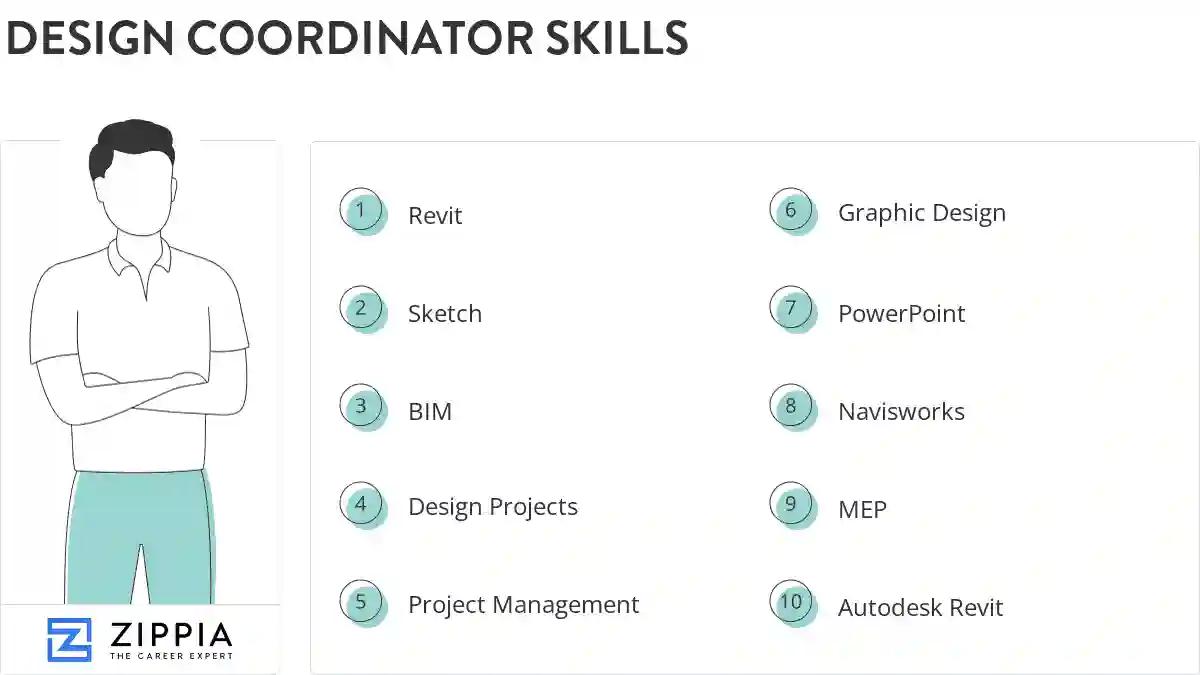
The most important skills for a design coordinator resume and required skills for a design coordinator to have include:
- Revit
- Sketch
- BIM
- Design Projects
- Project Management
- Graphic Design
- PowerPoint
- Navisworks
- MEP
- Autodesk Revit
- Design Development
- Auto CAD
- Design Software
- Design Layouts
- Design Process
- QC
- Design Concepts
- Adobe Illustrator
- Shop Drawings
- HVAC
- Adobe Photoshop
- Space Planning
- Design Studio
- Product Development
- Aided Design
- Construction Projects
- R
- BOM
- Construction Drawings
- P Id
- HTML
- GIS
- Design Drawings
- Cost Estimates
- Administrative Tasks
- RFI
- Training Materials
- Promotional Materials
- SEO
- Media Management
- Photo Shoots
- Embroidery
- CSS
- Presentation Boards
- Trade Shows
- Travel Arrangements
- ELearning
Updated January 8, 2025
