
Automatically apply for jobs with Zippia
Upload your resume to get started.
Design internship skills for your resume and career

15 design internship skills for your resume and career
1. Design Intern
- Summer Design Intern for a New York-based marketing and communications agency specializing in non-traditional advertising, public relations, and branding.
- Design internship position at a high-end architecture and interior design firm specializing in residential renovations and small-scale commercial work.
2. Sketch
- Formulated and expressed design ideas through sketch iterations.
- Helped with light sketch edits on illustrator - Organized season books and put together the color cards and samples.
3. Graphic Design
Graphic design is the art of making visual content to communicate messages. Designers apply different page layout methods and visual hierarchy by using letters and pictures to meet the need of end-users. Most companies use graphic design to sell their product or services and to convey complicated information by using infographics.
- Utilized elements of graphic design and patient free responses to redevelop and re-launch previously discontinued reporting system.
- Coordinated with engineers and graphic designers to create in-car and out-of-car feedback for historically logged driver data.
4. User Experience
- Created designs and interactive components with a deliberate focus on usability, user experience, typography, and strong visual communication
- Designed and proposed user experience and information architecture of a customized SharePoint Social system for the organization's 180,000 workforce.
5. Visualization
- Based on the outline provided constructed a 3D visualization of the assembly involving pumps, motors, racking systems etc.
- Finished projects involving the company's marketing materials, product packaging, and data visualization.
6. UI
- Collaborated with web design team and management to develop new UI enhancements and design through WordPress CMS and plugins.
- Conducted heuristic/expert reviews, UI design and user flow reviews, and competitor analysis for Trend Micro Consumer Products.
Choose from 10+ customizable design internship resume templates
Build a professional design internship resume in minutes. Our AI resume writing assistant will guide you through every step of the process, and you can choose from 10+ resume templates to create your design internship resume.7. Prototyping
- Involved in rapid prototyping and product design validation and verification.
- Worked with mechanical engineering department on research and prototyping.
8. Human Centered Design
- Use human centered design concepts to research and understand the problems faced by users of mobile devices in business contexts.
9. Adobe Creative Suite
- Created direct-mail advertisements from initial concept through final production using Adobe Creative Suite.
- Assisted creative design team in building product ad displays for client approval and sales meetings by utilizing Adobe Creative Suite programs.
10. Adobe Photoshop
- Created weekly illustrations for editorial content, sketched illustration concepts, used Adobe Photoshop and Illustrator to complete assignments
- Organized and watermarked library of company product images using Adobe Photoshop.
11. PowerPoint
- Assisted creative director in producing print publications, videos and PowerPoint presentations.
- Prepared PowerPoint presentations for important meetings.
12. Adobe Indesign
- Created my own logo, and business cards through the use of Adobe InDesign and Illustrator
- Translate the concepts into mood boards and color palettes for each concept in Adobe InDesign.
13. User Research
User research is a term that has a direct connection with the psyche, behavior, needs, and thoughts of a user. On a large scale, it refers to the studying and understanding of all these facets so that product managers and brands may improve the usability of their products or services by redesigning their business models to fit the user's needs.
- Create user research plans*Perform field research to identify user needs*Create interactive prototypes*Communicate functional design requirements with development team
- Initiated and conducted user research and usability testing to get fundamental insights for concept.
14. Auto CAD
- Enhanced my software skills (Auto CAD, ANSYS & CATIA V5) by implementing designs according to industry standards.
- Designed a cross center bracket using AUTO CAD, CATIA, PRO-E software's and increased supplier quality.
15. Adobe Illustrator
- Computer-based work using Adobe Illustrator and CorelDraw.
- Created prints and patterns on Adobe Illustrator to facilitate the design team preparation of mood boards based on extensive trend research.
5 Design Internship resume examples
Build a professional design internship resume in minutes. Browse through our resume examples to identify the best way to word your resume. Then choose from 5+ resume templates to create your design internship resume.

What skills help Design Interns find jobs?
Tell us what job you are looking for, we’ll show you what skills employers want.
What skills stand out on design internship resumes?
Samantha Osborne
Assistant Professor of Graphic Design, Owner, Samantha Osborne Design, Eastern Illinois University
What soft skills should all design internships possess?
Samantha Osborne
Assistant Professor of Graphic Design, Owner, Samantha Osborne Design, Eastern Illinois University
i. An ability to see big picture: there are an infinite number of details in graphic design, whether you work in website design on the front or back end, or in print media with physical outputs. It's easy to get caught up on the details, especially when clients are making specific demands about things such as paper type. A skilled designer must be able to see beyond the details and look at the big picture for an effective design solution. For example, a client may be asking for an invitation design for an up-coming event. A skilled designer will ask questions and dig in, eventually uncovering that perhaps for a successful event, the client also needs a splash page and social media, either in place of or in addition to an invitation. A skilled designer addresses design problems holistically, rather than minutely.
ii. An ability to "read" people: designers are trained in art-specific vocabulary. Hue, saturation, pixels, gestalt...most non-art folks don't use or speak that language. When clients are describing their goals, they aren't using art-vocabulary. It's a designer's job to translate what the client is saying into an advanced and effective creative solution. They must be able to speak and understand the language of non-creative folks, as well as the language of the broader creative industry.
iii. An ability to make a convincing argument for your design solution(s): many young and inexperienced designer tend to get their hearts broken when a client smashes one of their [very well thought-out] ideas. Rather than rolling over, a designer must learn to navigate how best to build support for their idea(s). That might mean in some instances you work more fluidly with the client throughout the design process, so that they feel they have ownership in the development of the solution. In other instances it might mean that the designer is presenting options, rather than a single solution, so that the client feels empowered to make choices throughout the design process. And in some instances, it might be a matter of better explaining and presenting your idea to a client; perhaps the designer needs to push back more, perhaps they need to provide more research as to why their solution is best, or maybe they simply need to present it with more excitement and enthusiasm.
What hard/technical skills are most important for design internships?
Jenn Stucker
Associate Professor, Chair of The Graphic Design Division, Bowling Green State University
What design internship skills would you recommend for someone trying to advance their career?
Carmita Sanchez-Fong
Professor and Chairperson, Fashion Institute of Technology, SUNY
What type of skills will young design internships need?
Nancy Miller
Program Coordinator and Assistant Professor of Graphic Design, Texas A&M University
At a minimum, technical proficiency in industry-standard software applications like Adobe InDesign, Illustrator, Photoshop, and Acrobat are expected for new graduates. They should be able to use these applications for composition and layout in creating various print and digital touchpoints. As social media continues to rise in importance to companies, students will need to stay abreast of changes with popular social networking sites to constantly appeal to users and engage audiences across the board. Behind social media design, knowledge of marketing fundamentals (research, tactics, media, copywriting), interactive user design (websites, apps, interactive displays), and motion design (animated graphics, videos, ads) are also critical to applicants in setting them apart and making them more competitive in the candidate pool. Strategic competencies such as creative problem solving, visual communication, and the ability to parse information uniquely and originally will allow candidates to seize career opportunities and stand out in the current labor market. In addition to successful coursework and projects, students should aspire to showcase work done for clients, in order to establish a record of imaginative, creative strategy in response to client needs and/or business goals.
Many of the aforementioned skills should be evident in the curated work shown and supported in the new graduate's professionally-vetted portfolio website. In her book, "Stand Out: Design a personal brand. Build a killer portfolio. Find a great design job.," author and Assistant Professor, Denise Anderson (2016, viii) declares, "In the field of professional design, your portfolio is the single most important apparatus you have for demonstrating your talents, skills, and body of work." The visual portfolio is a critical and non-negotiable part of a job application for new graduates. Students should support their polished works with concise and reflective contextual statements to give potential employers insight into their challenges, process, and solutions for each project. In the typical hiring process, the portfolio is the apparatus that allows the student to be vetted for the ensuing in-person or virtual interview. It is in this more intimate opportunity that the student will sell their interpersonal skills in collaborative dialogues with professionals. They are establishing a level of comfort talking with professionals and clients before this juncture that will prepare students for exceptional performance in this defining employment situation.
What technical skills for a design internship stand out to employers?
James Adler
Adjunct Professor of Fine Arts, Saint Peter's University
(a) First, and foremost, is the quality of the artist to be engaged or hired
(b) Do they possess the performing "chops?"
(c) Has the artist or performer prepared and learned the music, in advance of the first rehearsal, or run-through?
(d) Does he/she/they show up on time?
As they say, one gets a first chance to make a "first impression." The above-listed components will go into a hire.
List of design internship skills to add to your resume
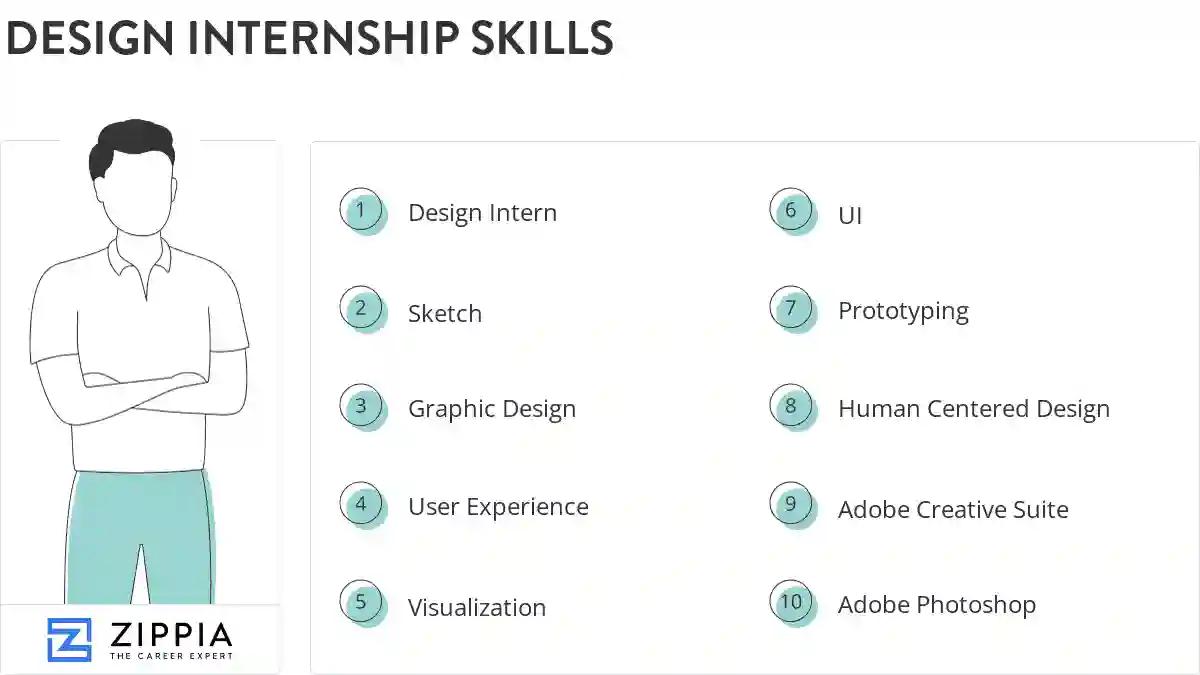
The most important skills for a design internship resume and required skills for a design internship to have include:
- Design Intern
- Sketch
- Graphic Design
- User Experience
- Visualization
- UI
- Prototyping
- Human Centered Design
- Adobe Creative Suite
- Adobe Photoshop
- PowerPoint
- Adobe Indesign
- User Research
- Auto CAD
- Adobe Illustrator
- Revit
- Invision
- User Interface
- Design Concepts
- CSS
- Good Design
- HTML
- Design Process
- Design Projects
- XD
- Design Research
- Mood Boards
- Design Development
- SketchUp
- JavaScript
- Photography
- Tech Packs
- Industrial Design
- Trend Research
- Product Development
- Solidworks
- Design Ideas
- Web Design
- Brand Design
- PLM
- Art Directors
- MATLAB
- Presentation Boards
- Line Sheets
- Market Research
- Design Studio
Updated January 8, 2025
