
Automatically apply for jobs with Zippia
Upload your resume to get started.
Designer, printer skills for your resume and career
15 designer, printer skills for your resume and career
1. Graphic Design
Graphic design is the art of making visual content to communicate messages. Designers apply different page layout methods and visual hierarchy by using letters and pictures to meet the need of end-users. Most companies use graphic design to sell their product or services and to convey complicated information by using infographics.
- Streamlined responsibilities in managing time-sensitive print and graphic design products.
- Worked as an intern with print and motion graphic designers working on promos and posters
2. CAD
- Generated CAD concept boards for meetings & presentations.
- Print designing by CAD and hand painting.
3. Adobe Photoshop
- Created first quarter '09 package for the Missy line, utilizing textile Adobe Photoshop & Illustrator
- Utilized programs :Adobe IllustratorAdobe PhotoshopAdobe BridgeMicrosoft WordMicrosoft ExcelDropbox
4. Art Direction
Art direction is an essential job in the activities related to theatre, advertising, fashion, publishing as well the film industry. All of these fields have a direct or indirect connection with art and therefore require direction and supervision regarding this very aspect of the job. The art director is responsible for how a product turns out visually..
- Managed art direction, production, designs and layouts concepts.
- Provide art direction, design and illustrations.
5. Adobe Creative Suite
- Designed artwork using Adobe Creative Suites.
- Photographed new products and manipulated images within Adobe creative suite optimizing them for e-commerce website.
6. Brochures
A template, leaflet, or pamphlet which carries particulars about a certain company or an organization is called a brochure. Brochures are informative documents that are mostly used for advertisement purposes. These informative papers are organized in the form of booklets that act as promotional documents.
- Created brochures, fliers, posters, and other print materials for conferences, special events, and non-profit functions.
- Designed and typeset a wide variety of personal and business documents, including business cards, brochures, and newsletters.
Choose from 10+ customizable designer, printer resume templates
Build a professional designer, printer resume in minutes. Our AI resume writing assistant will guide you through every step of the process, and you can choose from 10+ resume templates to create your designer, printer resume.7. Fine Arts
- Developed design skills using graphics programs and traditional fine arts educational training.
- Design promotional materials for fine arts events
8. Adobe Indesign
- Created appealing designs and promotional material to attract attention to the university station using Adobe InDesign
- Created print and digital marketing collateral for external publication using Adobe InDesign.
9. Design Process
The process by which a product is formed is referred to as the design process. It requires the conceptualization of what the product may look like in terms of aesthetics, what it will be made of and most importantly, what it will do. A design process puts this process in order so that the creation of the product is seamless and has the least amount of errors and slack while it is being made.
- Facilitate an entire design process from concept to final product development of woven shirts knits and bottoms for men.
- Facilitate the design process, gathering actionable feedback and iterating the appropriate level of changes.
10. Print Production
Print production is the process involved during the commercial and industrial act of printing. It involves the oversight function of printing images on paper or any printable material whether digital or manual. Print production is a term used majorly in the graphics design industry or any other industry related to the use of ink to print words, artworks, design, pictures, and many others on paper or other materials.
- Assisted with the implementation and bug testing for automated art file processing to improve the efficiency of the apparel print production.
- Involved in all aspects of print production including: shading, formulating dyes, scheduling, and distribution of standards.
11. Design Development
Design development is used to refer to a number of positions and skills in a number of different industries. In the architectural world, Design Development is used to refer to an architectural plan that is already halfway or more done but needs further development, alteration, and testing. In the automotive industry, it refers to the skills necessary to create and develop new car, engine, and other designs, as well as to ensure that all designs are safe and effective.
- Participate in design development rendering concepts, original designs, layouts and prep for final digital art.
- Design development in a way that can be technically printed on different surfaces.
12. Business Cards
- Designed pamphlets, business cards, name badges, stamps and various other advertising products.
- Design PageFlex templates for various stationery documents, such as business cards and letterheads.
13. Mentor Graphics
- Printed Circuit Board/Printed Wiring Board Designer using MENTOR GRAPHICS V6/V7 designer software.
14. Design Prints
- Maintain accurate count of design prints running daily before changing over.
- Hire and direct freelance artists to redesign prints and recolor.
15. Mac
A media access control or simply MAC is a network policy that identifies or determines how the data is being transferred in two particular servers through a network cable. The purpose of a MAC protocol is to prevent network or technical issues and simplify transferring the information or data.
- Resolved Mac IT issues and improved digital capabilities including server organization and file backup systems.
- Completed assigned task using digital files and photos utilizing Mac based operating system.
5 Designer, Printer resume examples
Build a professional designer, printer resume in minutes. Browse through our resume examples to identify the best way to word your resume. Then choose from 5+ resume templates to create your designer, printer resume.

What skills help Designers, Printer find jobs?
Tell us what job you are looking for, we’ll show you what skills employers want.
What skills stand out on designer, printer resumes?
Dr. Jennifer Jorgensen Ph.D.
Assistant Professor, University of Nebraska-Lincoln
What soft skills should all designer, printers possess?
Samantha Osborne
Assistant Professor of Graphic Design, Owner, Samantha Osborne Design, Eastern Illinois University
i. An ability to see big picture: there are an infinite number of details in graphic design, whether you work in website design on the front or back end, or in print media with physical outputs. It's easy to get caught up on the details, especially when clients are making specific demands about things such as paper type. A skilled designer must be able to see beyond the details and look at the big picture for an effective design solution. For example, a client may be asking for an invitation design for an up-coming event. A skilled designer will ask questions and dig in, eventually uncovering that perhaps for a successful event, the client also needs a splash page and social media, either in place of or in addition to an invitation. A skilled designer addresses design problems holistically, rather than minutely.
ii. An ability to "read" people: designers are trained in art-specific vocabulary. Hue, saturation, pixels, gestalt...most non-art folks don't use or speak that language. When clients are describing their goals, they aren't using art-vocabulary. It's a designer's job to translate what the client is saying into an advanced and effective creative solution. They must be able to speak and understand the language of non-creative folks, as well as the language of the broader creative industry.
iii. An ability to make a convincing argument for your design solution(s): many young and inexperienced designer tend to get their hearts broken when a client smashes one of their [very well thought-out] ideas. Rather than rolling over, a designer must learn to navigate how best to build support for their idea(s). That might mean in some instances you work more fluidly with the client throughout the design process, so that they feel they have ownership in the development of the solution. In other instances it might mean that the designer is presenting options, rather than a single solution, so that the client feels empowered to make choices throughout the design process. And in some instances, it might be a matter of better explaining and presenting your idea to a client; perhaps the designer needs to push back more, perhaps they need to provide more research as to why their solution is best, or maybe they simply need to present it with more excitement and enthusiasm.
What hard/technical skills are most important for designer, printers?
Samantha Osborne
Assistant Professor of Graphic Design, Owner, Samantha Osborne Design, Eastern Illinois University
What designer, printer skills would you recommend for someone trying to advance their career?
Carmita Sanchez-Fong
Professor and Chairperson, Fashion Institute of Technology, SUNY
What type of skills will young designer, printers need?
Michel Balasis
Associate Professor, Loyola University Chicago
List of designer, printer skills to add to your resume
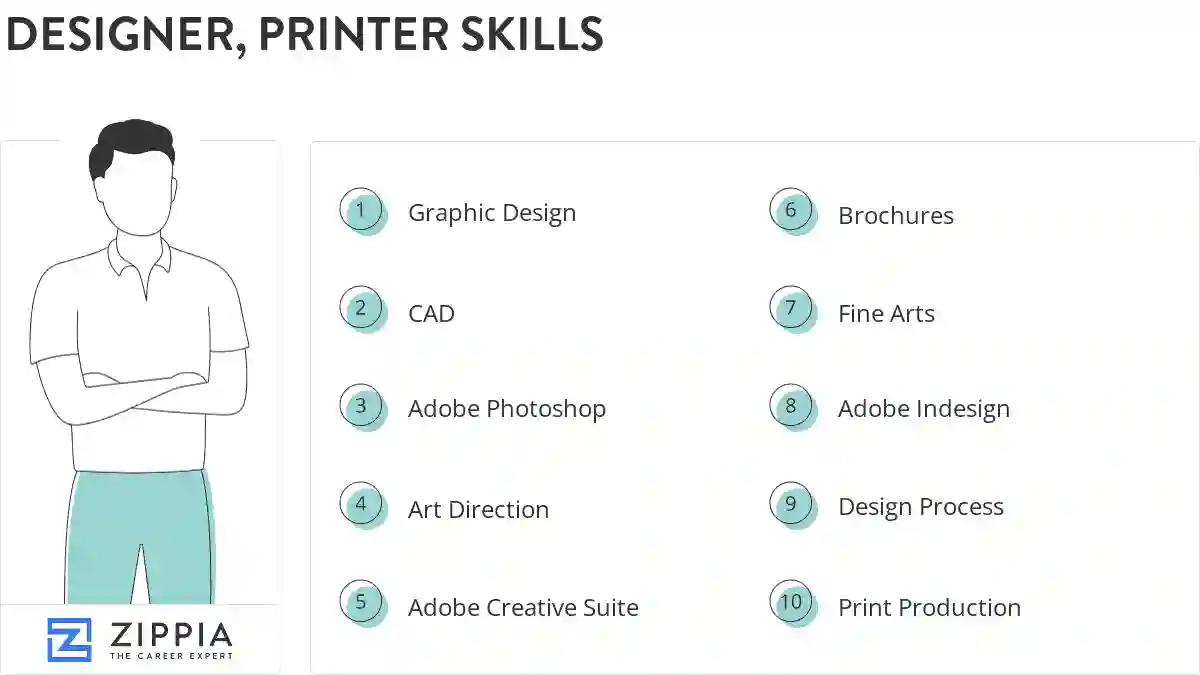
The most important skills for a designer, printer resume and required skills for a designer, printer to have include:
- Graphic Design
- CAD
- Adobe Photoshop
- Art Direction
- Adobe Creative Suite
- Brochures
- Fine Arts
- Adobe Indesign
- Design Process
- Print Production
- Design Development
- Business Cards
- Mentor Graphics
- Design Prints
- Mac
- Photography
- Design Projects
- HTML
- Web Design
- Web Graphics
- Posters
- Print Projects
- Design Services
- Logo Design
- CSS
- Color Correction
- Print Materials
- Client Presentations
- T-Shirts
- Print ADS
- Brand Development
- Embroidery
- Trade Shows
- Circuit Boards
- PowerPoint
- Vehicle Wraps
- Photo Shoots
- Epson
- Windows
- Color Ways
- Promotional Materials
- Computer Software
- PC
- CMS
- Client Relations
Updated January 8, 2025
