
Automatically apply for jobs with Zippia
Upload your resume to get started.
Detective lieutenant skills for your resume and career
15 detective lieutenant skills for your resume and career
1. Patrol
- Worked numerous positions within the dept to include undercover investigative work, supervision of both patrol and criminal investigations.
- Worked and supervised both patrol and investigations during career.
2. Law Enforcement Agencies
- Coordinate investigations with assistant prosecutors and other law enforcement agencies for grand jury and trial testimony.
- Make command decisions of administrative nature and coordinates with outside law enforcement agencies when needed.
3. Direct Supervision
Direct supervision is a term used to indicate that a person is supervising a certain task or a certain person while being physically present or in close proximity. It refers to the presence of a person and the availability of their supervision in something if it is needed.
- Documented personnel performance of subordinates and prepared annual reviews for each officer under my direct supervision.
- Reviewed and evaluated reports, as well as evaluated the performance of those departmental employees under my direct supervision.
4. Evidence Collection
- Gained 14+ years in evidence collection/preparation, as well as extensive experience in crime scene investigations.
- Command of crime scenes, evidence collection, supervise all interview/interrogations.
5. Internal Affairs
- Oversee regulatory compliance of all municipal internal affairs units.
- Conduct internal affairs and complaint investigations.
6. Criminal Cases
A criminal case is a court proceeding in which a person is charged with committing a crime against the state or the community. Such individuals are brought for trials, to decide they are guilty or not. There are two kinds of criminal cases misdemeanors and felonies. A misdemeanor is a crime on a lower level like traffic offenses or minor assaults. While felonies are offenses on a higher level.
- Assigned detectives to designated posts or criminal cases.
- Investigated all sensitive and complicated criminal cases, InternalAffair Investigations as assigned and background investigations on new employees.
Choose from 10+ customizable detective lieutenant resume templates
Build a professional detective lieutenant resume in minutes. Our AI resume writing assistant will guide you through every step of the process, and you can choose from 10+ resume templates to create your detective lieutenant resume.7. Oversight
Having oversight of someone means to monitor a process or a situation. If someone has oversight of something, they are responsible for the completion of the project. Oversight is usually given to experts as they monitor their juniors or newbies as they go through a project.
- Manage and oversight for the Traffic Unit and K9 Unit.
- Directed and provided direct oversight of compliance review program encompassing Federal Motor Carrier Safety Regulations (FMCSR) Title 49 C.F.R.
8. Crime Scene Processing
- Trained newly assigned personnel in criminal investigation techniques, crime scene processing and interview and interrogation.
9. Public Safety
Public safety can be defined as the well-being or protection of a community, citizen, or nation as a whole. There are 4 basic elements that come under public safety namely: national security, border policy, countering crime, and emergency management.
- Distinguished 20 plus-year career ensuring public safety for the Town of Saugus' large transient population.
- Respond to public safety calls for service and directs ongoing enforcements activities.
10. Background Investigations
- Conduct background investigations on all potential sworn and civilian applicants for the Prosecutors Office.
- Conducted and supervised all pre employment background investigations for sworn and civilian positions within the Police Department.
11. Firearms
A firearm is a type of weapon or device used by police, uniformed personnel or other related professional for security and protection purposes. This lethal and destructive weapon can often shoot bullet or missiles. A firearm usually consists of a chamber or barrel, frame body, breech bolt, and a magazine.
- Assisted in police training such as arrest procedures, firearms qualifications and report writing.
- Performed background checks and investigations for all firearms applications within the township.
12. Internal Investigations
Investigations that are conducted to inquire about any organization's internal matters and operations are termed an internal investigation. Internal investigations are commonly held due to the allegations of embezzlement, corruption, harassment, or other charges. Some companies also conduct internal investigations to keep themselves diligent and safeguard themselves from any unwanted charges.
- Conducted internal investigations to ensure compliance and maintain discipline.
- Coordinated and supervised all internal investigations.
13. Performance Evaluations
Performance evaluation is a formal and productive process to measure an employee's work and results based on their job responsibilities over a defined period of time and to properly measure an employee's contribution to the workforce and employers and achieve a high level of quality and quantity of work produced. The evaluation also helps employees provide information about deficiencies in job performance and the company's expectations for the future.
- Manage staff including performance evaluations, recommending discipline, approving time off.
- Reported all incidents and events to managers on a daily basis and prepared performance evaluations for Surveillance Detection Specialists.
14. Local Agencies
- Provided Federal, State and Local Agencies with intelligence research and imperative information pertaining to specific targets of interest.
- Support other State, Federal and local agencies in the investigation of on-line child sexual exploitation.
15. Police Reports
Police reports, also known as "incident reports," are recorded by members of the police department and detail a (potentially) illegal incident or confrontation. The following information is usually found on a police report: the date and time of the incident, which officers were involved, the address of the incident, what kind of incident (theft, assault, etc.), and how the officers were alerted to the incident.
- Review of all department police reports to ensure completeness and accuracy on a daily basis.
- Completed all police reports, arrest reports and supplemental investigative documentation.
5 Detective Lieutenant resume examples
Build a professional detective lieutenant resume in minutes. Browse through our resume examples to identify the best way to word your resume. Then choose from 5+ resume templates to create your detective lieutenant resume.

What skills help Detective Lieutenants find jobs?
Tell us what job you are looking for, we’ll show you what skills employers want.
List of detective lieutenant skills to add to your resume
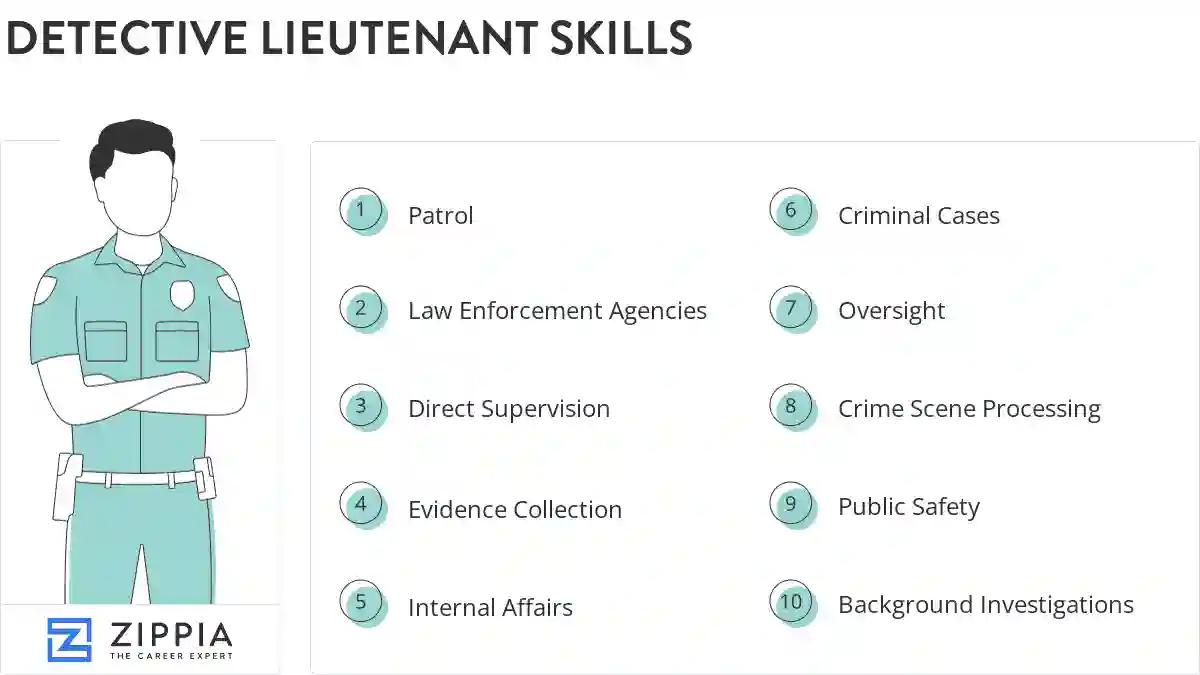
The most important skills for a detective lieutenant resume and required skills for a detective lieutenant to have include:
- Patrol
- Law Enforcement Agencies
- Direct Supervision
- Evidence Collection
- Internal Affairs
- Criminal Cases
- Oversight
- Crime Scene Processing
- Public Safety
- Background Investigations
- Firearms
- Internal Investigations
- Performance Evaluations
- Local Agencies
- Police Reports
- Federal Agencies
- Physical Evidence
- Administrative Functions
- Critical Incidents
Updated January 8, 2025
