Explore jobs
Find specific jobs
Explore careers
Explore professions
Best companies
Explore companies
What is a dialysis social worker and how to become one
Dialysis social workers are support persons for patients with renal problems before and after they start dialysis treatments. Kidney disease can be difficult to manage, more so if a patient already needs dialysis to survive. Dialysis social workers are there to help patients, and their families cope with the changes that come with the treatment and ultimately attain a better qualify of life despite their disease.
The responsibilities of a dialysis social worker typically include talking to patients about their emotional and mental needs, connecting patients with resources for transportation, nutrition, and other necessities, helping patients obtain financial assistance, and assisting patients with insurance. In essence, their role is imperative in helping patients live a normal life.
Social workers obtain a degree in social work before they can secure their roles. Dialysis social workers, in particular, specialize in serving patients with renal disease. As such, they may need additional training and experience in helping patients with this kind of condition. Moreover, dialysis social workers must be compassionate, patient, empathetic, and possess great interpersonal skills.
What general advice would you give to a dialysis social worker?
Virginia Schwindt
MSW Field Director/Associate Professor, Union University
Avg. Salary $52,616
Avg. Salary $59,228
Growth rate 9%
Growth rate 0.3%
American Indian and Alaska Native 0.60%
Asian 3.32%
Black or African American 19.92%
Hispanic or Latino 12.27%
Unknown 5.43%
White 58.45%
Genderfemale 81.46%
male 18.54%
Age - 44American Indian and Alaska Native 3.00%
Asian 7.00%
Black or African American 14.00%
Hispanic or Latino 19.00%
White 57.00%
Genderfemale 47.00%
male 53.00%
Age - 44Stress level is very high
7.1 - high
Complexity level is advanced
7 - challenging
Work life balance is fair
6.4 - fair
Dialysis social worker career paths
Key steps to become a dialysis social worker
Explore dialysis social worker education requirements
Start to develop specific dialysis social worker skills
Skills Percentages Social Work 45.80% Patients 28.92% Rehabilitation 2.94% Hemodialysis 2.70% ESRD 2.62% Complete relevant dialysis social worker training and internships
Accountants spend an average of 1-3 months on post-employment, on-the-job training. New dialysis social workers learn the skills and techniques required for their job and employer during this time. The chart below shows how long it takes to gain competency as a dialysis social worker based on U.S. Bureau of Labor Statistics data and data from real dialysis social worker resumes.Research dialysis social worker duties and responsibilities
- Teach and supervise MSW and BSW students in educational practicums.
- Position involve interdisciplinary collaboration and working with the patients and their families by providing assistance with emotional adjustment to illness.
- Facilitate assistance to both permanent and guest patients in the arrangement of dialysis treatment when traveling and ensure completion of arrangements.
- Work with a complex interdisciplinary team facilitating treatment for patients on medical floors including oncology, dialysis, cardiac and maternity.
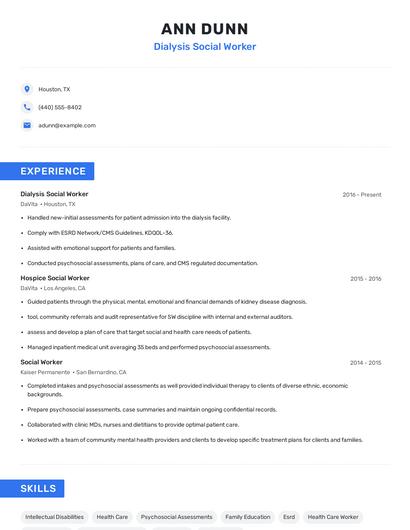
Prepare your dialysis social worker resume
When your background is strong enough, you can start writing your dialysis social worker resume.
You can use Zippia's AI resume builder to make the resume writing process easier while also making sure that you include key information that hiring managers expect to see on a dialysis social worker resume. You'll find resume tips and examples of skills, responsibilities, and summaries, all provided by Zippi, your career sidekick.
Choose from 10+ customizable dialysis social worker resume templates
Build a professional dialysis social worker resume in minutes. Browse through our resume examples to identify the best way to word your resume. Then choose from 10+ resume templates to create your dialysis social worker resume.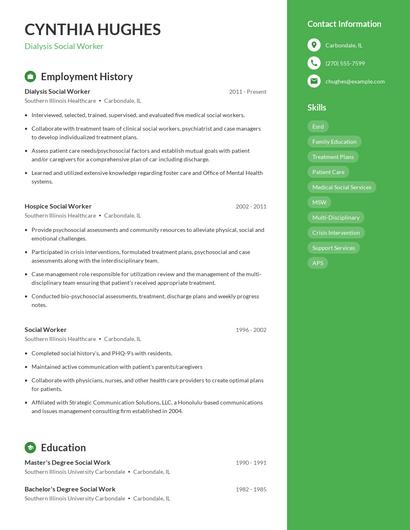
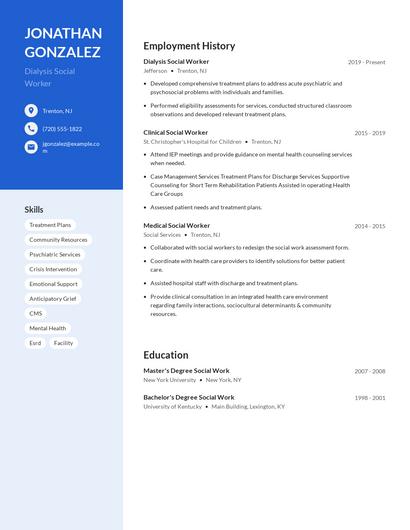
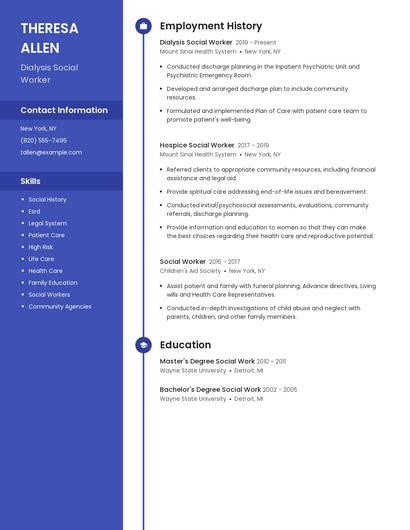
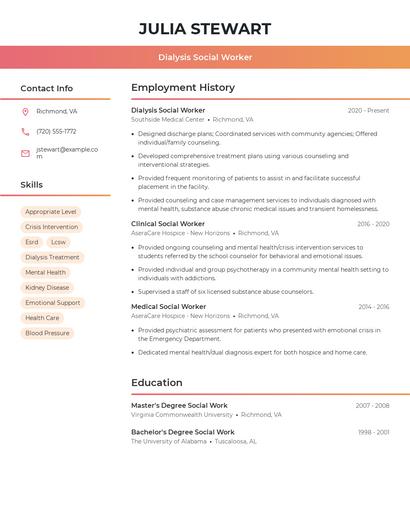
Apply for dialysis social worker jobs
Now it's time to start searching for a dialysis social worker job. Consider the tips below for a successful job search:
- Browse job boards for relevant postings
- Consult your professional network
- Reach out to companies you're interested in working for directly
- Watch out for job scams
How did you land your first dialysis social worker job

Are you a dialysis social worker?
Share your story for a free salary report.
Average dialysis social worker salary
The average dialysis social worker salary in the United States is $52,616 per year or $25 per hour. Dialysis social worker salaries range between $39,000 and $69,000 per year.
What am I worth?

How do dialysis social workers rate their job?
Dialysis social worker reviews

Get to know patients over a long period of time; sometimes decades.
Losing your patients to death, especially after knowing them and their families, for years.
Working collaboratively with clients to help them understand themselves and experience their authentic selves. Learning from my clients.
Low pay
Serving people, impacting change in communities, never boring
pay is low for what you need to do
Updated January 8, 2025
