
Automatically apply for jobs with Zippia
Upload your resume to get started.
Die operator skills for your resume and career
14 die operator skills for your resume and career
1. Calipers
- Measured completed work to verify conformance to specifications using micrometers and calipers.
- Operated precision measuring instruments including micrometers, calipers and scales.
2. Troubleshoot
Troubleshooting is the process of analyzing and fixing any kind of problem in a system or a machine. Troubleshooting is the detailed yet quick search in the system for the main source of an issue and solving it.
- Assemble and build quality air conditioning units Operate and troubleshoot equipment effectively 5s and housekeeping Inventory management
- Assemble and troubleshoot several apparatus.
3. Production Equipment
Production equipment in limited terms is used to define any type of machinery or equipment used in the production of a video or film. Basic production equipment includes a camera, tripod, lighting kit, camera light, short term microphone, light reflector, boom pole, shock mount, audio cables, wireless microphone, headphones, portable digital audio recorder, camera lenses, extra batteries, external hard drive, and DSLR shoulder mount rig.
- Performed preventative maintenance and electronic/mechanical repairs to semi-automated and automated production equipment.
- Mitigated any occurrence of performance issues between staff or within production equipment by leading investigations and root cause analysis procedures.
4. Grinders
- Operated flamecut machine, worked with hand grinders, operated forklift, operated over head crane.
5. Wire Bond
- Performed high and low magnification inspection after die attach and wire bond operations.
- Performed Quality Control Inspection after Die Attach and Wire Bond operations.
6. Blueprint Specifications
Blueprints are layouts or designs about the construction of a building or structure. It consists of accurate engineering drawing on light-sensitive sheets allowing to create copies easily.
- Prepared work to be accomplished by studying assembly instructions, blueprint specification, and part lists.
- Assemble power units and tools to blueprint specifications.
Choose from 10+ customizable die operator resume templates
Build a professional die operator resume in minutes. Our AI resume writing assistant will guide you through every step of the process, and you can choose from 10+ resume templates to create your die operator resume.7. Jigs
- Designed, created, and modified jigs, fixtures, and gauges to ensure part quality and consistency.
- Run the assembly machine through initial checking, setting up of the jigs, tools and data needed prior start-up.
8. Safety Committee
A safety committee is in charge of promoting a safety culture in an organization, primarily by implementing various safety policies and regulations. They may arrange meetings and seminars, address issues and concerns, and conduct regular inspections to ensure different departments comply with the safety standards and regulations.
- Lead the safety committee within the entire plant, ensuring ALL employees were working safely and safety conscious.
- Worked with research and development department, finishing department and quality and safety committee.
9. Article Inspection
- Preformed the first article inspection, final audit and in-process inspection at 2 other points on completed wafers.
10. RAN
RAN stands for "revenue anticipation note," which refers to a practice where an organization (often the government) borrows money to support a specific project. When these funds are then repaid, the money given to the lenders comes from the profits generated by the business originally funded.
- Digitized templates for custom tops and ran C and C machine.
- Staged jobs in order for shipping and ran production reports.
11. Customer Specifications
A Customer Specification is a document that describes the general requirement of an expected service from a contractor. It outlines the key requirements of the customer. Customer specifications should be written in simple and general language so that the contractor clearly understands the expectations of the customer. It is also known as a User Specification.
- Meet customer specifications and standards by performing inspection of parts.
- Perform daily operation of injection molding machines Verify accuracy of documentation per work orders, machine programming, and customer specifications.
12. Extrusion
- Job Responsibilities included but were not limited to operating and monitoring polyethylene film winder, and other plastic extrusion machinery.
- Set up and operate an extrusion machine in accordance with established procedures and guidelines and customer requirements.
13. Computer System
- Provided customer support with visual inspections, filed written documentations and entered data in naval aviation database computer system.
- Provided Subject Matter Expertise support on military BAT/HIIDE computer systems during exercises to validate training curriculum.
14. Quality Checks
Quality checks are a component of quality control aimed at ensuring that quality requirements are met. Internally, quality checks provide assurance to managers, and externally, it provides assurance to clients, federal departments, authorities, and certifiers.
- Maintained quality checks in accordance with company standards; accurately filling out hourly inspection sheets based on overall production quality.
- Perform quality checks on equipment utilized, diagnose and correct performance and image quality problems per operator maintenance standards.

What skills help Die Operators find jobs?
Tell us what job you are looking for, we’ll show you what skills employers want.
List of die operator skills to add to your resume
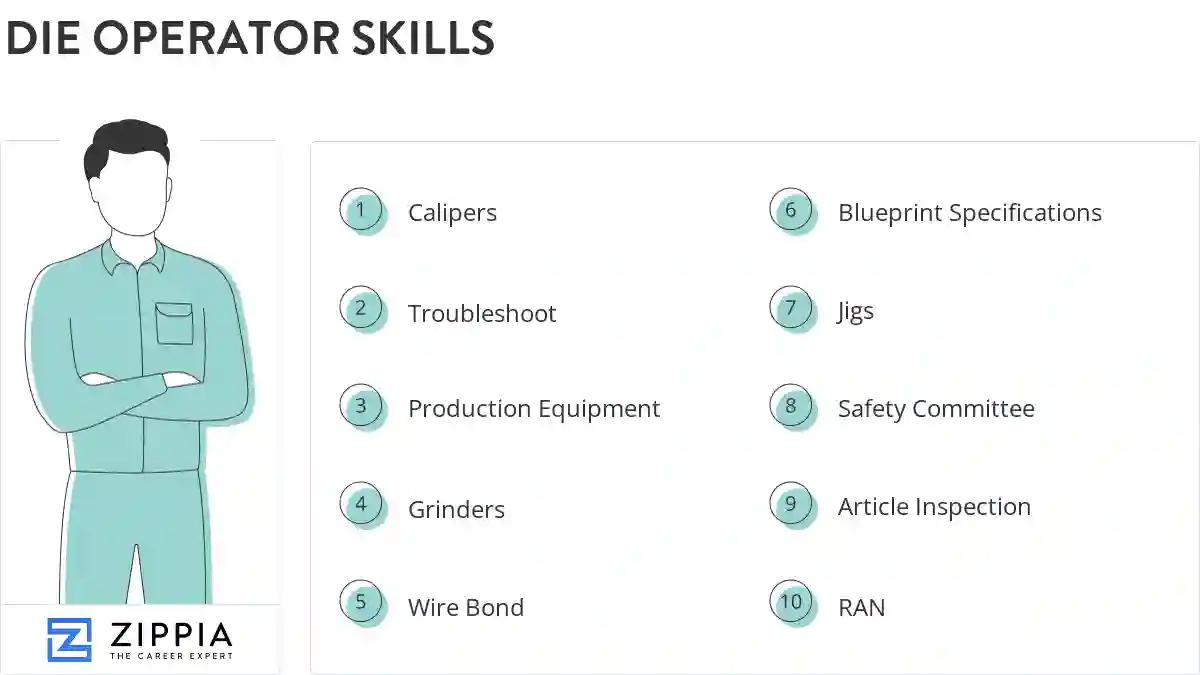
The most important skills for a die operator resume and required skills for a die operator to have include:
- Calipers
- Troubleshoot
- Production Equipment
- Grinders
- Wire Bond
- Blueprint Specifications
- Jigs
- Safety Committee
- Article Inspection
- RAN
- Customer Specifications
- Extrusion
- Computer System
- Quality Checks
Updated January 8, 2025
