Explore jobs
Find specific jobs
Explore careers
Explore professions
Best companies
Explore companies
Job outlook for digital media strategists in the United States
Digital media strategist job growth summary. After extensive research, interviews, and analysis, Zippia's data science team found that:
The projected digital media strategist job growth rate is 8% from 2018-2028.
About 22,300 new jobs for digital media strategists are projected over the next decade.
Digital media strategist salaries have increased 8% for digital media strategists in the last 5 years.
There are over 4,863 digital media strategists currently employed in the United States.
There are 31,387 active digital media strategist job openings in the US.
The average digital media strategist salary is $62,947.
Are digital media strategist jobs in demand?
Digital media strategist job and salary trends over time
Digital media strategist jobs over time
Digital media strategist job growth rate over time
| Year | # of jobs | % of population |
|---|---|---|
| 2021 | 4,863 | 0.00% |
| 2020 | 4,709 | 0.00% |
| 2019 | 4,616 | 0.00% |
| 2018 | 4,272 | 0.00% |
| 2017 | 3,947 | 0.00% |
Average digital media strategist salary over time
Digital media strategist salary by year
| Year | Avg. salary | Hourly rate | % Change |
|---|---|---|---|
| 2025 | $62,947 | $30.26 | +2.7% |
| 2024 | $61,284 | $29.46 | +1.9% |
| 2023 | $60,131 | $28.91 | +1.2% |
| 2022 | $59,430 | $28.57 | +2.2% |
| 2021 | $58,147 | $27.96 | +2.2% |
Digital media strategist jobs by state
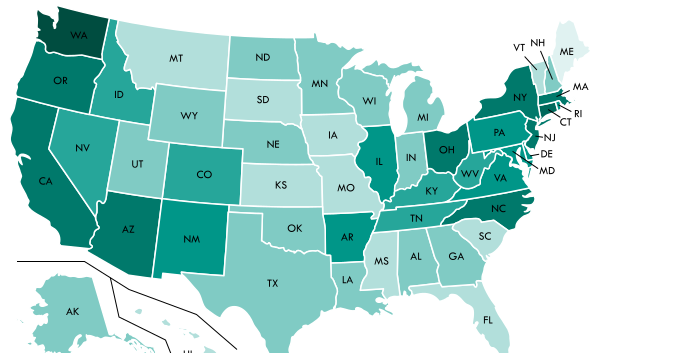
Most common states for digital media strategists
| Rank | State | Population | # of jobs | Employment/ 1000ppl |
|---|---|---|---|---|
| 1 | District of Columbia | 693,972 | 217 | 31% |
| 2 | Delaware | 961,939 | 113 | 12% |
| 3 | Vermont | 623,657 | 74 | 12% |
| 4 | Massachusetts | 6,859,819 | 686 | 10% |
| 5 | Rhode Island | 1,059,639 | 102 | 10% |
| 6 | Utah | 3,101,833 | 252 | 8% |
| 7 | New Hampshire | 1,342,795 | 106 | 8% |
| 8 | North Dakota | 755,393 | 64 | 8% |
| 9 | Wyoming | 579,315 | 48 | 8% |
| 10 | New York | 19,849,399 | 1,438 | 7% |
| 11 | Illinois | 12,802,023 | 903 | 7% |
| 12 | Minnesota | 5,576,606 | 397 | 7% |
| 13 | Oregon | 4,142,776 | 270 | 7% |
| 14 | Idaho | 1,716,943 | 119 | 7% |
| 15 | Montana | 1,050,493 | 74 | 7% |
| 16 | South Dakota | 869,666 | 59 | 7% |
| 17 | Alaska | 739,795 | 51 | 7% |
| 18 | Virginia | 8,470,020 | 475 | 6% |
| 19 | Maryland | 6,052,177 | 374 | 6% |
| 20 | Connecticut | 3,588,184 | 208 | 6% |
Most common cities for digital media strategists
| Rank | City | # of jobs | Employment/ 1000ppl | Avg. salary |
|---|---|---|---|---|
| 1 | Frankfort | 1 | 4% | $61,316 |
| 2 | Moon | 1 | 4% | $62,534 |
| 3 | Elk Grove Village | 1 | 3% | $65,505 |
| 4 | Englewood | 1 | 3% | $62,021 |
| 5 | Aurora | 2 | 1% | $61,828 |
| 6 | Alexandria | 1 | 1% | $68,598 |
| 7 | Lansing | 1 | 1% | $55,913 |
| 8 | New York | 5 | 0% | $71,901 |
| 9 | Chicago | 4 | 0% | $65,710 |
| 10 | Denver | 2 | 0% | $61,817 |
| 11 | Phoenix | 2 | 0% | $72,585 |
| 12 | Boston | 1 | 0% | $69,158 |
| 13 | Fresno | 1 | 0% | $75,839 |
| 14 | Glendale | 1 | 0% | $72,143 |
| 15 | Indianapolis | 1 | 0% | $54,987 |
| 16 | Irving | 1 | 0% | $57,951 |
Digital Media Strategist job outlook: Expert opinions
Our panel of digital media strategist experts
Kutztown University of Pennsylvania
Murray State University
Cabrini University
Maryville University of Saint Louis
Indiana University Bloomington
Texas Tech University
Webster University
Western Connecticut State University
University of Cincinnati
Huntington University

Duquesne University

Dominican University of California

University of Houston - Downtown
West Los Angeles College
Berea College

California State University - Stanislaus
Gulf Coast State College
What general advice would you give to a Digital Media Strategist?
Rich Johnson: Most job titles have a similar salary. Sometimes the salary is better in urban spaces where the cost of living is higher as well. Before I would assess salary, I would look at the cost of living and your monthly budget to build your personal requirements. You usually need to begin work in a starting salary position, but that doesn't mean that you need to stay there for long. When you get into a role, go all in. Master everything that is asked of you and start providing ideas to solve problems. Your value isn't just your ability to complete a task, it is your ability to provide value and creative solutions. Make sure that you retain credit for your contributions and stay positive. Building value in your role is key for job security and growth. Another part of the ladder of salary growth is self advocating for raises and knowing when you have hit the ceiling in your present position. If you do hit a plateau, the options are to pursue a new role or consider taking your skills to another business. One of the most effective growth tools that I have had in my career has been through freelance. If you have the bandwidth, consider taking on some freelance work. This will build skills and new connections that can lead to your next opportunity.
What Digital Media Strategist skills would you recommend for someone trying to advance their career?
Rich Johnson: One of the most difficult positions can be the beginning. But, the most potential starts there as well. Once you start down a path, inertia and career trajectory could keep you on that path for a while. Choose wisely... Always be curious and have an open mind. Try something for a while. Learn new skills, gain perspective and let the path unfold before you. A lot of jobs ask for a student to have work experience before they are willing to hire. This creates a dilemma too. One piece of advice that I give to my students is to do volunteer work in the direction that they would like their career to go. If you like the music industry, volunteer to create designs for the musicians and stages. Replace your college portfolio with work that involves collaboration and connects you to the community. Maybe your HR team might have seen that show and was impressed with your work. It can be hard to know when doors will open. The most important thing is to keep going. Don't let setbacks stop you.
What will help Digital Media Strategists increase their earning potential?
Rich Johnson: Digital media covers a lot of mediums and requires many skill sets (print, static online, animation, interactive). The print arm is a lesser component although still valuable in the scope of marketing. Smartphones, tablets and gaming have moved a lot of digital into a customer expectation of interactive and customizable content. The present model of career specialization in a certain aspect of this spectrum of skills is changing. The age of the generalist is becoming more of a reality as design tools are becoming more accessible and A.I. is assisting in the more complex tasks. I would say that someone working in digital media will need to focus more on the big picture of design, predicting trends and developing solutions from a point of view with perspective. It will be even more important to understand the needs of a system from the top down and provide solutions that enhance that system. This might be through partnering with marketing and sales to conceptualize solutions, pitching product ideas and other functions related to creative and art direction. And be curious, all of the time. Keep up to date with everything that is happening. Take classes, watch tutorials, read articles and be obsessed with the breakneck rate of change. Digital media is constantly changing and possibilities are always expanding. It can be near impossible to be a master of all of these trajectories, but you can understand them well enough to bring in a specialist when the challenge requires it. This is where I predict that A.I. will be a major paradigm shift. There will be a time when you will ask the system to solve a problem, and you can choose what parts of the process that you want to control. So to boil it down... Develop a well rounded set of skills Further develop specialist level skills where you excel Keep on top of change and keep a thirst for learning Strengthen your connection to problem solving and creative innovation Keep an eye on the future predicting what might be around the bend
What general advice would you give to a Digital Media Strategist?
Dr. Kaley Martin M.A. '16: For Digital Media degree graduates whether that’s in my field, Mass Communication, or other fields such as Communication Studies, Digital Filmmaking, Marketing, Social Media, etc. graduates need to have strong work portfolios entering the field. To gain that experience and portfolio work, I encourage students to join academic organizations that align with those interests and also turn every class assignment into an opportunity to gather portfolio work! I think at times students think “this is for a class only”, but really these are great opportunities to double-dip and get portfolio pieces while also completing your course work. Additionally, as much as you can, outside of the classroom create content in whatever medium fits your field of interest. Keep growing and practicing your craft so that your skills are continually worked like building muscle in a sense. Finally, entering the field, do not think your learning stops when you graduate. Our field is changing rapidly and constantly so you need to be plugged in to reputable organizations and resources that help you consistently grow in your chosen digital medium area to always be forward-thinking and able to move forward with our digital media ecosystem.
What Digital Media Strategist skills would you recommend for someone trying to advance their career?
Dr. Kaley Martin M.A. '16: As much as it pains me to say, artificial intelligence will be something to not only be familiar with, but something you need to take time to learn in whatever way that fleshes out for your area in the industry. AI content generation is NOT something I think we should be leaning in to because true creativity and talent is something uniquely human and what you are trained to do through your education, but knowledge of how AI affects your area is very important. For instance, be able to spot AI-generated content, be able to notice misinformation among AI-generated content, and be familiar with the processes and players in this space. Eventually, you’ll be hiring and you want to be able to spot a fake portfolio as well. Learning trends, developing that creative eye, and finding new, unique ways to create content is not going to come from AI any time soon, so I encourage new entrants to the industry to be trained professionals that can recognize when these technologies are in use and abused. Like a tool, they have their place, but a hammer did not build the house for the architect. The architect designed the house and the hammer helped execute that design plan so is AI as a tool for our field.
What will help Digital Media Strategists increase their earning potential?
Dr. Kaley Martin M.A. '16: The most important thing when negotiating salary in Digital Media fields is knowing your worth and pricing accordingly. So many freelance artists and newcomers tend to take lower salaries and rates due to creative work being culturally underpriced, but knowing you own worth and doing research will help you have those negotiation conversations. Additionally, knowing your worth means providing true value to those hiring you by showing you are bringing true skill, strategy, and artistry to the table — not just a degree. How are you using that degree to advance and innovate the field? My degree from the University of Montevallo, for instance, taught me as an undergraduate to be a consistent learner and be watchful of the changing tides of my field due to my university’s foundation in the liberal arts. Liberal arts foundations immerse students in not only their given area, but also expose them to diverse areas in the arts, sciences, humanities, business, and more. That allowed me to always examine how these areas intersect with my own and has made me a dynamic, sought-after, and decorated professional now. So, even if you are not coming from a liberal arts background, have that mindset about you on how I can show my true value to the employer and what I bring to the table that’s unique, different, and worth the money you are asking for. Also, if you are considering a degree in Digital Media, I strongly encourage you to research the paths we have for you here at the University of Montevallo.
Dr. Joseph Harasta Jr
Associate ProfessorKutztown University of Pennsylvania
Radio, Television, And Digital Communication
What general advice would you give to a Digital Media Strategist?
Dr. Joseph Harasta Jr: Digital Media Specialists essentially develop campaigns that further an organization’s mission or purpose, aligned with its brand. Being digital in nature, these campaigns encompass social media and online content. In many ways digital media specialists are public relations practitioners who concentrate in online content and development.
What Digital Media Strategist skills would you recommend for someone trying to advance their career?
Dr. Joseph Harasta Jr: Because digital media specialists must adhere to the brand and image of an organization, some might feel stifled as far as what they can and cannot do from a creative standpoint. Also, once something is put out in the online world, it’s there forever and of course can be seen by millions of people, so any mistake or misstep is not likely to go away quickly or easily. We all know that the online world, especially social media can be rather toxic and negative in nature, therefore it can take someone with a bit of thick skin to deal with critics or trolls who just wait for any mistake to bounce. Digital media specialists must work in a oftentimes nasty environment that is the internet.
What will help Digital Media Strategists increase their earning potential?
Dr. Joseph Harasta Jr: With so much focus on online presence today, digital media specialists are valued and key members of any organization’s marketing and publicity efforts. It’s hard to imagine any organization that can flourish today with at least some form on online content and presence. Many organizations that are too small to hire digital media specialists outright might consider hiring a consultant who can handle managing online content in a smaller way. That said, anyone getting into the digital media field has an array of options available to them whether it be for a standalone company, consulting firm that specializes in online presence, or freelance workers who take on several clients at the same time.
What Digital Media Strategist skills would you recommend for someone trying to advance their career?
Elizabeth Thomas: Digital media is still very fresh territory. It is ever-evolving. Companies, brands, and agencies are looking to hire talented professionals with any training or experience with these relatively new sets of tasks. The most experienced people working in the communications field did not learn how to work with newer digital media when they were being trained because these literally didn't exist when most started their careers. This is why there are currently more jobs available than there are qualified applicants to fill them. As a college professor teaching public relations and digital technologies, I encourage soon-to-be graduates to hone their skills in this area because the jobs are plentiful and their expertise is not only needed but will be rewarded.
Professor Cheryl Pilchik
Marketing at Cabrini U.Cabrini University
Business Administration, Management And Operations
What general advice would you give to a Digital Media Strategist?
Professor Cheryl Pilchik: Dress to impress for interviews. Consider the benefits offered by the company, not just the compensation. Use the position as a steppingstone in your field to a second job in the future.
What Digital Media Strategist skills would you recommend for someone trying to advance their career?
Professor Cheryl Pilchik: Look at all the benefits offered by the company, such as medical, holidays, 401K, etc. Also, consider using the position as a steppingstone in your field to a second job in the near future.
What will help Digital Media Strategists increase their earning potential?
Professor Cheryl Pilchik: Within Marketing, social media is still huge. There are many types of jobs within social media, including being an expert social media guru at an ad agency. I advise all students to be prepared and sign up for online courses if needed.
What general advice would you give to a Digital Media Strategist?
Kara Alaimo PhD: The communication landscape is always changing. The social media platforms that are popular right now may not even exist by the time my students graduate, and of course they're always changing their algorithms and the kinds of content they prioritize, so professional communicators can never get too comfortable in their work. Therefore, one of the most important skills to acquire is how to stay on top of all these changes, keep learning how different platforms work, and come up with creative ideas to use on them.
What Digital Media Strategist skills would you recommend for someone trying to advance their career?
Kara Alaimo PhD: A lot of my former communication students who are commanding the highest salaries are working in social media management. This is because often senior communication executives who have been working in the field for decades feel like they don't know how TikTok and emerging platforms work and think people who grew up as digital natives hold the secrets of the universe, so they empower them at earlier stages in their careers to run organizations' social channels. It's not uncommon for me to see a former student who manages social media accounts on behalf of an organization get multiple promotions and raises within their first few years of graduation.
What will help Digital Media Strategists increase their earning potential?
Kara Alaimo PhD: I strongly recommend that students consider jobs managing social media accounts on behalf of people and organizations. There's a lot of demand among employers to hire people for these positions right now, and a lot of my students are thrilled to discover that they can make a good living creating social media content - which many of them consider to be more like fun than work. This is why at Fairleigh Dickinson University we just created new academic programs in social media to give students the skills and credentials to go after these kinds of exciting jobs with significant labor market demand that often have particularly attractive starting salaries.
Dr. Leilani Carver-Madalon Ph.D.
Director of Graduate and Undergraduate Communication and Associate Professor of Strategic Communication and LeadershipMaryville University of Saint Louis
Public Relations, Advertising, And Applied Communication
What general advice would you give to a Digital Media Strategist?
Dr. Leilani Carver-Madalon Ph.D.: People hire people who they know, like, and are competent. So, how do you become known, liked, and competent? Beyond college, some unexpected ways to a successful career are 1) Internships 2) Informational Interviews, and 3) earning certifications.
Internships: Getting an internship is not a new idea but it is a very important one. Some organizations now only hire people who intern for them first. The internship now becomes a trial before hire. For example, Fleishman Hillard, ranked the fourth best PR agency in the World, offers many full-time Internships, 40 hours a week. Recent grads who want to work for Fleishman Hillard should see getting an Internship as the best avenue towards getting a job at Fleishman Hillard. Many organizations use their internship pools as potential hiring pools so do not be afraid to do a paid internship after graduation for a premier organization.
Informational Interviews: This is a wonderful way for people within an organization to get to know you and for you to learn from others with experience. Informational interviews are short interviews where you connect with someone in our field, research them, and their company and prepare questions to ask for advice. These interviews expand your network and also help you learn. These are a wonder source of networking.
Earn Certifications: Besides going to class and doing well, it is also important to be able to show what you know through certifications. For example, Hubspot has free certifications that you can take and link to your LinkedIn account. One I recommend is their Social Media Marketing Certification at https://academy.hubspot.com/courses/social-media?library=true&= This is yet another way to show your knowledge and expertise in our field. Showing through certifications is always preferable to telling someone you have the skillset.
What Digital Media Strategist skills would you recommend for someone trying to advance their career?
Dr. Leilani Carver-Madalon Ph.D.: Many of my students get hired to do social media for organizations because organizations need help in this area. Knowing how to create engaging and creative content, produce quality videos, manage and understand data analytics, and respond to crises are some of the most important skills. Additionally, utilizing AI to do more with less will also become more and more important.
What will help Digital Media Strategists increase their earning potential?
Dr. Leilani Carver-Madalon Ph.D.: The first thing is to do your research so that you know the market and what the salary range is for your job in your city. This article has a list of free salary calculators.
Then, you wait until an offer is made. Once an offer is made you can negotiate (but never before).
Then, you ask politely. The amount is usually around 5- 10% of the salary. I encourage you to ask for 10% because they will likely try to meet you in the middle.
For a script, you could say something like...
Thank you so much for this offer. I am very excited to work at Company X. I know my internship experiences and degree from X University will help me be able to bring value to this organization.
Regarding salary, I was looking for something closer to $_________. Is this possible?
(Then be quiet).
It is beneficial to ask. The worst thing they can say is no. Also realize that you can negotiate vacation days, working from home, a 4-day work week, and other benefits that may be important to you if they cannot offer you more money. Once when I worked for a non-profit, I maxed out their salary but I negotiated another week of paid vacation because I asked. Asking after research and with respect is always a win.
Professor Steve Vinson
Director of Undergraduate StudiesIndiana University Bloomington
Middle/Near Eastern And Semitic Languages, Literatures, And Linguistics
What general advice would you give to a Digital Media Strategist?
Professor Steve Vinson: Be flexible. Don't limit yourself to one geographic area in your job search. And don't decline what appears to be a "bad" job, if that's your one opportunity. It's important to get your foot in the door somewhere, and do a good job, and then you can move up from there. This is especially important if you're on the academic job market, but it's probably also true for non-academic jobs.
What Digital Media Strategist skills would you recommend for someone trying to advance their career?
Professor Steve Vinson: Digital skills, especially AI.
What will help Digital Media Strategists increase their earning potential?
Professor Steve Vinson: By being flexible, and by standing out. Cultivate multiple skills that complement your area studies/language skills, especially digital skills.
Don Shin
ChairTexas Tech University
Journalism
What Digital Media Strategist skills would you recommend for someone trying to advance their career?
Don Shin: The term "digital media" takes different forms (and keeps evolving and migrating) and involves a broad definition. Thus, the jobs related to digital media can be considered generalists rather than specialists. As we embark on an enhanced version of the media strategy program through data analytics, we can train our students as versatile specialists or all-rounders who can flexibly respond to changing ecology and become the digital/AI version of the "all-rounder." In this way, our students can secure quality top jobs in the digital and AI industry.
Rebecca Guth-Metzler
Assistant Professor of ChemistryWebster University
Radio, Television, And Digital Communication
What Digital Media Strategist skills would you recommend for someone trying to advance their career?
Rebecca Guth-Metzler: The integration of captured media such as sound and image recordings with computer-assisted elements will continue to define the digital creator toolbox, and I believe that motion graphics, visual effects, image retouching, sound design, and especially what we're now calling "virtual cinema production" will all continue to grow in importance in the next few years.
JC Barone Ph.D.
ProfessorWestern Connecticut State University
Communication And Media Studies
What Digital Media Strategist skills would you recommend for someone trying to advance their career?
JC Barone Ph.D.: The first two questions are interwoven. Media and digital literacy are increasingly essential when entering (and remaining in) the job market. Being able to interpret and analyze information critically is important. Understanding analytics and being knowledgeable in emerging technology, AI, and IoT are crucial. When I speak to industry professionals, I hear how flexibility and adaptability are necessary. Problem-solving and creative solutions are highly valued. Strong writing skills (yes, spelling and grammar) count! Soft skills are just as important as being tech-savvy-- effective communication, empathy, listening, and conflict resolution are necessary to work with others. Being an "always learner" committed to collaborating effectively with diverse teams shows a commitment to cultural competence and evolving to stay relevant and valued.
What general advice would you give to a Digital Media Strategist?
Chris Carter: I would recommend playing up their value as critical analysts and researchers who can synthesize information in accessible ways. I would tell them to be open to all kinds of writing opportunities, whether technical, journalistic, or editorial, watching for possibilities in online and print venues alike. English majors' detective skills suit them well to museums and libraries, but also to private and governmental organizations that need shrewd investigators. Turning interpretive savvy into pithy prose and presentations can be great for public relations, and a penchant for lucid communication can set graduates up for podcasting and social media management. Some people might turn those talents toward careers in law or marketing. Others might continue their paths as creative writers and cultural critics, though it's worth noting that full-time, tenure-track jobs in English Departments are hard to come by.
What Digital Media Strategist skills would you recommend for someone trying to advance their career?
Chris Carter: With the rise of ChatGPT and large language models, English majors will need to clarify how human writers, editors, and analysts can enrich machine-generated content. They do well to practice prompt engineering and gradual conditioning of machine responses, but they also need to be diligent readers who can spot bad AI syntheses. This means correcting faulty information stemming from data aggregation, for sure, but also spotting cultural biases that machines replicate when drawing on preexisting texts. Those texts carry with them the values and assumptions of the people who initially produced them, with ChatGPT reflecting and potentially amplifying the inequities that plague human cultures. The need for ethical intervention is quite urgent, then, and that's where English majors tend to excel. Such intervention will concern not only the accuracy and political tilt of information, but the question of whose language and style count as standard. Writing technologies have always been bound up with power relations. DEI-oriented humanists and English majors will have plenty of opportunities to address those problems as AI becomes more embedded in workplaces and public institutions.
Brock Zehr
Associate Professor of Business & Economics and MBA DirectorHuntington University
Religion/Religious Studies
What general advice would you give to a Digital Media Strategist?
Brock Zehr: Social media content development, data analytics, and quality video content generation will all be in greater demand. Employers tell me that the "soft skills" of being a team player, excellent communication skills, integrity, and a strong work ethic are still valued skills.
What will help Digital Media Strategists increase their earning potential?
Brock Zehr: Become a solution to an employer's problem. During the application and interview process, identify the needs of the employer and propose ways you can fulfill those needs. Every job, person, project, and client can lead to greater opportunities. So even if your first job is not ideal; do it well because it can be the impetus to propel your career forward. A positive, can-do attitude and quality work can take you wherever you want to go.
What soft skills should all Digital Media Strategists possess?
Dr. Mike Dillon: Today, teamwork is paramount. A young professional must work with and communicate effectively with a wide array of internal constituencies. You definitely need interpersonal skills -- whether you are working in person or over Zoom or another video platform. The ability to work independently to problem-solve. Media cycles are now measured in nano-seconds, so a supervisor needs to be able to trust that you can handle what comes your way without constantly checking in. Tone -- the insight to understand how different platforms you use for planning or dealing with sources/constituents/colleagues -- who may be of different ages or from different cultures -- require mindfulness about how and what you communicate.
What hard/technical skills are most important for Digital Media Strategists?
Dr. Mike Dillon: Media is about storytelling -- whether it's an ad, a social media campaign, a magazine story, etc. Being able to use the tools of your trade, whatever they may be -- algorithms, editing suites, etc. The most important skill, though, is understanding the essence of those tools -- what is they are intended to accomplish. If you understand that, you can easily adapt when tools change -- which they frequently do.
What skills stand out on Digital Media Strategist resumes?
Dr. Mike Dillon: Evidence (courses, internships, other experience) that demonstrates competence in communicating with a wide array of audiences across multiple platforms. Our journalism program, for instance, is multiplatform: students learn to write, edit, shoot video, create podcasts, adapt stories to fit the requirements of multiple platforms, etc. Basically, we want to send students out of here like Swiss Army Knives -- able to work in their area of proficiency, be that writing or videography, but also adept with a wide variety of other competencies.
Bradley Van Alstyne Ph.D.
Assistant Professor of Communications, Coordinator, Online Learning and Development, Chair of the Communications and Media Studies DepartmentDominican University of California
Communication and Media Studies
What skills will help Digital Media Strategists earn the most?
Bradley Van Alstyne Ph.D.: The hard skills (audio and video) usually get you the job, but the soft skills allow you to keep it and grow!
Dr. Richard Conde Ph.D.
Assistant ProfessorUniversity of Houston - Downtown
Marilyn Davies College of Business
What soft skills should all Digital Media Strategists possess?
Dr. Richard Conde Ph.D.: The need for soft skills are consistent through time. With our societal focus on social media, texting, emojis, etc. It appears to me companies are looking for the following:
- Active listening skills
- Willingness to be self-reflective and accept feedback
- Accept different perspectives. The collision of ideas creates knowledge
- Communicate to the listener (at their level). Flex communicators
- Cultural intelligence. Demographics changes will require better understanding of team member's, boss', customer's, etc. cultural context
How have salaries changed over time for Digital Media Strategists?
Dr. Richard Conde Ph.D.: - There is a small trend in sales to minimize variable comp and increase salaries. There are a few (15 or so) Silicon Valley companies limiting commissions and focusing more on salaries
- You see a correlation between higher salaries and more complex sales processes. I see that trend continuing as more transactional sales will be automated
- Increase in pay for inside sales agents as more and more sales are being handled by inside sales agents (thanks to tech and change in buying behaviors)
What are the biggest trends we'll see in the Digital Media Strategist job market given the pandemic?
Dr. Richard Conde Ph.D.: You are already seeing these trends, which will increase in the months to come:
- More remote work away from an office. Flexibility will be key for employees with more control over their time and schedule
- The increase of video in all stages of a business. We feel more comfortable communicating via all the video communication options
- More application of AI and machine learning. Companies are finally figuring out its better to work smart
- Automated personality identification. For example, Crystal Knows can provide a person's DISC profile based on an individual's LinkedIn profile. This type of information will be used by recruiters to determine fit, plus at all other departments
- Training at all levels to accommodate virtual, technology, and cultural changes
- The need for individuals at all levels of an organization to possess (based on the level) analytical skills. Data is king and there is more and more demand for individuals who can identify, interpret, and implement decisions based on complex data analysis.
Will there be an enduring impact of the coronavirus pandemic on Digital Media Strategists?
Anthony Cuomo: We have changed the ways in which we communicate with each other. Now, more than ever, we know that technology is pervasive and has revolutionized the way we communicate personally and professionally. Virtual interviews, online group meetings and presentations are the new norm. Job seekers who are able to communicate effectively online will have an advantage in our new context. I don't think Zoom meetings or Skype are going away any time soon. So, practicing how to sustain eye contact with a camera, being personable and communicating enthusiasm virtually will set you apart from other applicants.
What's a good job out of college for Digital Media Strategists?
Anthony Cuomo: A job that you are passionate about and helps you begin your journey. Pursue jobs that spark your interest and also provide opportunities to learn, grow and seek out mentorship. Think long term and how you a strengthening your professional foundation while also providing opportunities to support yourself and your lifestyle.
What will help Digital Media Strategists increase their earning potential?
Anthony Cuomo: Personally, every unpaid opportunity I pursued early on in my career led to a paid opportunity in the future. We should know our worth and expect our labor to be compensated, but we should also look at the bigger picture and identify service opportunities, volunteering and working outside of our required job duties provide new prospective, skills and a chance to develop our resumes. It pays off in the future.
J. Ian Norris Ph.D.
Professor of Marketing and Fellow, American Council on EducationBerea College
Economics and Business Department
Will there be an enduring impact of the coronavirus pandemic on Digital Media Strategists?
J. Ian Norris Ph.D.: There is little doubt that workers will continue some of their work remotely. This was a trend already underway before the pandemic that was greatly accelerated during the pandemic. In marketing specifically, many businesses had to shift business to online that had not been online before. It is likely that this will also have a lasting impact on how business is conducted. This was particularly true in the service industry and in arts and entertainment. The big take-home lesson for marketing graduates is that digital literacy has never been more important. All marketers are digital marketers, to some degree or another, today.
What certifications/licenses/courses can have the biggest impact for Digital Media Strategists?
J. Ian Norris Ph.D.: Digital marketing skills are essential for any area of marketing. Luckily there are many online certifications available for this purpose. On the research side, Google Analytics offers a certification. It will also be valuable to know the analytics platforms on social media sites such as facebook, Instagram, and TikTok. Conversely, all of these sites also offer training on digital advertising and promotion, such as Google AdWords. Any coursework in digital marketing that provides instruction in Search Engine Marketing (SEM) will also be highly valuable. Finally, digital video and editing skills are also quite valuable, as all kinds of companies and organizations are using the short video format for storytelling and brand advertising.
What will help Digital Media Strategists increase their earning potential?
J. Ian Norris Ph.D.: No matter what area of marketing you are working in--in fact, no matter what job you are working in at all, statistical literacy is essential. There is so much data out there that data literacy will confer significant competitive advantage to those who can leverage it. This doesn't mean everyone has to be able to do regression modeling, but being able to interpret correlational patterns and draw actionable meaning from it will be a foundational skill. A big bonus would be some basic coding skills. Finally, it is worth mentioning that while most social media marketing still happens on Facebook, it will be essential to know platforms such as Instagram and TikTok for any products or services targeted to younger consumers.
Will there be an enduring impact of the coronavirus pandemic on Digital Media Strategists?
Dr. Veronica Radeva Dawson Ph.D.: According to Nicholas A. Christakis, the author of "Apollo's Arrow: The Profound and Enduring Impact of the Coronavirus on the Way We Live," the coronavirus pandemic will have long lasting impact on the economy, new graduates job market, and the processes of doing work for everyone (among other things). While we are already hearing about projections of the economy coming back stronger than ever in late 2021, those seem to refer to the stock market, and the stock market isn't the job market. I expect that our graduates will have a harder time getting that first professional position as companies are trying to figure out how work will be done, especially in the near future. So, my advice is to remain flexible and focus on gaining experience, even if it happens that it isn't in a graduate's "dream career." Communication remains the top skill sought after by employers, regardless of occupation (see for example, LinkedIn's 2020 Grad Guide to Getting Hired ) and our graduates are obviously in a unique position to claim expertise in this area.
What's a day at work look like for a Digital Media Strategist?
Dr. Veronica Radeva Dawson Ph.D.: A day at work for a recent graduate could look much like a day at school, if the student went to one of the universities where instruction remained virtual. Most job ads at this time, still come out as "temporarily offsite," which means that new hires would work from home. And while recent graduates might have the hang of using Zoom or Microsoft Teams to get their work done, working remotely comes with its own set of challenges. Perhaps most relevant for a new hire is the different onboarding experience and the absence of traditional socialization activities and learning processes (onsite trainings, social gatherings, and impromptu Q&A sessions with co-workers). I think that this precisely (remote organizational socialization) would be one of the biggest challenges for companies that choose to embrace a remote workforce for the foreseeable future. Additionally, familiar challenges from the virtual classroom would remain, such as mastering time management, fostering self-motivation, and avoiding overwhelm and burnout.
What will help Digital Media Strategists increase their earning potential?
Dr. Veronica Radeva Dawson Ph.D.: As the Internships Coordinator for our department, I have seen an increased demand for communication studies majors who are able to contribute in the areas of web design, videography, photography, and digital media/ graphic design, in addition to more traditional areas, such as public relations. So, I would recommend that prior to graduation students seek out opportunities to take courses that may help them in these areas. Not many Communication Studies programs offer such courses as part of their curriculum, although some might. One of the surest ways to increase earning potential, especially in a time of economic recession, is through more education. This could mean securing a spot in a graduate program where students can mature and hone their interests and skills. Over time, an employee with a graduate degree will earn more (money, opportunities) than someone without one. I do want to caution students and new graduates about going the graduate school route over the job experience route, however, as it comes with a cost, financial of course, but also in terms of work experience. To some degree, and especially early in someone's career, employers value specialized work experience over graduate education.
William Covington
ProfessorGulf Coast State College
Business and Technology Department
What are the biggest trends we'll see in the Digital Media Strategist job market given the pandemic?
William Covington: In my opinion, the job market will continue to stagnate for smaller businesses especially. With the hike in what people can receive in unemployment and the ability to not have that amount taxed It is very probable to be able to live on income from unemployment and a stimulus check. The issue is not, "where are the jobs?" So many small businesses are looking to place people in entry level positions. However many students just out of a secondary institution are looking, or demanding a high salary position. Thus the implementation of the $15 minimum wage, which many small businesses just cannot do. There in lies the "catch 22."
What technical skills for a Digital Media Strategist stand out to employers?
William Covington: Most employers understand that today's world revolves around technology. Therefore having a skill set that may include, web design and marketing of some kind, can be very valuable to an employer.
How have salaries changed over time for Digital Media Strategists?
William Covington: I am not so sure that salaries have changed as much as tools of the trade and the skills needed to be proficient with those tools have changed. Salaries will always be based on 2 things. Educational experience and real world experience. The real determining factor of a salary is "who" the employer is and which type of experience they consider to be the most relevant.