
Automatically apply for jobs with Zippia
Upload your resume to get started.
Director of exhibits skills for your resume and career
15 director of exhibits skills for your resume and career
1. Exhibit Design
- Project Manager Supervised all aspects of exhibit design, content development, audio visual, new technologies and graphic design components.
- Served as project manager, led internal stakeholders and exhibit design team through masterplanning, design, fabrication and installation.
2. Event Management
Event management applies project management to the development and creation of corporate events such as conferences, festivals, ceremonies, concerts, or formal parties.
- Provide exceptional professional coordination and event management for one of the leading publishers of educational materials.
- Utilize creativity in developing and implementing strategic marketing and event management plans assuring that strategies align to organizational goals.
3. Trade Shows
- Recruited, trained, and coached a team of marketers to promote the organization at six annual trade shows.
- Developed and implemented Event Scorecard system that provided a standard in which GEHC trade shows are measured and compared.
4. Contemporary Art
- Consulted on, supervised, and assisted artists / curators' works, applying expertise in contemporary art.
5. Contract Negotiations
When a contract is negotiated, an agreement is reached on a series of legally binding terms before it is signed and made official. Two or more parties agree on the terms of their relationship. When negotiating a contract, the focus is usually on risk and return.
- Planned and organized information and documentation on each event handling contract negotiations and venue reconciliation.
- Develop and grow business relationships with key accounts supporting departmental goals through contract negotiations.
6. Educational Programs
An educational program is a program primarily concerned with the provision of education, including but not limited to early childhood education, primary and secondary education, post-secondary education, special education, vocational training, career and technical education, education for adults, and any program managed by an educational agency or institution.
- Managed the development of all educational programs and overall implementation and development of educational exhibits in start-up science center.
- Design, develop, direct, and implement educational programs, sponsorship and exhibits programs, and meeting logistics.
7. Corporate Events
A corporate event is a social or hospitality activity organized or funded by a business entity. The focus audience for corporate events can include but not be limited to employees, board members, stakeholders, customers/clients, and potential clients. The motivation for businesses to organize events may be to reward, motivate, celebrate, educate, manage organizational change, mark milestones, or encourage collaboration.
- Participated in local community business to business connections to cross-market and promote corporate events services programs.
- Coordinate strategic branding activities including sponsored industry events, client hospitality events, and corporate events.
8. Audio Visual
Audiovisual refers to material intended for showing to the public and has sound accompanying it.
- Cut overall audio visual budget by 9% while increasing loyalty among vendors and enhanced overall learning experience for attendees.
- Position manages overall growing on-site operation of hotel's Audio Visual Department.
9. Program Development
Program development refers to a road for developers to guide them on creating and developing viable community programs. Since it provides an action plan for the project, it is a continuous process that only ends with the program's full implementation.
- Provided expert consultation and direction for the development of comprehensive program development and management strategies to effectively generate successful outcomes.
- Program development and evaluation, grant writing and curriculum development for National program.
10. Exhibit Development
- Planned future exhibit development based on visitor interest and industry trends.
- Managed the 5 million dollar exhibit development, design and installation for the The Discovery hands on museum.
11. Press Releases
- Coordinated the installation of artwork, maintained exhibitions and assembled information for press releases and artists' statements.
- Direct the design and write copy for all print collateral, e-newsletter, e-marketing and press releases.
12. Concept Development
Concept development refers to the process of developing activities or ideas about a product or procedure in order to solve design issues or operational challenges. This is typically seen early in a design or engineering process in order to smooth out any details regarding the product's form and that all needs will be met by the current design.
- Created script concepts; commissioned and concept development; hired and managed actors; created costumes; designed and built sets.
13. Site Selection
- Handled all sourcing and site selection; negotiated all vendor contracts and managed multiple hotel blocks for domestic and international meetings.
- Conducted site selection, including securing necessary permits.
14. PowerPoint
- Prepared PowerPoint presentations, handled VP travel arrangements & itinerary and expense reports.
- Provided and compiled PowerPoint slides for monthly and quarterly executive readouts.
15. RFP
- Organized the RFP process for selection of audio-visual, decorators, hotels and other vendors.
- Conducted RFP processes, selected vendors, and negotiated contracts and managed multiple professional services, software and data providers.

What skills help Directors Of Exhibits find jobs?
Tell us what job you are looking for, we’ll show you what skills employers want.
List of director of exhibits skills to add to your resume
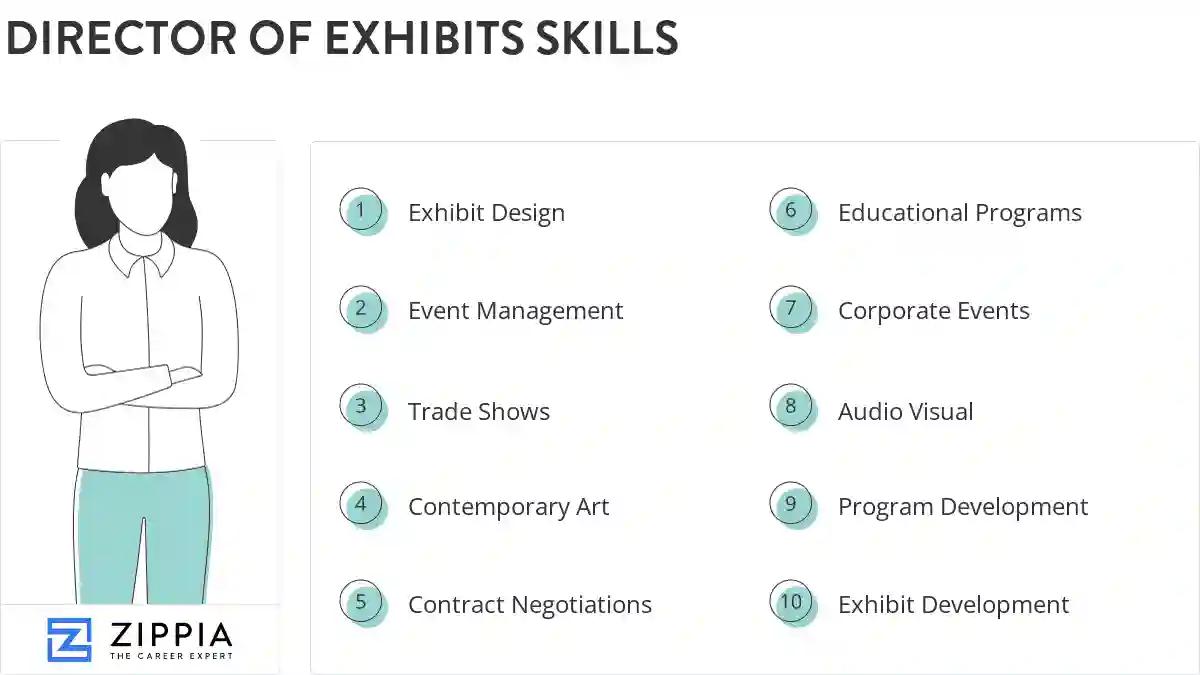
The most important skills for a director of exhibits resume and required skills for a director of exhibits to have include:
- Exhibit Design
- Event Management
- Trade Shows
- Contemporary Art
- Contract Negotiations
- Educational Programs
- Corporate Events
- Audio Visual
- Program Development
- Exhibit Development
- Press Releases
- Concept Development
- Site Selection
- PowerPoint
- RFP
Updated January 8, 2025
