Explore jobs
Find specific jobs
Explore careers
Explore professions
Best companies
Explore companies
Job outlook for directors, online marketing in the United States
Director, online marketing job growth summary. After extensive research, interviews, and analysis, Zippia's data science team found that:
The projected director, online marketing job growth rate is 10% from 2018-2028.
About 33,700 new jobs for directors, online marketing are projected over the next decade.
Director, online marketing salaries have increased 8% for directors, online marketing in the last 5 years.
There are over 28,416 directors, online marketing currently employed in the United States.
There are 93,166 active director, online marketing job openings in the US.
The average director, online marketing salary is $115,982.
Are director, online marketing jobs in demand?
Director, online marketing job and salary trends over time
Director, online marketing jobs over time
Director, online marketing job growth rate over time
| Year | # of jobs | % of population |
|---|---|---|
| 2021 | 28,416 | 0.01% |
| 2020 | 27,550 | 0.01% |
| 2019 | 26,886 | 0.01% |
| 2018 | 24,516 | 0.01% |
| 2017 | 22,327 | 0.01% |
Average director, online marketing salary over time
Director, online marketing salary by year
| Year | Avg. salary | Hourly rate | % Change |
|---|---|---|---|
| 2025 | $115,982 | $55.76 | +3.9% |
| 2024 | $111,642 | $53.67 | +1.9% |
| 2023 | $109,554 | $52.67 | +1.6% |
| 2022 | $107,873 | $51.86 | +0.8% |
| 2021 | $107,017 | $51.45 | +1.9% |
Director, online marketing jobs by state
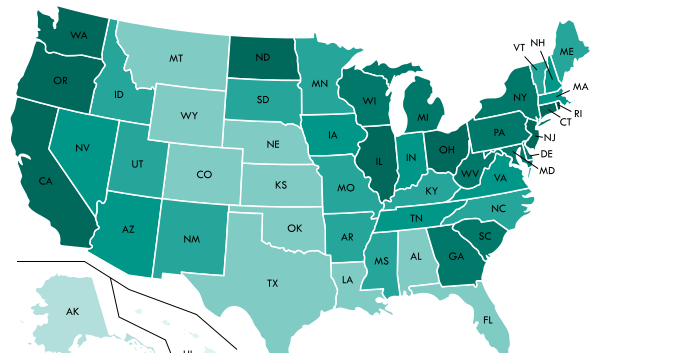
Most common states for directors, online marketing
| Rank | State | Population | # of jobs | Employment/ 1000ppl |
|---|---|---|---|---|
| 1 | District of Columbia | 693,972 | 294 | 42% |
| 2 | Iowa | 3,145,711 | 772 | 25% |
| 3 | Arkansas | 3,004,279 | 743 | 25% |
| 4 | New Hampshire | 1,342,795 | 292 | 22% |
| 5 | Wyoming | 579,315 | 116 | 20% |
| 6 | Massachusetts | 6,859,819 | 1,310 | 19% |
| 7 | Minnesota | 5,576,606 | 1,023 | 18% |
| 8 | Rhode Island | 1,059,639 | 184 | 17% |
| 9 | North Dakota | 755,393 | 131 | 17% |
| 10 | Vermont | 623,657 | 107 | 17% |
| 11 | Virginia | 8,470,020 | 1,315 | 16% |
| 12 | Alabama | 4,874,747 | 769 | 16% |
| 13 | Oregon | 4,142,776 | 671 | 16% |
| 14 | Oklahoma | 3,930,864 | 623 | 16% |
| 15 | Connecticut | 3,588,184 | 577 | 16% |
| 16 | Mississippi | 2,984,100 | 476 | 16% |
| 17 | South Dakota | 869,666 | 142 | 16% |
| 18 | Alaska | 739,795 | 115 | 16% |
| 19 | Louisiana | 4,684,333 | 711 | 15% |
| 20 | Maine | 1,335,907 | 196 | 15% |
Director, Online Marketing job outlook: Expert opinions
Our panel of director, online marketing experts
Metropolitan State University of Denver
City University of Seattle
Catholic University of America
Lasell University
North Dakota State University
Siena College
Siena College
Siena College

University of Scranton

University of Houston - Downtown
University of Houston - Downtown
Towson University
Auburn University-Montgomery
Auburn University-Montgomery

East Stroudsburg University of Pennsylvania
Tusculum University
What general advice would you give to a Director, Online Marketing?
Rich Johnson: Most job titles have a similar salary. Sometimes the salary is better in urban spaces where the cost of living is higher as well. Before I would assess salary, I would look at the cost of living and your monthly budget to build your personal requirements. You usually need to begin work in a starting salary position, but that doesn't mean that you need to stay there for long. When you get into a role, go all in. Master everything that is asked of you and start providing ideas to solve problems. Your value isn't just your ability to complete a task, it is your ability to provide value and creative solutions. Make sure that you retain credit for your contributions and stay positive. Building value in your role is key for job security and growth. Another part of the ladder of salary growth is self advocating for raises and knowing when you have hit the ceiling in your present position. If you do hit a plateau, the options are to pursue a new role or consider taking your skills to another business. One of the most effective growth tools that I have had in my career has been through freelance. If you have the bandwidth, consider taking on some freelance work. This will build skills and new connections that can lead to your next opportunity.
What Director, Online Marketing skills would you recommend for someone trying to advance their career?
Rich Johnson: One of the most difficult positions can be the beginning. But, the most potential starts there as well. Once you start down a path, inertia and career trajectory could keep you on that path for a while. Choose wisely... Always be curious and have an open mind. Try something for a while. Learn new skills, gain perspective and let the path unfold before you. A lot of jobs ask for a student to have work experience before they are willing to hire. This creates a dilemma too. One piece of advice that I give to my students is to do volunteer work in the direction that they would like their career to go. If you like the music industry, volunteer to create designs for the musicians and stages. Replace your college portfolio with work that involves collaboration and connects you to the community. Maybe your HR team might have seen that show and was impressed with your work. It can be hard to know when doors will open. The most important thing is to keep going. Don't let setbacks stop you.
What will help Directors, Online Marketing increase their earning potential?
Rich Johnson: Digital media covers a lot of mediums and requires many skill sets (print, static online, animation, interactive). The print arm is a lesser component although still valuable in the scope of marketing. Smartphones, tablets and gaming have moved a lot of digital into a customer expectation of interactive and customizable content. The present model of career specialization in a certain aspect of this spectrum of skills is changing. The age of the generalist is becoming more of a reality as design tools are becoming more accessible and A.I. is assisting in the more complex tasks. I would say that someone working in digital media will need to focus more on the big picture of design, predicting trends and developing solutions from a point of view with perspective. It will be even more important to understand the needs of a system from the top down and provide solutions that enhance that system. This might be through partnering with marketing and sales to conceptualize solutions, pitching product ideas and other functions related to creative and art direction. And be curious, all of the time. Keep up to date with everything that is happening. Take classes, watch tutorials, read articles and be obsessed with the breakneck rate of change. Digital media is constantly changing and possibilities are always expanding. It can be near impossible to be a master of all of these trajectories, but you can understand them well enough to bring in a specialist when the challenge requires it. This is where I predict that A.I. will be a major paradigm shift. There will be a time when you will ask the system to solve a problem, and you can choose what parts of the process that you want to control. So to boil it down... Develop a well rounded set of skills Further develop specialist level skills where you excel Keep on top of change and keep a thirst for learning Strengthen your connection to problem solving and creative innovation Keep an eye on the future predicting what might be around the bend
What general advice would you give to a Director, Online Marketing?
Dr. Kaley Martin M.A. '16: For Digital Media degree graduates whether that’s in my field, Mass Communication, or other fields such as Communication Studies, Digital Filmmaking, Marketing, Social Media, etc. graduates need to have strong work portfolios entering the field. To gain that experience and portfolio work, I encourage students to join academic organizations that align with those interests and also turn every class assignment into an opportunity to gather portfolio work! I think at times students think “this is for a class only”, but really these are great opportunities to double-dip and get portfolio pieces while also completing your course work. Additionally, as much as you can, outside of the classroom create content in whatever medium fits your field of interest. Keep growing and practicing your craft so that your skills are continually worked like building muscle in a sense. Finally, entering the field, do not think your learning stops when you graduate. Our field is changing rapidly and constantly so you need to be plugged in to reputable organizations and resources that help you consistently grow in your chosen digital medium area to always be forward-thinking and able to move forward with our digital media ecosystem.
What Director, Online Marketing skills would you recommend for someone trying to advance their career?
Dr. Kaley Martin M.A. '16: As much as it pains me to say, artificial intelligence will be something to not only be familiar with, but something you need to take time to learn in whatever way that fleshes out for your area in the industry. AI content generation is NOT something I think we should be leaning in to because true creativity and talent is something uniquely human and what you are trained to do through your education, but knowledge of how AI affects your area is very important. For instance, be able to spot AI-generated content, be able to notice misinformation among AI-generated content, and be familiar with the processes and players in this space. Eventually, you’ll be hiring and you want to be able to spot a fake portfolio as well. Learning trends, developing that creative eye, and finding new, unique ways to create content is not going to come from AI any time soon, so I encourage new entrants to the industry to be trained professionals that can recognize when these technologies are in use and abused. Like a tool, they have their place, but a hammer did not build the house for the architect. The architect designed the house and the hammer helped execute that design plan so is AI as a tool for our field.
What will help Directors, Online Marketing increase their earning potential?
Dr. Kaley Martin M.A. '16: The most important thing when negotiating salary in Digital Media fields is knowing your worth and pricing accordingly. So many freelance artists and newcomers tend to take lower salaries and rates due to creative work being culturally underpriced, but knowing you own worth and doing research will help you have those negotiation conversations. Additionally, knowing your worth means providing true value to those hiring you by showing you are bringing true skill, strategy, and artistry to the table — not just a degree. How are you using that degree to advance and innovate the field? My degree from the University of Montevallo, for instance, taught me as an undergraduate to be a consistent learner and be watchful of the changing tides of my field due to my university’s foundation in the liberal arts. Liberal arts foundations immerse students in not only their given area, but also expose them to diverse areas in the arts, sciences, humanities, business, and more. That allowed me to always examine how these areas intersect with my own and has made me a dynamic, sought-after, and decorated professional now. So, even if you are not coming from a liberal arts background, have that mindset about you on how I can show my true value to the employer and what I bring to the table that’s unique, different, and worth the money you are asking for. Also, if you are considering a degree in Digital Media, I strongly encourage you to research the paths we have for you here at the University of Montevallo.
Sally Baalbaki-Yassine Ph.D.
Department Chair, Professor and Digital Marketing Program DirectorMetropolitan State University of Denver
Marketing
What Director, Online Marketing skills would you recommend for someone trying to advance their career?
Sally Baalbaki-Yassine Ph.D.: Digital Marketing is booming, so knowing how to use AI to make your work more efficient is very important. AI will not replace you, but the person who knows how to use AI better than you will replace you. Communication skills are also very important, knowing how to communicate (which includes good listening skills) is important in any marketing role.
Jennifer D'Angelo PhD
Assistant Professor of MarketingWhat will help Directors, Online Marketing increase their earning potential?
Jennifer D'Angelo PhD: A marketing manager is often responsible for planning and implementing a marketing plan. What this marketing plan encompasses can vary, as marketing involves many different things such as branding, product development, sales, advertising, digital and social media, and retailing.
What general advice would you give to a Director, Online Marketing?
Jennifer D'Angelo PhD: The ever-changing landscape of consumer trends and technological advancements in how to market to consumers often makes the job exciting and fast-paced. However, with the increased emphasis on results, marketers must be conscious of how to measure and demonstrate the value of their work.
What Director, Online Marketing skills would you recommend for someone trying to advance their career?
Jennifer D'Angelo PhD: Brands across many product categories are facing an increasing level of competition. Brands may struggle with rising brand parity, where brands and their competitors are seen as similar to one another. Therefore, to stand out from competitors, it has become increasingly important for brands to have marketing managers that create value for consumers and communicate that value to consumers.
What general advice would you give to a Director, Online Marketing?
Ajay Abraham Ph. D.: Earning a fair salary is important, although what exactly is fair might vary based on individual perceptions. More important, think of a job as offering a combination of financial and other non-monetary benefits such as perks (e.g., work culture, work-life balance, self-fulfillment, good colleagues, networking). Try to optimize your benefits across this multi-dimensional perspective rather than by simply focusing on salary. That stated, some job opportunities have scope for negotiation on salary. First, identify if the job that you are applying for has scope for negotiation, in which case, there's no harm in negotiating if done ethically, professionally, and reasonably. If the job is not one in which there's scope for negotiation, don't worry. Instead, focus on performance and making a case for yourself at the time of annual evaluations and/or salary hikes (which should be done even if there were salary negotiations before joining). Similar suggestions apply if you are thinking of switching roles/organizations.
What Director, Online Marketing skills would you recommend for someone trying to advance their career?
Ajay Abraham Ph. D.: Everyone is talking about AI these days, so I will start off by joining the bandwagon, but with some nuance. It's important to know how to use artificial intelligence tools in order to be better or more effective at one's job. This doesn't mean that everyone needs to become an AI expert, but that we should be able to harness the power of AI tools to improve the quality and efficiency of our work. This requires being fluent enough with AI tools to understand, discuss, and make decisions involving AI or about AI output (even if we don't actually use those tools in a hands-on manner). This should be done while also being able to bridge the gap for those who are less fluent (perhaps those in more senior-level roles who are even less hands-on with these tools). That apart, as more of the workforce focuses more of their time on technical and similar skills, "softer" skills such as integrity, professionalism, self-awareness, and team-orientation will become even more important as differentiators.
What will help Directors, Online Marketing increase their earning potential?
Ajay Abraham Ph. D.: Earning a fair salary is important, although what exactly is fair might vary based on individual perceptions. More important, think of a job as offering a combination of financial and other non-monetary benefits such as perks (e.g., work culture, work-life balance, self-fulfillment, good colleagues, networking). Try to optimize your benefits across this multi-dimensional perspective rather than by simply focusing on salary. That stated, some job opportunities have scope for negotiation on salary. First, identify if the job that you are applying for has scope for negotiation, in which case, there’s no harm in negotiating if done ethically, professionally, and reasonably. If the job is not one in which there’s scope for negotiation, don’t worry. Instead, focus on performance and making a case for yourself at the time of annual evaluations and/or salary hikes (which should be done even if there were salary negotiations before joining). Similar suggestions apply if you are thinking of switching roles/organizations.
Chad Smith
Director of Legal ProgramsCatholic University of America
Legal Research And Advanced Professional Studies
What will help Directors, Online Marketing increase their earning potential?
Chad Smith: First off, start by researching the job market and knowing what the going salaries are for your particular area/job. Then, prove to the employer/potential job that you offer more value than the next applicant. Recent graduates tend to have similar resumes and qualifications. Thus, you need to find what you do that sets you apart and adds the value that the potential employer is seeking.
Meryl Perlson MFA
Professor & Chair, CommunicationLasell University
Communication And Media Studies
What will help Directors, Online Marketing increase their earning potential?
Meryl Perlson MFA: As technology, including generative AI, makes it easier to produce content, it will become harder for organizations to break through the glut of messages. I anticipate increasing demand for digital storytelling skills - graduates who can harness, words, images and especially video to produce multimedia content for different platforms. Social media expertise - understanding how to track trends, engage audiences and measure the impact of messages to inform strategy - will also be increasingly valuable. Perennial list toppers like interpersonal communication (both virtual and in-person), problem solving and teamwork skills will continue to be important.
What general advice would you give to a Director, Online Marketing?
Jennifer D'Angelo Ph.D.: Brands across many product categories are facing an increasing level of competition. Brands may struggle with rising brand parity, where brands and their competitors are seen as similar to one another. Therefore, to stand out from competitors, it has become increasingly important for brands to have marketing managers that create value for consumers and communicate that value to consumers.
What Director, Online Marketing skills would you recommend for someone trying to advance their career?
Jennifer D'Angelo Ph.D.: The ever-changing landscape of consumer trends and technological advancements in how to market to consumers often makes the job exciting and fast-paced. However, with the increased emphasis on results, marketers must be conscious of how to measure and demonstrate the value of their work.
What will help Directors, Online Marketing increase their earning potential?
Jennifer D'Angelo Ph.D.: Brands across many product categories are facing an increasing level of competition. Brands may struggle with rising brand parity, where brands and their competitors are seen as similar to one another. Therefore, to stand out from competitors, it has become increasingly important for brands to have marketing managers that create value for consumers and communicate that value to consumers.
Ahmad Asady
Assistant Professor of Management Faculty Scholar, Challey Institute for Global Innovation and GrowthNorth Dakota State University
Marketing
What general advice would you give to a Director, Online Marketing?
Ahmad Asady: The role of a Marketing professional is as rewarding as it is demanding. On one hand, it offers the chance to unleash creativity, see the direct impact of your work, and enjoy a variety of experiences across different projects and industries. On the other hand, it comes with its fair share of challenges, such as the pressure to perform under tight deadlines and budgets, the constant need to stay ahead in a fast-evolving field, and the stress of quantifying the effectiveness of marketing campaigns. Despite these challenges, the role remains appealing for those drawn to a career that demands both strategic thinking and creative innovation, underscored by the powerful tool of persuasion to shape consumer behavior and drive business success.
What Director, Online Marketing skills would you recommend for someone trying to advance their career?
Ahmad Asady: Now is an exciting time to enter the field of marketing. The digital age has transformed how brands connect with consumers, opening up a plethora of channels and tools for innovative engagement strategies. This digital expansion, coupled with the shift towards a more consumer-centric marketing approach, has made the role of a Marketing professional more crucial and impactful than ever. Professionals in this field enjoy the privilege of working at the intersection of creativity and analytics, where they can make significant contributions to a brand's growth and adapt to new challenges and technologies, ensuring a career that is both stable and filled with opportunities for continuous learning.
What will help Directors, Online Marketing increase their earning potential?
Ahmad Asady: A Marketing professional's day is a blend of art and science, filled with the pursuit of understanding and engaging the target audience. Their daily activities revolve around creating and managing content that resonates with consumers, conducting market research to stay ahead of trends, analyzing data to refine strategies, and collaborating with cross-functional teams to ensure a unified brand message. Persuasion lies at the heart of their role, as they must continuously convince both internal stakeholders and external audiences of the value and relevance of their brand's offerings.
S.Sinem Atakan
Assistant Professor of MarketingSiena College
Marketing Department
What skills will help Directors, Online Marketing earn the most?
S.Sinem Atakan: The most important skills for marketing graduates, especially given the remote working conditions due to the pandemic, are self-motivation, communication, and digital marketing skills. Creativity and analytical skills are always important in marketing, but pandemic has highlighted the importance of being able to work independently and motivate yourself even when external forces are not directly present. Communication skills are crucial to work remotely and be on the same page with your team members. Digital marketing was big but getting even bigger with this breakthrough changes in consumer behavior. Hence, the rising stars of the marketing job market will be graduates who can combine all these skills seamlessly
Soyoung Joo
Assistant Professor of MarketingSiena College
Marketing Department
What skills stand out on Director, Online Marketing resumes?
Soyoung Joo: Communication and time management skills are valuable skills for marketing managers.
What soft skills should all Directors, Online Marketing possess?
Soyoung Joo: Creativity and intellectual curiosity (willingness to keep learning) can be added to the above soft skills.
What hard/technical skills are most important for Directors, Online Marketing?
Soyoung Joo: Being able to interpret the consumer data and identify the true needs and wants of the consumer is imperative for marketers.
What skills will help Directors, Online Marketing earn the most?
Soyoung Joo: Being able to work well with people from diverse backgrounds can be added to the above skills.
Allison Lauenstein
Teaching Instructor of MarketingSiena College
Marketing Department
What hard/technical skills are most important for Directors, Online Marketing?
Allison Lauenstein: Project Management and being able to connect the dots around the data and insights are critical. You have to analyze a situation and uncover insights from the customer, the competitors, and the industry.
What skills will help Directors, Online Marketing earn the most?
Allison Lauenstein: Leadership and collaboration will go a long way. The best ideas can come from anywhere, and it's not always about who has the best idea but who can execute the idea the best. Good marketers must understand that if you cannot successfully execute or effectively communicate a great idea, it may not be so great.
What skills stand out on Director, Online Marketing resumes?
Allison Lauenstein: Skills that stand out show that the candidate has had some experience leading projects and project teams. Marketing is a collaborative effort, and it is critically important for upcoming managers to understand how to manage and motivate a team to achieve its objectives.
What soft skills should all Directors, Online Marketing possess?
Allison Lauenstein: Listening and asking questions are some of the most important skills. As Marketers, you not only have to listen to what people say, but you have to try to understand what they are not saying. How do their actions differ from what they are saying?
Abhijit Roy
Professor of MarketingUniversity of Scranton
School of Management
What skills stand out on Director, Online Marketing resumes?
Abhijit Roy: In general, companies will look to see whether or not the candidate can overall market the company's products. Given the depth and breadth of marketing jobs, the specific skill requirements will vary. For example, a sales manager position will require individuals with high interpersonal skills, advertising positions will look for individuals with creativity, while marketing research positions will demand strong analytical skills. Overall, most companies today are looking for individuals with strong digital marketing and social media skills.
Job market candidates must look for the job descriptions in the ads and ensure they have relevant matching skills that they can include in their resumes.
What soft skills should all Directors, Online Marketing possess?
Abhijit Roy: These are very important, yet harder to quantify skills, not only for marketing professionals but for business graduates in general. They include the ability to make sound decisions under pressure, having a high emotional intelligence quotient (EQ) as embodied by having empathy towards coworkers and subordinates, delegating appropriately, mentoring, communicating, time management, maintaining positivity despite setbacks and adapting to unforeseen challenges, being flexible, being persuasive and assertive at appropriate moments, yet being collaborative, seeking feedback, and the ability to negotiate and resolve conflicts when needed, amongst others.
Soft skills are typically more instrumental in enabling candidates to fit into an organization's culture and be strong candidates for promotion. Most marketing jobs involve candidates representing their brand initiatives and building strong client relationships, so interpersonal, and other soft skills are often valued more than hard skills. The strongest case for having excellent soft skills is that they are more easily transferable across various jobs and industries.
What hard/technical skills are most important for Directors, Online Marketing?
Abhijit Roy: The Marketing field has undergone a major paradigmatic shift with the growth of digitization. Hence, hard/technical skills in performing data-driven marketing, social media and data analytics, data visualization, Search Engine Optimization (SEO)/Search Engine Marketing (SEM), content creation and storytelling, and omnichannel communication are critical hard skills that are in great demand today.
What skills will help Directors, Online Marketing earn the most?
Abhijit Roy: The above skills are in high demand and also currently pay the most. Still, I strongly recommend that students focus not on skills that will help them earn the most but on the skill sets that each individual possesses and think of how they can best leverage that in the marketplace to have a long sustained, and enjoyable career.
Dr. Richard Conde Ph.D.
Assistant ProfessorUniversity of Houston - Downtown
Marilyn Davies College of Business
What skills will help Directors, Online Marketing earn the most?
Dr. Richard Conde Ph.D.: It's a combination of skills, plus the patience to build those skills. Great people and leadership skills always seem to trump most other variables. I would encourage individuals to invest in their leadership skills and consider partnering with a leadership coach.
What skills stand out on Director, Online Marketing resumes?
Dr. Richard Conde Ph.D.: Showcasing the balance between people management and analytical skills. Marketing today relies on a substantial amount of data, which requires marketing managers to possess strong analytical skills. At the same time, leaders have to motivate, inspire, and guide employees. In the last 3-5 years, I have seen a greater emphasis on analytical skills.
What soft skills should all Directors, Online Marketing possess?
Dr. Richard Conde Ph.D.: Leaders need to lead. A leader who is curious, vulnerable, transparent, and inclusive generally has better success. The challenge is to teach leaders to be authentically curious. That is a big challenge in leadership.
What hard/technical skills are most important for Directors, Online Marketing?
Dr. Richard Conde Ph.D.: First, understand A/B experiments. Marketers are consistently comparing different campaigns, and the ability to create thoughtful experiments is critical.
Second, go beyond averages and percentages and learn linear and logistic regression and more advanced analytical tools. The exposure to more complex analytics allows for more thoughtful outcomes and interpretation.
Third, be exposed to a programming language like R or Python. Not that you are going to code, but it allows you to speak the language of data.
Dr. Richard Conde Ph.D.
Assistant ProfessorUniversity of Houston - Downtown
Marilyn Davies College of Business
What soft skills should all Directors, Online Marketing possess?
Dr. Richard Conde Ph.D.: The need for soft skills are consistent through time. With our societal focus on social media, texting, emojis, etc. It appears to me companies are looking for the following:
- Active listening skills
- Willingness to be self-reflective and accept feedback
- Accept different perspectives. The collision of ideas creates knowledge
- Communicate to the listener (at their level). Flex communicators
- Cultural intelligence. Demographics changes will require better understanding of team member's, boss', customer's, etc. cultural context
How have salaries changed over time for Directors, Online Marketing?
Dr. Richard Conde Ph.D.: - There is a small trend in sales to minimize variable comp and increase salaries. There are a few (15 or so) Silicon Valley companies limiting commissions and focusing more on salaries
- You see a correlation between higher salaries and more complex sales processes. I see that trend continuing as more transactional sales will be automated
- Increase in pay for inside sales agents as more and more sales are being handled by inside sales agents (thanks to tech and change in buying behaviors)
What are the biggest trends we'll see in the Director, Online Marketing job market given the pandemic?
Dr. Richard Conde Ph.D.: You are already seeing these trends, which will increase in the months to come:
- More remote work away from an office. Flexibility will be key for employees with more control over their time and schedule
- The increase of video in all stages of a business. We feel more comfortable communicating via all the video communication options
- More application of AI and machine learning. Companies are finally figuring out its better to work smart
- Automated personality identification. For example, Crystal Knows can provide a person's DISC profile based on an individual's LinkedIn profile. This type of information will be used by recruiters to determine fit, plus at all other departments
- Training at all levels to accommodate virtual, technology, and cultural changes
- The need for individuals at all levels of an organization to possess (based on the level) analytical skills. Data is king and there is more and more demand for individuals who can identify, interpret, and implement decisions based on complex data analysis.
Erin Steffes Ph.D.
Department Chair and ProfessorTowson University
Marketing Department
What skills stand out on Director, Online Marketing resumes?
Erin Steffes Ph.D.: Entry-level marketing positions span a wide range of responsibilities, and as such, there are many different skill sets depending on the job itself. For example, many recent grads will pursue a position in digital marketing wherein proficiencies in search engine optimization, online advertising, web design, and data analytics are key skill sets. On the other hand, many recent grads pursue a career in sales wherein proficiencies in business development, networking, personal selling, and data analytics are valued. Someone hiring for a general marketing coordinator position would likely look for a candidate with a solid understanding of marketing theory and excellent critical and creative thinking skills.
What soft skills should all Directors, Online Marketing possess?
Erin Steffes Ph.D.: Students often underestimate the importance of soft skills. To succeed in a marketing career, you need to be able to communicate effectively both verbally and in writing, work well in a team environment, use critical and creative thinking, and get along with others. On an individual level, successful marketers are typically good time managers, decisive, adaptable to change, good listeners, and open to feedback. Emotional intelligence plays a significant role in one's career progression and success.
What hard/technical skills are most important for Directors, Online Marketing?
Erin Steffes Ph.D.: As a science and an art, marketing utilizes both soft skills and technical skills on a daily basis. While some technologies are industry-specific, having an understanding and basic mastery of data analysis, statistics, data visualization, digital marketing, marketing research, and customer relationship management will position a candidate well.
What skills will help Directors, Online Marketing earn the most?
Erin Steffes Ph.D.: At the end of the day, firms want to hire candidates that will contribute value over the long term and are adaptable to change. Demonstrating that you have the skills to do the job at hand while signaling that you are willing to contribute to the team is critical in landing that first job. One of the most important lessons for a job candidate or new hire is to eliminate the notion that something "is not my job." Your new career will give you many opportunities to create value for your customers, your colleagues, or the firm as a whole, many of which may lie beyond your immediate scope of responsibility.
What will help Directors, Online Marketing increase their earning potential?
Jeff Bates: The same thing will help people in any field continue to increase their earning potential as in the past. If an employee can find a way to differentiate themselves in a positive manner and make themselves valuable or even invaluable to their company, they should see increased earnings potential. Learning a foreign language, computer skills such as Excel, good math skills, and the ability to communicate will prove to be extremely important in advancing one's career.
Will there be an enduring impact of the coronavirus pandemic on Directors, Online Marketing?
Jeff Bates: I believe there will be an impact on everyone, but especially our younger generation, as we progress into the Covid future. The current students have entered into a new realm of attending college and will face similar challenges in entering the workplace. The traditional method of interviewing, learning a new job, and even interacting with co-workers will be altered in at least the near future. Graduates will need much greater on-line communication skills and will probably need to be more self-taught in their new positions instead of learning from in-person mentoring.
What's a day at work look like for a Director, Online Marketing?
Jeff Bates: As Covid has spread across the world, we have seen companies find alternative methods to allow their businesses to continue being productive. According to Jeremy Powell, Chair of the Federal Reserve, we are scheduled to have one of the most robust economies that has occurred in a very long time over the next few years. Graduates will acclimate themselves and I believe will probably find the new work environment easier to handle than workers that have been more accustomed to the way business was done in the past. The current generation of graduates has grown up in a tech heavy world so they should be comfortable in this new environment of the workplace that relies heavily on Zoom and other non-traditional methods. It is very likely that the recent graduates will work at least part time remotely. In some instances, we are seeing people find themselves working for a company that is located in another state or even another country without ever going to the office in person. This trend is very likely to continue and grow.
Mary Kiker Ph.D.
Professor of ManagementAuburn University-Montgomery
Department of Business Administration
What are the biggest trends we'll see in the Director, Online Marketing job market given the pandemic?
Mary Kiker Ph.D.: Yes, I think there will be an enduring impact of the pandemic on graduates. They now realize that life can change drastically in an instant. They realized that they had to change their behavior, be flexible, and they realized that circumstances out of their control will impact their life dramatically.
What soft skills should all Directors, Online Marketing possess?
Mary Kiker Ph.D.: A good job is one that graduating students can get in their field of study making a decent salary. There are many "good" jobs out there. If you're asking about high-paying jobs or in-demand jobs, then those are most likely in the IT sector.
What will help Directors, Online Marketing increase their earning potential?
Mary Kiker Ph.D.: For people in human resource management, earning an HR certification will increase their earning potential (SHRM-CP or PHR).
Will there be an enduring impact of the coronavirus pandemic on Directors, Online Marketing?
Weichu Xu Ph.D.: There are enduring impact of the covid-19 pandemic on graduate. We have students who are not get used to online classes and asked for suspension for one semester or one year. Some students ever dropped out of school. This will greatly delayed their normal schedule to graduate and their future career.
What certifications/licenses/courses can have the biggest impact for Directors, Online Marketing?
Weichu Xu Ph.D.: We are designed some certifications to our students after they finish several classes together. For example, soft skills certification after finished business communication, organizational leadership, human resource management, organizational behaviors and team management classes etc. Project management certification after students finish relevant project management classes and pass PMP test. Data analysis certification with SAS after students finish basic data analysis using SAS, advanced data analysis using SAS, Data mining using SAS, machine learning using SAS and data visualization using SAS.
What will help Directors, Online Marketing increase their earning potential?
Weichu Xu Ph.D.: We believe the bachelor degree is only give students the general knowledge to begin their career. Soft skills(good communication, leadership and team work), project management knowledge and data analysis, etc., are very important to the students' success. Google had a project showed its employees are more successful because of their soft skills.
Will there be an enduring impact of the coronavirus pandemic on Directors, Online Marketing?
Joshua Ray Ph.D.: The COVID response for graduates and for businesses generally is still uncertain but early indications suggest thinking about remote work, leveraging of technology, and entrepreneurial/intrapreneurial inclinations have changed considerably and are likely to persist. Folks who are entering the workforce post-COVID will have to develop a level of comfort working in distributed teams, relying on virtual tools, and initiating and developing innovation.
What's a good job out of college for Directors, Online Marketing?
Joshua Ray Ph.D.: A considerable amount of anecdotal evidence suggests more people are considering entrepreneurial ventures as COVID uncovered some of the faults in relying on employers for job security. Other pressing issues, including environmental, healthcare, and sustainability concerns, suggest related fields will see growth in the coming years. Additionally, a specific need for supply chain contributors is imminent because of the tremendous strain COVID put on distribution channels and the significant rise in web-based commerce.
What will help Directors, Online Marketing increase their earning potential?
Joshua Ray Ph.D.: For several years my conversations with employers concerning graduate preparation have centered around problem-solving skills and attitude. Employers desperately need employees how can identify, define, analyze, and solve business issues in real-time and who have the demeanor to work well with people inside and outside the organization. These skills also serve entrepreneurial minded individuals. More specific skills in technology, analytics, and leadership have been, and continue to be, highly sought after.