Explore jobs
Find specific jobs
Explore careers
Explore professions
Best companies
Explore companies
Job outlook for e-business specialists in the United States
Are e-business specialist jobs in demand?
E-business specialist job and salary trends over time
E-business specialist jobs over time
E-business specialist job growth rate over time
| Year | # of jobs | % of population |
|---|---|---|
| 2021 | 2,180 | 0.00% |
| 2020 | 4,373 | 0.00% |
| 2019 | 4,672 | 0.00% |
| 2018 | 1,444 | 0.00% |
| 2017 | 1,405 | 0.00% |
Average e-business specialist salary over time
E-business specialist salary by year
| Year | Avg. salary | Hourly rate | % Change |
|---|---|---|---|
| 2026 | $60,753 | $29.21 | +3.4% |
| 2025 | $58,751 | $28.25 | +2.3% |
| 2024 | $57,421 | $27.61 | +1.5% |
| 2023 | $56,554 | $27.19 | +1.7% |
| 2022 | $55,630 | $26.75 | +1.6% |
E-business specialist jobs by state
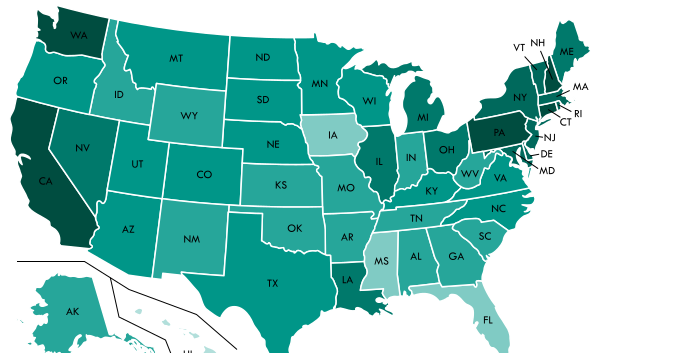
Most common states for e-business specialists
| Rank | State | Population | # of jobs | Employment/ 1000ppl |
|---|---|---|---|---|
| 1 | District of Columbia | 693,972 | 391 | 56% |
| 2 | Vermont | 623,657 | 266 | 43% |
| 3 | New Hampshire | 1,342,795 | 405 | 30% |
| 4 | Rhode Island | 1,059,639 | 314 | 30% |
| 5 | Alaska | 739,795 | 219 | 30% |
| 6 | Wyoming | 579,315 | 173 | 30% |
| 7 | Utah | 3,101,833 | 891 | 29% |
| 8 | Nebraska | 1,920,076 | 550 | 29% |
| 9 | Maine | 1,335,907 | 365 | 27% |
| 10 | South Dakota | 869,666 | 231 | 27% |
| 11 | Maryland | 6,052,177 | 1,530 | 25% |
| 12 | Montana | 1,050,493 | 259 | 25% |
| 13 | Minnesota | 5,576,606 | 1,345 | 24% |
| 14 | Iowa | 3,145,711 | 753 | 24% |
| 15 | North Carolina | 10,273,419 | 2,259 | 22% |
| 16 | Wisconsin | 5,795,483 | 1,215 | 21% |
| 17 | Arkansas | 3,004,279 | 600 | 20% |
| 18 | Pennsylvania | 12,805,537 | 2,453 | 19% |
| 19 | Kansas | 2,913,123 | 562 | 19% |
| 20 | North Dakota | 755,393 | 132 | 17% |
Most common cities for e-business specialists
| Rank | City | # of jobs | Employment/ 1000ppl | Avg. salary |
|---|---|---|---|---|
| 1 | Easton | 1 | 4% | $89,539 |
| 2 | Cedar Rapids | 1 | 1% | $58,145 |
E-Business Specialist job outlook: Expert opinions
Our panel of e-business specialist experts
University of Richmond
Salem State University

University of Nebraska- Lincoln

University of Nevada, Reno

University of Central Arkansas

Alverno College

Grand Valley State University
Tiffin University

Albertus Magnus College

Marymount Manhattan College

Montclair State University

Duquesne University

Ashland University
Baylor University

Stonehill College

The City College of New York

Southern Oregon University

University of California, Irvine

Concordia University Irvine
What soft skills should all E-Business Specialists possess?
Keith Webb: Oral and written communication skills are critical. Also, the ability to work within a team orientation, flexibility, and adaptability, to name a few.
What skills stand out on E-Business Specialist resumes?
Keith Webb: Academically, we prepare our students for numerous opportunities, whether they are pursuing opportunities as business analyst interns, investment banking interns, consulting interns, etc. Generally, relevant experience is a plus. However, transferable skills stand out as well.
Zlatinka Blaber Ph.D.
Associate Professor of AccountingSalem State University
Accounting & Finance Department, Bertolon School of Business
What skills stand out on E-Business Specialist resumes?
Zlatinka Blaber Ph.D.: In my opinion, the skills that recent university graduates need to succeed professionally in a time of the pandemic, i.e., mostly remote office work, are 1) communication skills, 2) research skills, 3) data analytics skills, and 4) adaptability. A newly hired graduate in an accounting firm or in the accounting department of a non-accounting firm needs to write concisely, to the point, and error-free. Bad writing projects a weak professional (and company) image to clients, suppliers, and others. Communication skills do not extend only to writing emails and reports; asking questions when clarification is needed also is very important for a smooth work process. No one is born knowing everything, but one can research topics of interest and learn new things. Nowadays, there are plenty of library books, magazines, databases, search engines, online forums, massive open online courses (MOOCs), such as Udemy, EdX, and Coursera, and other resources available at our fingertips. Knowledge has never been available so widely and so cheaply, often for free. I call this the democratization of knowledge. Curiosity is an important characteristic of acquiring new knowledge and skills. New knowledge and skills lead to upskilling, especially if acquired regularly. The future belongs to those willing to get out of their comfort zone, upskill, and adopt a lifetime learning worldview. This is a matter of values and priorities. We see lifetime learning in action in business, too - Netflix and SpaceX, for example, have adopted innovative business models that no one had thought of before, and they have not stopped innovating. These companies did not rest on their laurels. Likewise, graduates need to be proactive, do research, and find the answers the company is looking for. "Data" is all around us and is valuable. Learning the basics of Microsoft Excel, Word, PowerPoint, Tableau, or Microsoft Power BI and getting certified in them can be very useful, too. For more advanced software features, the makers of these programs have online classes, support, and user manuals. Learning data analytics skills may take some time, but it will save a lot of time and effort in the long run. Finally, adaptability.
My native country, Bulgaria, for example, has seen an influx of workers from Latin America, North America, the rest of Europe, and other places since the mid-2000s. Big Western pharmaceutical and software companies, among others, have offshored their offices there because the cost of labor and the income taxes are lower than those in Western countries. A low cost of labor corresponds to a low cost of living, too. Today, recent graduates should stay open-minded as to the location of their employer. We live in a global village that constantly changes. Sometimes, one's ideal job is far away from home. Accepting a job opportunity abroad requires flexibility and the long term in mind. It may come with nice surprises - a generous foreign earned income tax credit (for U.S. citizens working abroad), college debt forgiveness or postponement (for jobs with the Peace Corps and the Fulbright Commission, for example), new places to see, new languages to learn, and new friends to make. When one door shuts, another one opens.
Ozgur Araz Ph.D.
Associate Professor, Supply Chain Management & AnalyticsUniversity of Nebraska- Lincoln
Supply Chain Management & Analytics Department
What hard/technical skills are most important for E-Business Specialists?
Ozgur Araz Ph.D.: Data processing, modeling, and analyses are important technical skills.
Jim McClenahan
Director of Career and Corporate OutreachUniversity of Nevada, Reno
College of Business
What soft skills should all E-Business Specialists possess?
Jim McClenahan: As I said, soft skills are desired more than ever. Angela Duckworth describes Grit as "Perseverance, effort, and skill." We can teach the skill; the other two have to come with the new hire. Empathy is important as someone grows in their career-you can't be an effective leader and not have empathy in your skillset.
Anthony McMullen
Associate Professor of Business Law and Director of Forensics, vUniversity of Central Arkansas
Accounting Department
What skills stand out on E-Business Specialist resumes?
Anthony McMullen: This will depend on the specific field. Business is an incredibly broad area. Anyone with a business type of degree will at least obtain basic knowledge in accounting, economics, finance, management, and marketing. These skills should be highlighted. But when thinking about a resume, workers should think about (and participate in) experiences that allow them to use these skills. And once they have these experiences, they should be able to articulate how they used these skills on a resume. Don't just say, "I did ______." Say, "I used _________ in order to accomplish __________."
What soft skills should all E-Business Specialists possess?
Anthony McMullen: Admittedly, I'm not a fan of the phrase "soft skills" v. "hard skills," as some might take such phrases to imply that soft skills are not as important or are easier to obtain. That being said, to answer the question, communication and critical-thinking skills are essential to a successful career. Communication skills (both oral and written) are necessary to convey messages. It does not matter how much technical expertise someone has if that person is unable to convey that expertise to others. Critical-thinking skills are important because skilled workers need to know how to think through problems. The answer will not always be readily apparent. And even when it is, workers need to ensure that they can analyze it to ensure that it is trustworthy. Maybe the information found is outdated, doesn't apply to the situation, or is just flat out wrong, and a skilled worker needs to be able to make that determination.
If the pandemic has taught us anything, adaptability is also necessary to be successful. So many jobs have changed (and will continue to change). Many people left their respective industries during the pandemic because they couldn't (or did not want to) adapt to change. Those who can, or at least try, will find more opportunities in the workplace.
What hard/technical skills are most important for E-Business Specialists?
Anthony McMullen: Generally, the most valuable hard skills are going to depend on your field. So, it is hard to identify a specific "hard skill" that is most important. The current "buzz words" in business education is data analytics, or the ability to use tools to analyze and present data. Our society is increasingly data-driven. How do people wade through all of this information and provide something useful? Those who can do this well will have the upper hand.
Stephani Richards-Wilson Ph.D.
Associate Professor of Business and Management, MBA Faculty Director, Associate - School Sisters of St. FrancisAlverno College
Business and Management Department
What skills will help E-Business Specialists earn the most?
Stephani Richards-Wilson Ph.D.: My experience has been that it depends on the position, organization, and industry, among other variables. Digital and information literacy are key to researching, analyzing, and evaluating credible information, in this case, skills that are in demand and could lead to well-paying jobs. I would emphasize, however, that there are intrinsic benefits that sometimes eclipse salary as the primary consideration. It depends on the individual and how they want to improve their quality of life, earn incentives, or be compensated. For many, contributing to an organization that promotes humane and positive interactions, allows for flexible work arrangements, and aligns with one's personal values is paramount. I encourage business specialists to stay vigilant and knowledgeable about developing industry or marketplace trends. Embrace continuous learning, upskilling, and workplace training to remain relevant in the post-pandemic world.
What technical skills for an E-Business Specialist stand out to employers?
Chirag Parikh Ph.D.: If you ask me, I consider valuable experience over good paycheck. Once you have gained that experience the paycheck will follow. As soon as you are out of college, the knowledge gained is very fresh and raring to go. If put into the right place can enhance your technical skills and you can do wonders.
As a Computer Engineering professor, I would say the job opportunities are tremendous for students out of college as they can venture into hardware field (technical support, hardware engineer, test engineer and much more) as well as software field (software engineer, software developer, software tester and much more). The possibilities are endless.
With COVID and employees working remotely there is still ample opportunity to enhance your technical and interpersonal skills as I believe remote working might stay for a while till things get back to normal.
What type of skills will young E-Business Specialists need?
George Miller: Many organizations realize graduates cannot learn everything in college about their major but want the graduate to have a solid foundation on their field of study. The organization wants to mold the graduate to their company environment with how they do things related to the field of study. Most companies want college graduates to have good communication skills (both oral and written), critical thinking skills and be able to work well in teams. These skills have been a staple for graduates since I can remember. This is why a college graduate takes many general education courses related to these skills and many of their major courses emphasize these skills.
Going back to the previous answer I believe graduates in all fields of study will need a better knowledge of technology and easier adaptability to changing technology. Again, an IS degree is already preparing students for this.
What technology do you think will become more important and prevalent for E-Business Specialists in the next 3-5 years?
William Aniskovich JD: Well, it's the nature of modern technology that we can't possibly imagine what that might be! It will change, and it will change fast, that's for sure. However, on balance, I think it's safe to say that the field we call "analytics" will play an increasing role in how we work (and play!). The application of new technologies to how we make decisions in the workplace (from recruitment to hiring and even retention strategies) will undoubtedly continue to be an essential part of every job sector.
How would you rate the starting salaries for E-Business Specialists, as well as the prospects for salary advancement?
William Aniskovich JD: That's a tough one! There are a variety of factors that play into this. First and foremost, getting the economy back to the pre-Covid growth rates. That said, I think there will continue to be lots of pressure on wages, both private sector and public sector pressure, and that will be good news for graduates. This field will continue to expand as companies need expertise in navigating a fast-changing and highly regulated economy.
What are the biggest trends we'll see in the E-Business Specialist job market given the pandemic?
Dr. Vandana Rao Ph.D.: Skills related to technology will be in great demand. More jobs require a higher level of mastery in designing remote work, learning, and collaborating tools.
Will there be an increase or decrease in demand for E-Business Specialists in the next 5 years?
Dr. Vandana Rao Ph.D.: There will be a need for grads with a high degree of comfort with technology - the ability to innovate and adapt and thrive, even amidst uncertainty, will be invaluable.
What E-Business Specialist skills would you recommend for someone trying to advance their career?
Dr. Melissa Gutworth Ph.D.: I know that there is a lot of talk about gap years now, but I do not recommend this. Most travel isn't safe, or even possible, and unemployment rates are high, leaving fewer job opportunities. Gap years can lead to students losing the motivation to finish their degrees and lengthening the amount of time it takes to obtain well-paying, satisfying work. I would recommend that students either continue with their degree, if they are in the middle of one, or consider a graduate program. There are many options for students to advance their degrees, depending on their current situation.
For example, the Feliciano School of Business at Montclair State University has a 4+1 program (where students can earn their Bachelor's degree and MBA in a total of 5 years), online or hybrid MBA programs, and accelerated programs, like 12- a month or 17-month MBAs. There are also certificate programs that are designed to train specific skills in a shorter time frame. By earning an advanced degree or certificate, students will be better able to stand out among the increased job market competition. They will be more likely to pursue a successful career.
What technology do you think will become more important and prevalent for E-Business Specialists in the next 3-5 years?
Dr. Melissa Gutworth Ph.D.: In regard to technology, remote work will be here to stay, so we will likely see more technology designed to facilitate that transition. New software and tools that enable people to be more productive while working from home are likely, such as better time management programs, virtual communication platforms, project management tools, and other software that better enable collaborative remote work. Despite how ironic it is, we might see more technology designed to help us limit current technologies.
As more people spend most of their time at home, we are likely to see problems with people being unable to separate work and non-work time and unable to disconnect from technology. This is already creating all sorts of mental and physical health problems for employees currently working from home. I think we will see more technology in the future that helps us reduce screen time, be more active at home, and be more present and engaged with others. Virtual reality was also already on the rise before the pandemic. Still, we are likely to see this being used even more as companies adopt it to train remote workers, enable remote workers to interact in virtual spaces, and generally enable people to experience situations that they're unable to engage in physically.
What type of skills will young E-Business Specialists need?
Richard Longo: Key will be how to use performance metrics to determine and assess productivity. Outbound marketing will be another required requisite for effective management. How e-commerce and AI will force most businesses, both big and small, to think globally.
What type of skills will young E-Business Specialists need?
Joan Kalamas: To successfully enter the workforce, I believe new graduates will need to have a solid base of technical knowledge, skills, and abilities in their chosen fields such as finance, marketing, supply chain, human resources, etc. Yet they will also need effective "soft skills," such as critical thinking, problem solving, oral and written communications, teamwork and collaboration, emotional intelligence, digital technology skills, professionalism, and a solid work ethic. Soft skills are equally as important, if not more important, than technical skills, states Joan Berry Kalamas, SPHR, SHRM-SCP, an H.R. professional with 30 years of business, leadership, and H.R. experience and now serving as a full-time faculty member, teaching H.R. undergraduate and MBA courses at Ashland University.
From experience, I know that most employers will select candidates who possess and demonstrate emotional intelligence, effective oral and written communications, and other "soft skills" over those candidates that possess just the technical skills. Students need to learn about real business practices and challenges and then learn practical, applicable, "real-life" technical and soft skills to deal with various situations that occur in organizations. An "it depends" answer is usually a response that allows students to look at the variables, analyze the facts, and use critical thinking skills to determine the appropriate course of action to take. The goal should be to teach students how to think, not what to think. I feel very fortunate to have been in the business world, as I can help develop in our students the types of skills and abilities employers are seeking from new graduates.
Ms. Berry Kalamas also serves on the Ohio SHRM State Council, an affiliate of The Society of Human Resource Management (SHRM), an organization of over 300,000 HR and business executive members in 65 countries that is an expert in H.R. practices. A new initiative regarding "Young Professionals" is being introduced from SHRM all across the country as SHRM has identified and understands the energy, passion, and work ethic this new generation of employees bring to organizations, and SHRM is providing guidance to assist that next generation of H.R. leadership.
What are the biggest trends we'll see in the E-Business Specialist job market given the pandemic?
Sara Perry Ph.D.: More opportunities for remote work will be available than ever before, even after the pandemic. Even for new hires/new grads. Remote recruitment is another huge trend right now that will likely continue in some form. New types of job opportunities right now in the booming areas (e.g., covid-related jobs but also amazon and Home Depot, to name a few).
What technology do you think will become more important and prevalent for E-Business Specialists in the next 3-5 years?
Sara Perry Ph.D.: Video conferencing will need to get even easier to use and richer in terms of communication abilities with options to hold both informal and formal interactions to substitute for 100% in-person interactions. Will also see enhancements to tools that allow for secure and remote collaboration.
Glen Ilacqua
Associate Professor of Accounting, Accounting Program DirectorStonehill College
Department of Business Administration
What technology do you think will become more important and prevalent for E-Business Specialists in the next 3-5 years?
Glen Ilacqua: Continue with their knowledge and use of Microsoft Excel but also add in technology associated with data analytics. There are many programs in this area. Different companies use different ones. Learning how data analytics is used in business will assist you in understanding the various programs.
What experience really stands out on E-Business Specialist resumes?
Matthew Nagler: We encourage our Economics and Business majors to think about how they will represent their coursework with us on the resumes since we understand the importance of positioning your educational background for the job market. We offer a concentration in financial economics, and we encourage our students to highlight that finance background, especially if they are seeking finance or banking jobs.
What technology do you think will become more important and prevalent for E-Business Specialists in the next 3-5 years?
Matthew Nagler: Well, by force, we've all had to learn to use Zoom and other online platforms! But, for sure, these skills will remain important, both in education and in the workplace. So students should see their experiences in these areas as an opportunity to be ready for the future!
Katie Pittman Ph.D.
Division Director, Associate ProfessorSouthern Oregon University
School of Business
What technology do you think will become more important and prevalent for E-Business Specialists in the next 3-5 years?
Katie Pittman Ph.D.: Artificial intelligence is already having a significant impact in the area of predictive analytics. I like to describe MIS as a field that lies in the middle of a business/computer science continuum, both in the study and practice. While an MIS graduate may not be the one that develops AI algorithms, they will need to know how to apply AI tools and interpret and present results.
AI also holds great promise in automating repetitive tasks. This is an area where MIS graduates are a good fit, given their understanding of workflow and business processes combined with programming and software skills. As automation tools supporting "white collar" tasks become more mainstream, we will need those with both business understanding and technical competencies to help lead the way.
Finally, the ability to generate insights from large data sets using data visualization tools (e.g., Tableau, MS PowerBI) continues to be a growth area and opportunity for MIS graduates.
Are there any particularly good places in the United States for E-Business Specialists to find work opportunities?
Vidyanand Choudhary: As companies continue to expand their businesses to digital platforms, the U.S. Bureau of Labor Statistics predicts a 10 percent employment outlook increase for computer and information systems managers between 2019 - 2029, which is well above the average other occupations. And with more emphasis being placed on the quality of life by the current and emerging workforce, the tech industry, for example, is seeing the growth of new hot spots within the U.S., including Austin and Dallas, TX; Raleigh and Charlotte, North Carolina; Seattle, Washington; San Francisco and San Jose, California; Atlanta, Georgia, and Denver, Colorado.
Also, something to watch is how the Covid-19 remote workplace impacts job location going forward. As we continue to emerge from the pandemic, we expect to see geography become somewhat less important to select MIS roles, if they can be done remotely from anywhere. This offers graduates an entirely new channel of opportunity.
https://www.comptia.org/content/research/best-tech-cities-it-jobs
How do you envision technology impacting E-Business Specialists in the next 5 years?
Vidyanand Choudhary: Covid-19 has made companies realize that to survive during the pandemic and thrive after, they must rethink how they function. The epidemic has pushed technology forward, at lightning speed, where MIS-related considerations (programming, security, data mining, and analysis), coupled with a more remote workforce, pave the way for graduates to be in one of the most effective degree programs the next few years.
We have seen tremendous growth in large internet/e-commerce companies such as Amazon and Google. Other companies are busy adding digital components to their products. For example, Tesla's cars have a significant amount of software, and other firms move in the same direction. The growth in data science and AI is also offering new ways for firms to improve their processes and provide such services to customers. Finally, there is a growing realization of the importance of IT security, and that should also boost demand for MIS majors.
Kim Chatani
Assistant ProfessorConcordia University Irvine
School of Business & Economics
What technology do you think will become more important and prevalent for E-Business Specialists in the next 3-5 years?
Kim Chatani: It is hard to predict technological advancement in the future. However, mobility and securities around new technologies will be at the forefront of many industries. Technology will continue to evolve at a much faster pace. Although you may not need to understand the "bites" behind the technology, approach these emerging technologies with business and risk management perspectives. How will these technologies impact my company and my industry? What new risk may they present while addressing business opportunities? A curious and inquisitive mind will serve you well.