Explore jobs
Find specific jobs
Explore careers
Explore professions
Best companies
Explore companies
Job outlook for educational aids in the United States
Educational aid job growth summary. After extensive research, interviews, and analysis, Zippia's data science team found that:
The projected educational aid job growth rate is 4% from 2018-2028.
About 55,400 new jobs for educational aids are projected over the next decade.
Educational aid salaries have increased 14% for educational aids in the last 5 years.
There are over 28,046 educational aids currently employed in the United States.
There are 71,043 active educational aid job openings in the US.
The average educational aid salary is $29,988.
Are educational aid jobs in demand?
Educational aid job and salary trends over time
Educational aid jobs over time
Educational aid job growth rate over time
| Year | # of jobs | % of population |
|---|---|---|
| 2021 | 28,046 | 0.01% |
| 2020 | 30,254 | 0.01% |
| 2019 | 31,815 | 0.01% |
| 2018 | 28,539 | 0.01% |
| 2017 | 27,858 | 0.01% |
Average educational aid salary over time
Educational aid salary by year
| Year | Avg. salary | Hourly rate | % Change |
|---|---|---|---|
| 2026 | $29,988 | $14.42 | +3.5% |
| 2025 | $28,961 | $13.92 | +3.4% |
| 2024 | $28,003 | $13.46 | +2.7% |
| 2023 | $27,265 | $13.11 | +3.3% |
| 2022 | $26,383 | $12.68 | +2.0% |
Educational aid jobs by state
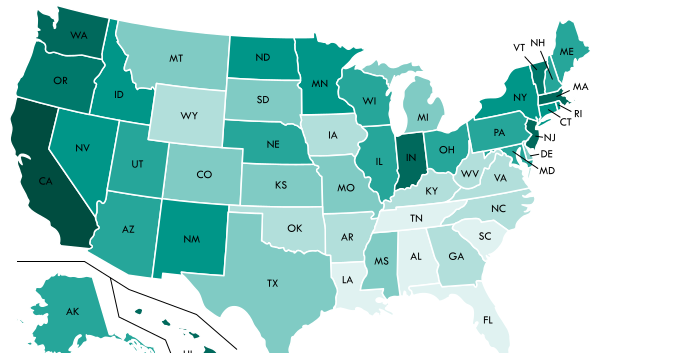
Most common states for educational aids
| Rank | State | Population | # of jobs | Employment/ 1000ppl |
|---|---|---|---|---|
| 1 | Oregon | 4,142,776 | 397 | 10% |
| 2 | Montana | 1,050,493 | 107 | 10% |
| 3 | New Jersey | 9,005,644 | 833 | 9% |
| 4 | Connecticut | 3,588,184 | 313 | 9% |
| 5 | Illinois | 12,802,023 | 1,056 | 8% |
| 6 | Massachusetts | 6,859,819 | 521 | 8% |
| 7 | New Mexico | 2,088,070 | 162 | 8% |
| 8 | Michigan | 9,962,311 | 630 | 6% |
| 9 | Indiana | 6,666,818 | 412 | 6% |
| 10 | Washington | 7,405,743 | 408 | 6% |
| 11 | Tennessee | 6,715,984 | 404 | 6% |
| 12 | Minnesota | 5,576,606 | 355 | 6% |
| 13 | Missouri | 6,113,532 | 355 | 6% |
| 14 | Idaho | 1,716,943 | 96 | 6% |
| 15 | New Hampshire | 1,342,795 | 78 | 6% |
| 16 | New York | 19,849,399 | 1,051 | 5% |
| 17 | Ohio | 11,658,609 | 639 | 5% |
| 18 | Wisconsin | 5,795,483 | 272 | 5% |
| 19 | Colorado | 5,607,154 | 262 | 5% |
| 20 | Maine | 1,335,907 | 68 | 5% |
Most common cities for educational aids
| Rank | City | # of jobs | Employment/ 1000ppl | Avg. salary |
|---|---|---|---|---|
| 1 | Palm Bay | 1 | 1% | $22,597 |
| 2 | Saint Joseph | 1 | 1% | $26,018 |
Educational Aid job outlook: Expert opinions
Our panel of educational aid experts
Towson University
University of South Florida
Florida Atlantic University
University of New England
Eastern Mennonite University
University of Wisconsin - Green Bay
University of Arkansas, Fayetteville
Boise State University

University of Central Arkansas

Cabrini University
University of South Florida

Springfield College
Berry College

Missouri State University

Boston College

Nicholls State University
Chatham University

Seattle Pacific University
Colby-Sawyer College

University of Mary Washington
What will help Educational Aids increase their earning potential?
David Wizer: In nonprofit, public education field there’s not a great deal of negotiating opportunities. For students in the instructional design field there are ways to feature projects completed, skills they have, and a strong resume that highlights professional skills and experiences.
What will help Educational Aids increase their earning potential?
Sarah Lauer: View yourself as the professional that you are. Seek out those resources that will help you to continually improve in your career path. This might mean joining a professional learning community (PLC) at your school, or starting an online/evening/weekend Master’s degree program. Be curious when something doesn’t go well in the classroom. Build a network of experts and resources that you can go to when you have questions.
What Educational Aid skills would you recommend for someone trying to advance their career?
Dr. Torica Exume Ph.D.: The education sector undergoes continuous change, requiring graduates to remain adaptable and responsive to evolving trends and innovations. Skills that may gain importance in the field include proficiency in employing educational technology tools for teaching, learning, and assessment; using student data to inform instructional strategies; and adapting to emerging technologies and platforms.
What Educational Aid skills would you recommend for someone trying to advance their career?
Peter Badalament: Do everything you can to get a foot in the door - substitute teacher or get hired as a paraprofessional. I know that many schools hire teachers from pools of people they know. Preserve. Getting hired as an educator can be challenging at times, so hang in there.
What general advice would you give to an Educational Aid?
Paul Yoder: A key insight is that teaching is about making learning engaging and content relevant to students. It is rare for educators to teach students who are 'just like them' so building relationships with students is the first step. Keep in mind that each human is so much more than meets the eye so listening and curiosity are paramount.
Dr. Valerie Pilmaier PhD
Associate Professor of English, Humanities and Women's, Gender and Sexuality Studies; co-chair of Women's, Gender and Sexuality Studies; Assessment CoordinatorUniversity of Wisconsin - Green Bay
Ethnic, Cultural Minority, Gender, And Group Studies
What general advice would you give to an Educational Aid?
Dr. Valerie Pilmaier PhD: Trauma-Informed Pedagogy and Culturally Responsive Pedagogy are going to become even more important with each passing year as we recognize the way that trauma and circumstance affect the ability of students to learn. Technology will always be evolving, and we will always be running behind to catch it, but nothing can replace the feeling that a child has when she/he/they have been really 'seen' by a teacher. It makes all of the difference in terms of learning, self-esteem, belonging and hope.
What Educational Aid skills would you recommend for someone trying to advance their career?
Dr. Vicki Collet: In addition to pay increases for experience, additional education helps you climb the salary ladder. Be intentional so that your ongoing education counts not just for license renewal, but also for an additional endorsement or degree.
Ross Perkins Ph.D.
Associate Professor, Educational TechnologyBoise State University
Educational/Instructional Media Design
What will help Educational Aids increase their earning potential?
Ross Perkins Ph.D.: The job attracts people who are curious and who are problem-solvers. Those who tend not to stay in the profession are those who are relegated to doing routine maintenance or only getting to implement devices in a context where all decisions are made at the top and passed down.
Dr. Nina Roofe Ph.D.
Associate Professor & ChairUniversity of Central Arkansas
Department of Nutrition & Family Sciences
What soft skills should all Educational Aids possess?
Dr. Nina Roofe Ph.D.: Collegiality is the most important soft skill an educator can possess. This is seen in how educators interact with each other and conduct themselves in their schools. Participating in peer teaching consultations objectively and willingly sharing ideas to support new educators shows your dedication to the teaching profession and commitment to mentoring new professionals. Demonstrating flexibility with scheduling and room assignments, sharing materials and space, assisting colleagues, and team teaching when appropriate are examples of collegiality in action. Attending meetings and participating positively and professionally communicates respect for others and the value you place on your peers and supervisor. Leadership skills are essential for navigating parent-teacher conferences and earning the respect of parents. Demonstrating leadership also demonstrates to administration your FCS skills in conflict resolution and financial management. Good communication skills are critical for effective teaching. This relates to our ability to deliver the lesson's content and provide feedback to our students. Teamwork and collaborative problem solving are essential to a functional campus. With collaboration and respectful dialogue, a school can be innovative in resolving challenges. Social and emotional intelligence ensures safety for students and colleagues, promotes a positive learning environment, and provides the foundation for a growth mindset. Finally, cultural awareness is a critical soft skill all educators must achieve. We are required to understand our students to relate to them and effectively educate them across cultures and demographics.
Amber Gentile
Graduate Secondary Education Program Coordinator, Middle Level Program Coordinator, Assistant Professor of Teacher EducationCabrini University
Teacher Education Program
What skills will help Educational Aids earn the most?
Amber Gentile: In general, the longer you teach, the more you earn, so a commitment and love of the profession will help you earn the most. Similarly, enjoying being with children may prompt you to serve as a leader in extracurricular school activities, which can supplement a teacher's income. Leadership skills are important in the classroom and can enhance a teacher's earning potential with increased responsibilities and involvement in the school.
Dr. Elizabeth Doone Ph.D.
UG and MAT in ESE Programs CoordinatorUniversity of South Florida
College of Education
What skills stand out on Educational Aid resumes?
Dr. Elizabeth Doone Ph.D.: Teachers must be responsive, engaging, flexible and creative. While these skills are not so notable on resumes, having experience with online teaching and a range of educational apps to engage and target instruction is beneficial. For ESE teachers, identifying specific student needs and targeting interventions with appropriate strategies to meet those needs while monitoring progress and adjusting accordingly is a crucial skill set.
Dr. Linda Davis-Delano
Director, Educator Preparation & Licensure, Professor, Physical EducationSpringfield College
Educator Preparation
What skills stand out on Educational Aid resumes?
Dr. Linda Davis-Delano: Ability to teach remotely and use a variety of pedagogical techniques including the use of a variety of technological platforms (e.g., YouTube, Zoom, Microsoft Teams, Nearpod, Kahoot, Brainpop, TedEd).
What are the biggest trends we'll see in the Educational Aid job market given the pandemic?
Dr. Frances Roe: One of the biggest current trends in education is that the pandemic has prompted many teachers to retire or to leave the teaching profession. This exodus from the profession means that there will be more jobs available for our graduates. Locally, administrators from different districts have asked me if the Teacher Education Department knows of any recent graduates who do not have teaching jobs. They are ready to hire our recent graduates right now! The certification area did not matter. They need certified teachers now!
A trend is one that continues from pre-pandemic days. That trend is the need for math and science teachers for middle and high schools. Foreign language and special education teachers are also remain in demand.
Are there any particularly good places in the United States for Educational Aids to find work opportunities?
Dr. Frances Roe: Urban and large suburban areas are typically excellent places to our graduates to find teaching jobs. Large districts such as Hamilton County in Chattanooga, Cobb, and Gwinnet Counties in Georgia, as well as our local school districts are regulars at our Teacher Recruitment Fairs. The districts are holding their own district teacher recruitment fairs earlier and earlier in hopes of hiring our graduates. It is not usual for districts of various sizes to either email or call me asking for help finding certified teachers in the areas I identified earlier.
What are the biggest trends we'll see in the Educational Aid job market given the pandemic?
Dr. Ximena Uribe-Zarain: Even though the pandemic has had an enormous impact on the social, economic, and emotional fabric of our society, jobs in our field have not been greatly affected by it. Graduates from the field of educational assessment, program evaluation, and research in education will find plenty of opportunities even in harsh times like these. The trends in the job market continue to be in industry in the area of psychometrics, program evaluation firms, and higher education.
What the pandemic has changed is the way we conduct business. The pandemic has made more evident and even widened systemic inequalities. As researchers, we need to pay close attention to our own cultural responsiveness and be mindful of the disparities in terms of health, racial justice, and technological access. We need to be intentional in our designs, analyses, and the dissemination of results; ultimately thinking on the way our work contributes to a more inclusive and equitable society.
What skills stand out on Educational Aid resumes?
Dr. Ximena Uribe-Zarain: Graduates of programs in the realm of educational assessment, program evaluation, and research in education tend to excel at critically evaluating social issues, and at using sophisticated methodologies to solve such issues. They are prepared to understand psychometric theory and to implement program evaluation. All of these are good skills to highlight. However, we cannot forget that graduates are more often than not avid users of technologies capable of navigating complex research and statistical software. I believe that highlighting technological skills (quantitative and qualitative analysis software, programming, use of VPN, etc.) is a good bet, especially now that working from home is so prevalent. Also, it is important to mention that being a good communicator could be the deciding factor, especially as we are communicating clearly and professionally more and more often using different media.
Tim Klein
MSW, True North LeadBoston College
Lynch School Of Education and Human Development
What skills stand out on Educational Aid resumes?
Tim Klein: This market shift will influence the skills that employers are looking for. Specifically, this will put a premium on universal human skills-skills that cannot be replaced by technology. Companies will be looking for three types of workers who possess different universal human skills-they will want innovators who are creative, critical thinkers adept at navigating uncertainty. They will want facilitators, who are skilled communicators and expert relationship builders. They will want executors-people who are incredibly responsible, accountable and trustworthy. The good news is that interdisciplinary studies provides ample opportunity for students to become innovators, facilitators and executors. Because these skills are not domain specific, students with an interdisciplinary background could really excel in a variety of fields, from healthcare, to tech, to education. Recent college graduate ability to successfully enter the workforce will depend on their ability to "self-credential"-that is, effectively tell the story of how they developed universal human skills through their college education, and show how those skills will transfer to success in the workforce.
Karen Cheramie
Interdisciplinary Studies Program CoordinatorNicholls State University
English, Modern Languages & Cultural Studies Department
What skills stand out on Educational Aid resumes?
Karen Cheramie: Make sure your future employers know the impact you can make in the job. Check on your transferable skills. Be flexible and adaptable.
Christie Lewis
Assistant Professor of Education, Field CoordinatorChatham University
Education Department
What experience really stands out on Educational Aid resumes?
Christie Lewis: I believe that graduates that go above and beyond the "check the box" really stand out. What I mean by this is that graduates who have been involved in the school and that became part of the school community really stand out. Perhaps a graduate volunteered to help with events at the school, started a tutoring club, and/or participated and did other things than teach in the classroom stands out. In addition, I think that volunteering in the community and also participating in teacher professional development really stands out. These things show that a graduate is excited and passionate.
Christopher Hanson
Assistant Professor of Music, Director of Music Education and Orchestral ActivitiesSeattle Pacific University
Music Department
What general advice would you give to an Educational Aid?
Christopher Hanson: Keep asking questions and look for opportunities to engage in teaching and learning wherever you can. Connect with peers and future colleagues. Do not just wait. Now is the time to create and sustain dialog on educational change. Although there are endless numbers of variables to how, when, what, and with whom we learn, our genuine curiosity and sincere desire to engage others in the educative process is our greatest hope to see education in a better place than it was before the pandemic.
We must heed the call of innovation and encourage a transition from our current state of triage and survival. You, as a recent graduate, are the future of what education will be. Ask yourself, what will the world look like that you will help create? Is this a world that you and others can learn in? What more can you do to secure the possibilities and promise of education for all? These are the questions that will fuel change and secure growth through the inevitable vicissitudes of education.
What technology do you think will become more important and prevalent for Educational Aids in the next 3-5 years?
R. Todd Coy Ph.D.: Even before the onset of COVID-19, the increasing importance of technology in areas like education and business communications was apparent. I believe Covid only served to speed up the oncoming changes. Using online formats to deliver professional services like mental health or education will continue to become even more mainstream. Therefore, staying current with the various applications and features found online will allow you to be more effective and marketable.
Janine Davis Ph.D.
Associate ProfessorUniversity of Mary Washington
College of Education
Will there be an enduring impact of the coronavirus pandemic on Educational Aids?
Janine Davis Ph.D.: For our teacher education graduates, the impact of the pandemic will most likely work in their favor when it comes to finding jobs-the pandemic has led to many retirements, which will mean that we will need even more teachers to fill those empty positions. At the same time, the advent of increased virtual learning means that it will no longer be an option that teachers know and use technology, including teaching online and using learning management and data analysis systems-those skills will almost certainly be a non-negotiable for future teaching positions. Finally, I think that this event has highlighted the importance of working as part of a team of teachers and other school leaders.