
Automatically apply for jobs with Zippia
Upload your resume to get started.
Electrical electronics engineers skills for your resume and career
15 electrical electronics engineers skills for your resume and career
1. Electrical Components
- Specify, locate and validate electrical components which meet product design goals while complying with government regulations and supplier installation requirements.
- Coordinated the procurement and assembly of electrical/electronic components/equipment and identify sources of critical parts and subsystems to resolve technical issues.
2. Analog
An analog system refers to a system that uses continuously variable signals.
- Designed and developed an analog NiMH battery controller.
- Design experience included control of stepper motors, closed-loop controlled linear and rotary motors, and analog and digital circuits.
3. C++
C++ is a general-purpose programming language that is used to create high-performing applications. It was invented as an extension to the C language. C++ lets the programmer have a high level of domination over memory and system resources. C++ is an object-oriented language that helps you implement real-time issues based on different data functions
- Converted the simulation from assembly to C++.
- Created interrupt driven C++ test software and serial/parallel communication software to control instrumentation.
4. Power Electronics
- Design instrumentation and control systems, including communications, power electronics, basic electronics sensors and much more.
- Included power electronics and EMI filter circuit design for various environments.
5. CAD
- Used CAD software to perform parts specification and documentation.
- Used most drafting programs and OR CAD can even save time PCB layouts.
6. Circuit Design
Circuit Design is the process of designing how an electrical circuit will be constructed. These designs can be used to create complex electrical systems or smaller systems with individual circuits integrated within a transistor. Simpler systems may only require a single designer, whereas larger and more complex designs require entire teams dedicated to the design and construction.
- Implemented new Hardware circuit designs and sustaining support for Key Tronic computer keyboards and Peripheral Products.
- Performed circuit simulations and evaluations using Cadence, Matlab, and spice products for circuit design.
Choose from 10+ customizable electrical electronics engineers resume templates
Build a professional electrical electronics engineers resume in minutes. Our AI resume writing assistant will guide you through every step of the process, and you can choose from 10+ resume templates to create your electrical electronics engineers resume.7. Test Equipment
Test equipment is a mechanical tool or a device which is used create signals and gather response from an electronic device under test. It helps in detecting any faults in the device and it also proves the proper operation of the electronic device.
- Supported the maintenance and improvement of computer and PLC controlled automated test equipment used in the certification of magnetic memory discs.
- Tested electronics units using standard test equipment Performed preventative maintenance or calibration of equipment and/or systems.
8. PowerPoint
- Delivered formal PowerPoint presentation of results including graphs that are being used in continuing experimentation.
- Provided step-by-step instruction using PowerPoint for design change to minimize issues during implementation
9. Electrical Systems
- Diagnosed and repaired communication, navigation and other electrical systems on large luxury yachts.
- Involved in installation and commission of electrical systems/equipments.
10. PCB
The PCB (Printed Circuit Board) refers to the hardware part housing all of the device's electrical connections.
- Modified electronic circuit boards, selected, verified components to modify and redesign PCB according to Engineering change requests.
- Used Proteus 6.x software for PCB schematic design, production, assembling (up to 4 layers).
11. UL
- Adapted international product documentation for product safety to assure conformance with North American standards (including UL and NFPA).
- Provided additional supports for Chinese-speaking customers to smooth out their process for obtaining UL product safety certifications.
12. LabVIEW
- Developed improvements to GPS software and controls software currently used in locomotive simulator environment using the LabVIEW graphical programming language.
- Delivered remarkable improvement by replacing a manual test system with personally designed automated test software using National Instruments LabView.
13. RF
- Experience with the entire 3 MHz to 110 GHz RF frequencyrange as well as some EO/IR related.
- Developed RF products based on low to high level implementation specifications based on customer or requests or company design modification requirements.
14. Control Systems
- Conducted reliability analyses of electronic and control systems and their major components.
- Subject matter expert in digital closed-loop control systems for autonomous vehicle control.
15. Firmware
Firmware is a software, tangible electronic component, which contains necessary instructions for the hardware to work with the operating system. Firmware is embedded software instructions that are used to tell an electronic device on how to operate.
- Developed assembly code (firmware) for 8/16bit microcontroller designs.
5 Electrical Electronics Engineers resume examples
Build a professional electrical electronics engineers resume in minutes. Browse through our resume examples to identify the best way to word your resume. Then choose from 5+ resume templates to create your electrical electronics engineers resume.

What skills help Electrical Electronics Engineers find jobs?
Tell us what job you are looking for, we’ll show you what skills employers want.
What skills stand out on electrical electronics engineers resumes?
Florian Solzbacher
Department Chair, Professor, Elect & Computer Engineering, University of Utah
Supplemental skills, such as Entrepreneurial or business training, can enhance and differentiate a student's resume. This shows that an engineer is not solely focused on the core technical engineering skills but does have an understanding of the driving forces and their interaction in a real-world business setting, that are not only part of the design requirements for a product (e.g., design to cost), but also often drive the selection of technical solution paths, after all, every development and product has to make business sense. Imagine two young engineers proposing a solution to their manager for a new product: one maybe even over-exceeds the technical requirements, but the development and/or manufacturing and servicing effort and cost is significantly higher than a colleagues solution that may only just about reach the requirements, or maybe even compromise on some specifications, but that is far cheaper to develop, make and service and that may allow entering a far larger market- chances are very high that the business may decide to go for the "inferior" solution from a technical point of view, that is, however, the better product. This supplemental skill set is a significant competitive advantage to have as an engineer.
What soft skills should all electrical electronics engineerss possess?
Florian Solzbacher
Department Chair, Professor, Elect & Computer Engineering, University of Utah
What hard/technical skills are most important for electrical electronics engineerss?
Florian Solzbacher
Department Chair, Professor, Elect & Computer Engineering, University of Utah
Beyond that, given the accelerating breadth of specializations and sub-areas, it is important that students have sufficient depth and breadth of knowledge in the specific area they are targeting. It is important that schools are offering tracks and guidance as to what skills are needed to allow students to successfully master engineering tasks across a range of sub-areas. We have to recognize that in the context of a 4-year program, it is no longer possible to train a student in all areas of ECE - a combined BS/MS degree or MS/Ph.D. degree obviously provides more runway to add breadth.
What electrical electronics engineers skills would you recommend for someone trying to advance their career?
Dr. Angela Rasmussen
Professor (Lecturer) Director of Mentoring and Advising Director of Electrical Engineering Senior Projects, University of Utah
Another skill to expand is programming. Consider learning a new programming language to build on your current skills. Also, look at different job opportunities and choose a skill that you are lacking to improve upon.
What type of skills will young electrical electronics engineerss need?
Dr. Ramanarayanan "Vish" Viswanathan Ph.D.
Chair and Professor, University of Mississippi
List of electrical electronics engineers skills to add to your resume
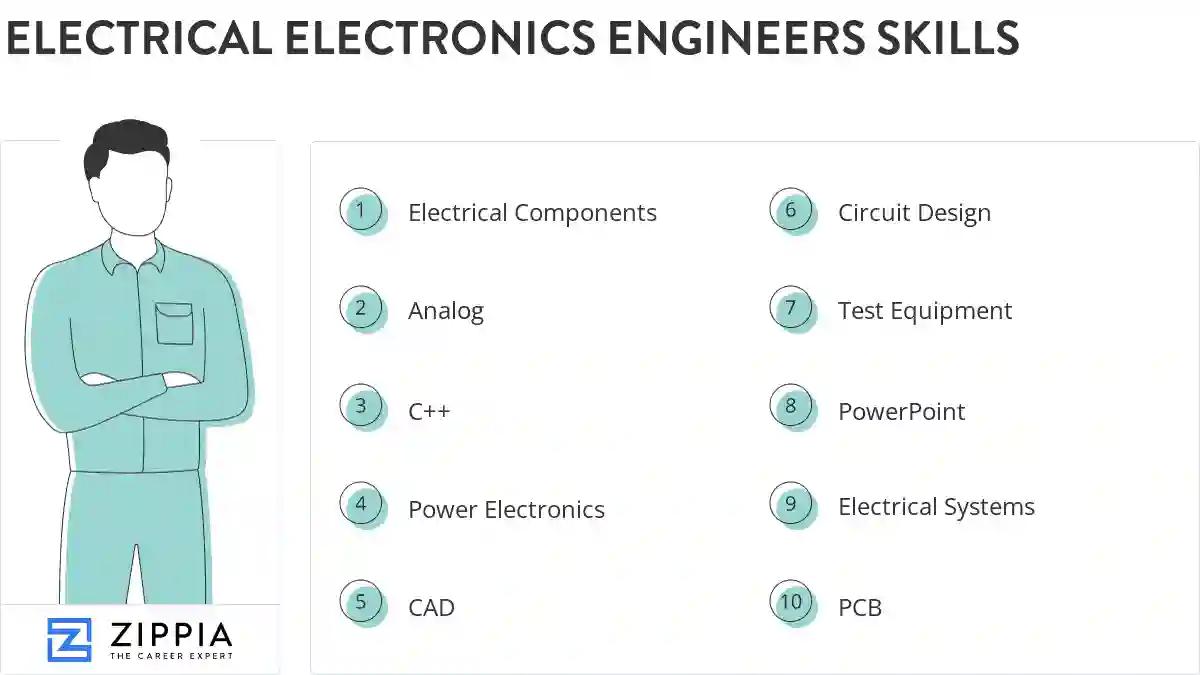
The most important skills for an electrical electronics engineers resume and required skills for an electrical electronics engineers to have include:
- Electrical Components
- Analog
- C++
- Power Electronics
- CAD
- Circuit Design
- Test Equipment
- PowerPoint
- Electrical Systems
- PCB
- UL
- LabVIEW
- RF
- Control Systems
- Firmware
- Embedded Systems
- Test Procedures
- FPGA
- EMC
- DSP
- Troubleshoot
- Engineering Support
- System Integration
- DFMEA
- Debugging
- Circuit Boards
- Microcontrollers
- Technical Support
- PLC
- Provide Engineering Support
- Microprocessors
- Ac
- Dc
- Radar
- Verification Testing
- ISO
- HMI
- Switches
- PC
- Transformers
- IEC
- Linux
- Prototyping
- IEEE
Updated January 8, 2025
