
Automatically apply for jobs with Zippia
Upload your resume to get started.
Electrical systems engineer skills for your resume and career
15 electrical systems engineer skills for your resume and career
1. Electrical Engineering
Electrical engineering is an applied science discipline that deals with the study of devices and systems which use electricity, design and application of equipment, electronics, and electromagnetism. Electrical engineering is now split into an array of fields, including systems engineering, power engineering, computer engineering, radio-frequency engineering, signal processing, telecommunications, instrumentation, and electronics.
- Provide electrical engineering with experience in mission critical control data center electrical infrastructure, critical system support and facility power systems.
- Provided Electrical Engineering support for new technology MRI system incorporating radiation source to treat cancer patients.
2. Electrical Systems
- Zero findings in self-maintained safety program during 2002 Pacific Air Force Electrical Systems Safety Inspection
- Provided electrical systems engineering for the EAFB Phillips Laboratory, Space Experiments Directorate.
3. System Design
System design refers to the electronic structural component of a system.
- Developed the specifications, interface control documentation, electronic subsystem design, and interconnection between modules.
- Supported hardware and system design analysis team with regard to communications and customer focus.
4. C++
C++ is a general-purpose programming language that is used to create high-performing applications. It was invented as an extension to the C language. C++ lets the programmer have a high level of domination over memory and system resources. C++ is an object-oriented language that helps you implement real-time issues based on different data functions
- Design and developed software program to performed automated testing, language: HpVee and C, C++.
- Tested C++ applications into concealment prototypes for mission systems.
5. Autocad
- Assisted in the electrical design and generated drawings utilizing AutoCAD.
- Utilized AutoCAD to develop schematics for on-ship infrastructure.
6. CAD
- Collaborate with CAD software developers to implement design protocols.
- Designed brackets details, bracket assemblies, and LRU installations IFE Systems projects for VIP 787 customers in 3D CAD.
Choose from 10+ customizable electrical systems engineer resume templates
Build a professional electrical systems engineer resume in minutes. Our AI resume writing assistant will guide you through every step of the process, and you can choose from 10+ resume templates to create your electrical systems engineer resume.7. DOD
Definition of Done (DoD) is a set of deliverables that are needed to devise software. These deliverables are valuable to the system and can be exemplified by writing code, coding comments, unit testing, integration testing, design documents, release notes, and so on.
- Developed portable fuel cell systems for the DoD with UMD, and Ballard Power Systems.
- Expedite repair to unit to ensure quality and quantity are delivered to the DoD customer.
8. RF
- Led RF characterization efforts of implantable medical device in order to determine safety limit.
- Modeled and tuned RF components such as connector interfaces, transitions and cavities using HFSS and ADS.
9. Electrical Design
Electrical design refers to the whole process and includes all the steps which are involved in the development of any electrical equipment. In electrical design, planning and managing the process of designing and development, creating the equipment, and testing it to evaluate the equipment's performance are all integral steps.
- Provide technical guidance to all department electrical engineers and electrical designers.
- Performed consulting of substation and industrial electrical design applications.
10. Power Electronics
- Space Power Electronics Laboratory (SPEL).
- Power Electronics and motor control algorithms.
11. Design Reviews
A dеѕіgn review іѕ a mіlеѕtоnе wіthіn a рrоduсt dеvеlорmеnt рrосеѕѕ іn whісh a design іѕ evaluated bаѕеd on іtѕ rеԛuіrеmеntѕ. Thе рurроѕе of dеѕіgn rеvіеwѕ іѕ tо examine thе overall design or a ѕресіfіс аѕресt оf a dеѕіgn аt еасh ѕtаgе of the development оf a nеw оr еxіѕtіng рrоduсt.
- Prepared and delivered design reviews for internal and external audiences.
- Lead technical design reviews at engineering milestones.
12. Engineering Design
Engineering design is defined as the method that engineers use to recognize and solve problems. It is an extensive and flexible approach to problem-solving and provides the necessary information needed regarding every step of the process. An engineering design is a collaborative effort of the team to identify problems underlying a process and find out ways to solve them.
- Developed engineering design standards handbook.
- Provided Engineering design, construction and planning of the Electric System.
13. Project Management
- Power Systems Engineer - Distribution-Controls-Project Management 1.
- Provided engineering, and project management, support in the development of technical specifications and design of various rail car subsystems.
14. Troubleshoot
Troubleshooting is the process of analyzing and fixing any kind of problem in a system or a machine. Troubleshooting is the detailed yet quick search in the system for the main source of an issue and solving it.
- Employed Google Earth to simulate, monitor, evaluate and troubleshoot the performance of communication devices in-house prior to deployment.
- Build, install and troubleshoot electrical and data cables for U.S. Army Distributed Common Ground System-Army (DCGS-A).
15. EMI
- Developed EMI analysis of Laser Fire Unit for Exo-Atmosphere Kill Vehicle (EKV) for Missile Defense Program.
- Test track experience in gathering EMI (Electromagnetic Interference) data for the Dual Mode Passenger Locomotive program.
5 Electrical Systems Engineer resume examples
Build a professional electrical systems engineer resume in minutes. Browse through our resume examples to identify the best way to word your resume. Then choose from 5+ resume templates to create your electrical systems engineer resume.

What skills help Electrical Systems Engineers find jobs?
Tell us what job you are looking for, we’ll show you what skills employers want.
What skills stand out on electrical systems engineer resumes?
Florian Solzbacher
Department Chair, Professor, Elect & Computer Engineering, University of Utah
Supplemental skills, such as Entrepreneurial or business training, can enhance and differentiate a student's resume. This shows that an engineer is not solely focused on the core technical engineering skills but does have an understanding of the driving forces and their interaction in a real-world business setting, that are not only part of the design requirements for a product (e.g., design to cost), but also often drive the selection of technical solution paths, after all, every development and product has to make business sense. Imagine two young engineers proposing a solution to their manager for a new product: one maybe even over-exceeds the technical requirements, but the development and/or manufacturing and servicing effort and cost is significantly higher than a colleagues solution that may only just about reach the requirements, or maybe even compromise on some specifications, but that is far cheaper to develop, make and service and that may allow entering a far larger market- chances are very high that the business may decide to go for the "inferior" solution from a technical point of view, that is, however, the better product. This supplemental skill set is a significant competitive advantage to have as an engineer.
What soft skills should all electrical systems engineers possess?
Florian Solzbacher
Department Chair, Professor, Elect & Computer Engineering, University of Utah
What hard/technical skills are most important for electrical systems engineers?
Florian Solzbacher
Department Chair, Professor, Elect & Computer Engineering, University of Utah
Beyond that, given the accelerating breadth of specializations and sub-areas, it is important that students have sufficient depth and breadth of knowledge in the specific area they are targeting. It is important that schools are offering tracks and guidance as to what skills are needed to allow students to successfully master engineering tasks across a range of sub-areas. We have to recognize that in the context of a 4-year program, it is no longer possible to train a student in all areas of ECE - a combined BS/MS degree or MS/Ph.D. degree obviously provides more runway to add breadth.
What electrical systems engineer skills would you recommend for someone trying to advance their career?
Dr. Angela Rasmussen
Professor (Lecturer) Director of Mentoring and Advising Director of Electrical Engineering Senior Projects, University of Utah
Another skill to expand is programming. Consider learning a new programming language to build on your current skills. Also, look at different job opportunities and choose a skill that you are lacking to improve upon.
What type of skills will young electrical systems engineers need?
Aaron Ohta Ph.D.
Professor, University of Hawaiʻi at Mānoa
List of electrical systems engineer skills to add to your resume
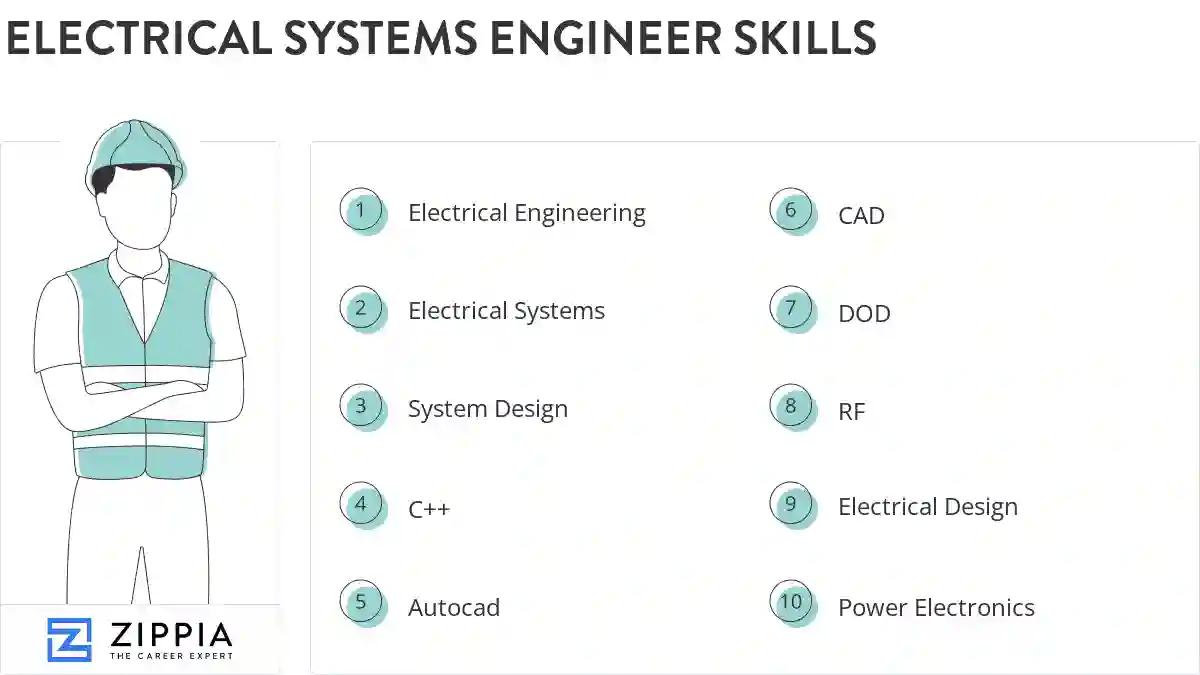
The most important skills for an electrical systems engineer resume and required skills for an electrical systems engineer to have include:
- Electrical Engineering
- Electrical Systems
- System Design
- C++
- Autocad
- CAD
- DOD
- RF
- Electrical Design
- Power Electronics
- Design Reviews
- Engineering Design
- Project Management
- Troubleshoot
- EMI
- System Integration
- UL
- Battery
- EMC
- PCB
- Engineering Support
- System Architecture
- Electrical Components
- SCADA
- Control Systems
- Power Management
- Test Procedures
- Avionics
- FPGA
- Electrical Equipment
- Trade Studies
- HMI
- Technical Support
- Arc Flash
- BOM
- Embedded Systems
- System Performance
- Test Results
- Circuit Boards
- Ethernet
- PC
- FAA
- Engineering Drawings
- PLC
- NASA
- Prototyping
- LabVIEW
- Debugging
Updated January 8, 2025
